










Storage Technologies cash conversion lagged operating profit
Key highlights
- STAL generated Rs 80 lakh of standalone operating cash flow in H1 FY27 after a Rs 2.53 crore working-capital outflow.
- STAL's trade receivables rose by Rs 9.22 crore to Rs 40.11 crore and inventory rose by Rs 3.57 crore to Rs 19.55 crore at 30 September 2026.
- STAL received Rs 1.59 crore from a machinery sale-and-leaseback to partly fund Rs 2.71 crore of H1 FY27 capex.
- STAL's net cash outflow narrowed to Rs 72 lakh in H1 FY27 from Rs 1.56 crore in H1 FY26.
powered by IRIS
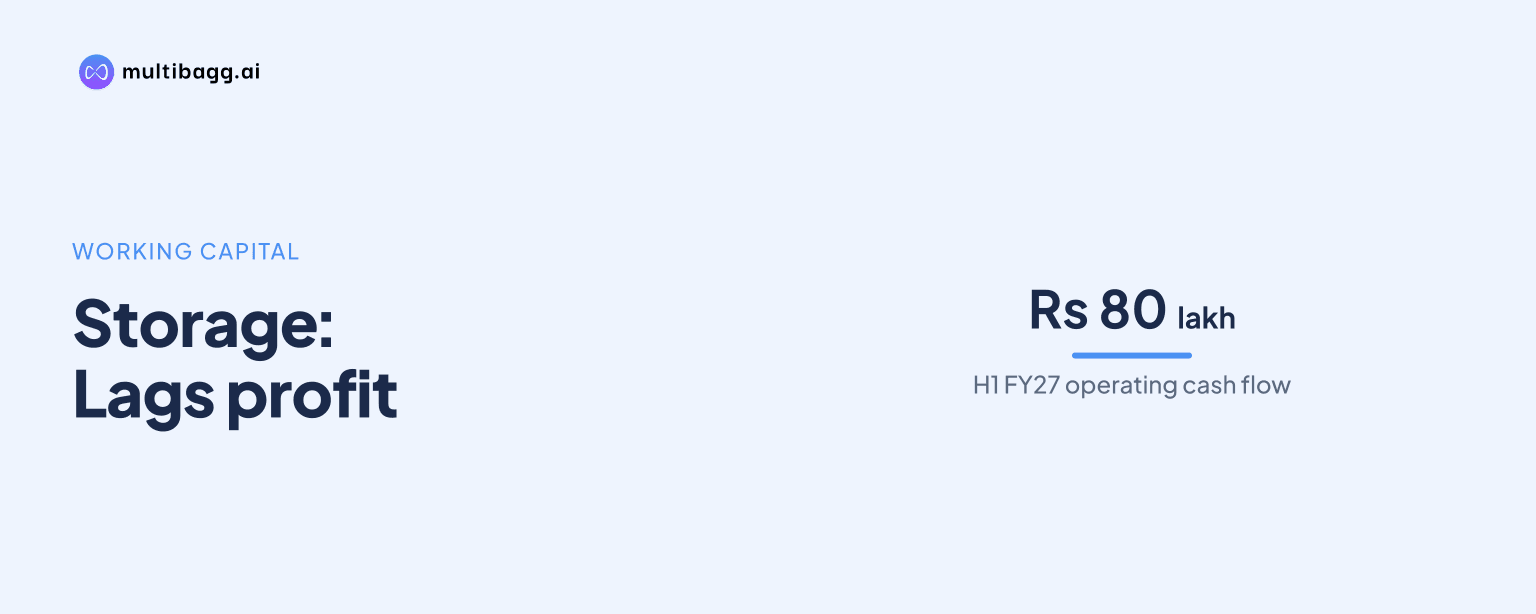
Storage Technologies generated Rs 80 lakh of standalone operating cash flow in H1 FY27, as a Rs 2.53 crore working-capital outflow and Rs 16 lakh of tax reduced Rs 3.48 crore of operating profit before working-capital changes. STAL also spent Rs 2.71 crore on capex, partly funded by Rs 1.59 crore from a machinery sale-and-leaseback.
Know Storage Technologies & Automation inside out
Results, valuation, peers and who's buying, in one view.
How did STAL convert profit into cash in H1 FY27?
STAL converted Rs 3.48 crore of operating profit before working-capital changes into Rs 80 lakh of cash flow from operations in H1 FY27. The company defines operating profit in its cash-flow bridge as profit before working-capital changes. A Rs 2.53 crore working-capital outflow and a Rs 16 lakh tax payment reduced the cash generated in the six months ended 30 September 2026.
The cash result was lower than the improvement in the standalone income statement. Revenue from operations rose 22.4% year on year to Rs 57.57 crore in H1 FY27, while earnings before interest, tax, depreciation and amortisation, or EBITDA, increased to Rs 3.52 crore from Rs 47 lakh. Gross profit, however, declined to Rs 10.76 crore from Rs 11.24 crore as cost of goods sold rose 30.7% to Rs 46.81 crore.
STAL reported standalone profit after tax of Rs 1.60 crore in H1 FY27, compared with a Rs 1.55 crore loss a year earlier, but operating cash flow was Rs 80 lakh. The presentation attributes the working-capital pressure to growth cash tied up in receivables and inventory, partly funded by suppliers. It does not provide a separate cash-flow reconciliation for each balance-sheet account.
Why did STAL's receivables and inventory rise?
STAL's standalone trade receivables increased by Rs 9.22 crore to Rs 40.11 crore at 30 September 2026 from Rs 30.89 crore at 31 March 2026. Inventories rose by Rs 3.57 crore to Rs 19.55 crore from Rs 15.98 crore over the same period. Those balance-sheet movements accompanied the 22.4% increase in H1 FY27 revenue and were identified by STAL as cash-consuming working-capital items.
Supplier balances provided partial funding. Trade payables to parties other than micro, small and medium enterprises, or MSMEs, increased to Rs 22.45 crore from Rs 9.27 crore, while MSME trade payables declined to Rs 2.73 crore from Rs 3.71 crore. Combined trade payables therefore rose by Rs 12.20 crore, but other current liabilities fell to Rs 2.88 crore from Rs 5.51 crore, so the Rs 2.53 crore working-capital outflow is not a direct sum of the listed receivable, inventory and payable changes.
STAL ended the half year with Rs 3.63 crore of cash and cash equivalents, down from Rs 4.35 crore at 31 March 2026. Short-term borrowings declined to Rs 13.36 crore from Rs 13.96 crore, while long-term borrowings increased to Rs 1 crore from Rs 9 lakh. The interim standalone balance sheet therefore records lower cash alongside higher receivables and inventory at the September reporting date.
Got a follow-up? Ask IRIS
How did STAL fund capital expenditure in H1 FY27?
STAL spent Rs 2.71 crore on capital expenditure in H1 FY27 and received Rs 1.59 crore from a machinery sale-and-leaseback. The cash-flow bridge records the sale-and-leaseback proceeds separately, along with Rs 11 lakh of interest received. These items resulted in a Rs 1.01 crore cash outflow from investing activities for the period.
The sale-and-leaseback reduced the immediate cash requirement associated with capex rather than removing the reported Rs 2.71 crore expenditure. Property, plant and equipment stood at Rs 9.60 crore at 30 September 2026, marginally below Rs 9.63 crore at 31 March 2026. That comparison means the cash capex amount should not be equated with the change in the period-end property, plant and equipment balance.
Financing activities used Rs 51 lakh in H1 FY27, following Rs 48 lakh used in H1 FY26. With Rs 80 lakh of operating cash inflow and a Rs 1.01 crore investing outflow, this produced a Rs 72 lakh net decrease in cash during H1 FY27. STAL specifically describes the machinery transaction as part-funding capex.
How did STAL's cash flow compare with H1 FY26?
STAL's net cash outflow narrowed to Rs 72 lakh in H1 FY27 from Rs 1.56 crore in H1 FY26. The investing outflow reduced to Rs 1.01 crore from Rs 2.24 crore, aided by the Rs 1.59 crore machinery sale-and-leaseback. Closing cash was Rs 3.63 crore in H1 FY27, compared with Rs 3.80 crore at the end of H1 FY26.
Cash flow from operations moved in the opposite direction, decreasing to Rs 80 lakh from Rs 1.16 crore a year earlier despite EBITDA rising by Rs 3.05 crore to Rs 3.52 crore. Employee cost fell 30.6% to Rs 4.49 crore and other expenses declined 26.3% to Rs 3 crore, while materials consumed increased 35.3% to Rs 40.62 crore as raw-material prices rose.
The period comparison separates operating performance from cash conversion. Standalone EBITDA margin increased to 6.1% from 1.0%, but the H1 FY27 working-capital requirement constrained cash flow from operations. The lower overall cash outflow instead reflected the smaller investing outflow and the machinery sale-and-leaseback proceeds.
Conclusion
STAL's H1 FY27 standalone results show that higher profit did not translate into higher operating cash flow. The company generated Rs 3.48 crore of operating profit before working-capital changes and Rs 1.60 crore of profit after tax, but working capital used Rs 2.53 crore and left an Rs 80 lakh operating cash inflow. Receivables and inventory were both higher at 30 September 2026, while supplier balances partly offset the funding requirement.
The next measure to watch is whether STAL can meet management's FY27 guidance of Rs 110 crore in revenue and a 5% to 8% EBITDA margin without further material working-capital absorption. Management reported an order book of Rs 50.60 crore on 10 November 2026, compared with about Rs 35 crore in May 2026; subsequent disclosures can indicate how that order book converts into revenue, receivables, inventory and cash flow.