










Sun Pharma India sales rise 17.3% on volumes and launches
Key highlights
- Sun Pharma’s India formulations sales rose 17.3% to Rs 5,552.3 crore in Q2 FY27.
- Management said volumes and new products contributed about 50% to 60% of India growth.
- Sun Pharma reported 6% to 6.7% volume growth, versus 1.6% to 1.8% for the IPM.
- Sun Pharma launched 15 India products in Q2 FY27 and reported 8.6% market share in September 2026.
powered by IRIS
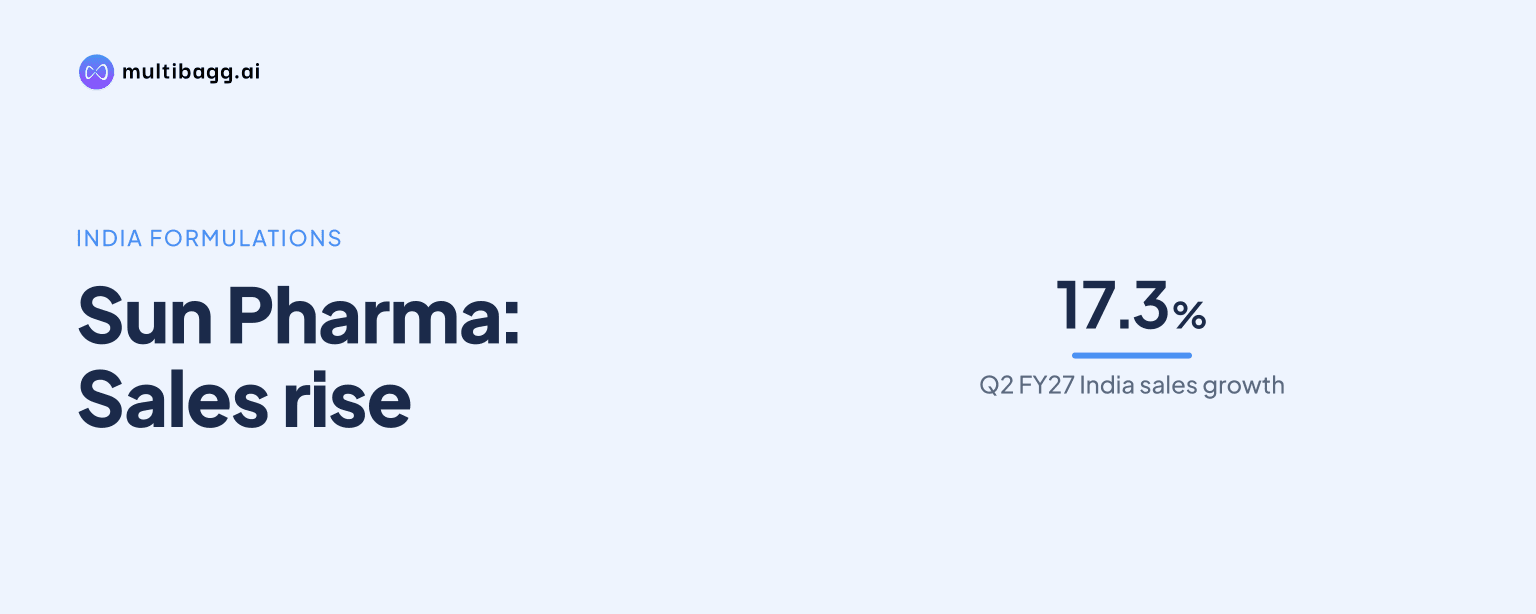
Sun Pharmaceutical Industries Ltd reported India formulations sales growth of 17.3% to Rs 5,552.3 crore in Q2 FY27, with management attributing about 50% to 60% of the increase to volume gains and new-product launches. Sun Pharma’s 6% to 6.7% volume growth also exceeded the Indian pharmaceutical market’s 1.6% to 1.8% growth rate.
Know Sun Pharmaceutical Industries inside out
Results, valuation, peers and who's buying, in one view.
Why did Sun Pharma’s India formulations sales rise 17.3%?
Sun Pharma said India formulations sales rose 17.3% year on year to Rs 5,552.3 crore in Q2 FY27 because growth extended across the 12 major therapy areas in which it operates. Management said the business performed well on prescription volumes and value, without identifying a single therapy area or product as the principal contributor to the quarterly increase.
Management said volumes and new products together supplied around 50% to 60% of the 17.3% growth, while pricing accounted for the remainder. This is management’s qualitative allocation rather than a separately reported revenue bridge, but it indicates that factors other than pricing made up the larger portion of the sales increase.
Sun Pharma launched 15 products in India during Q2 FY27. Management attributed the volume and launch contribution to ongoing brand building, scientific promotion, field-force expansion, higher prescriber coverage and product introductions ahead of competition, describing these as the combined drivers of India growth over the last two years.
How did Sun Pharma’s volume growth compare with the market?
Sun Pharma’s volume growth exceeded the Indian pharmaceutical market, or IPM, in both data sets discussed on the October 30, 2026 call. Management initially cited 6.7% Sun Pharma volume growth against 1.8% for the IPM for the quarter ending September 2026, based on Pharmarack data.
In response to an analyst question, management separately cited AWACS data showing Sun Pharma volume growth of 6%, compared with IPM growth of 1.6%. The figures come from different market-data references, but both show a volume-growth gap of more than four percentage points in Sun Pharma’s favour.
Sun Pharma reported an 8.6% share of the more than Rs 2,61,800 crore Indian pharmaceutical market in Pharmarack moving annual total data for September 2026, up from 8.3% in the corresponding previous period. Management said the company ranked first in that market-share measure and grew faster than the IPM across major represented therapy areas.
The company also said it ranked first by prescription volumes in the SMSRC March-June 2026 report and first by prescriptions across 12 doctor categories. The call did not provide a percentage increase in prescriptions, but those indicators provide context for the reported 6% to 6.7% volume expansion.
Was Sun Pharma’s India growth broad-based across therapies?
Yes, Sun Pharma said its Q2 FY27 India growth was broad-based across all 12 major therapeutic areas in which it is present. Management said the company was performing well in both prescription and value terms across those therapy areas, supporting the Rs 5,552.3 crore quarterly formulations-sales result.
The call did not disclose sales, growth or market share by therapeutic category. It also did not quantify the revenue contribution from any of the 15 products launched in Q2 FY27, so the available information does not establish which therapy area or brand added the most to the 17.3% increase.
Semaglutide was discussed in relation to India, Brazil and South Africa, but management did not quantify its contribution to India sales or volume growth. Asked about India volume growth excluding semaglutide, management did not provide a figure and instead pointed to the broader combination of brand building, field-force expansion, prescriptions and new launches.
Management said new products can take three to four years to build when discussing glucagon-like peptide-1, or GLP-1, drugs in India. That observation was not a forecast for semaglutide sales, FY28 India formulations growth or the contribution from any individual launch.
Got a follow-up? Ask IRIS
What share does India contribute to Sun Pharma’s results?
Sun Pharma’s India formulations business represented 34.5% of consolidated Q2 FY27 sales, compared with 27% for the US business, 20.7% for emerging markets and about 14.3% for rest-of-world markets. Consolidated sales rose 11.8% year on year to Rs 16,100 crore, below the India business’s 17.3% growth rate.
The comparison with other disclosed regions shows differing growth patterns during Q2 FY27. US sales declined 8.2% to USD455 million, largely because of lenalidomide erosion, while emerging-markets formulation revenue rose 7.6% to USD350 million and global innovative-medicines sales increased 6.9% to USD356 million.
Management said global innovative-medicines growth was slowed by Ilumya’s US performance, where it identified a mix of market and execution factors. In contrast, India’s growth was linked to volume, launches and broad therapy-area performance, while the company’s 15 India launches occurred during the same quarter.
At the consolidated level, Sun Pharma reported earnings before interest, tax, depreciation and amortisation, or EBITDA, of Rs 4,743.9 crore in Q2 FY27, up 4.8% year on year, with a 29.3% margin. Management said Q2 FY26 EBITDA had benefited from lenalidomide sales and that adjusted EBITDA growth outpaced revenue growth.
Can Sun Pharma maintain volume-led India growth?
Sun Pharma did not provide India-specific revenue or volume guidance and management said it could not predict whether the same growth rate would continue in the next one or two quarters. It retained its overall FY27 revenue-growth guidance of high single digits, despite first-half consolidated sales rising 11% to Rs 31,283.6 crore.
Management identified several continuing commercial mechanisms behind the 6% to 6.7% India volume growth: brand investment, scientific promotion, field-force expansion, more prescribers, prescription gains and launches ahead of competitors. The 15 launches in Q2 FY27 and the increase in market share to 8.6% are measurable indicators for tracking the execution of that strategy.
Product availability and quality actions are also relevant to the India outlook. Sun Pharma said it had voluntarily recalled 11 ophthalmology products and temporarily stopped the related manufacturing activities, while keeping the Indian regulator informed and taking remedial action to put the required measures in place shortly.
Conclusion
Sun Pharma’s India formulations performance in Q2 FY27 was driven mainly by volumes and new-product launches rather than pricing, according to management’s estimate that these factors supplied 50% to 60% of the 17.3% sales increase. Its 6% to 6.7% volume growth exceeded the IPM’s 1.6% to 1.8% expansion, while market share rose from 8.3% to 8.6% in the Pharmarack September 2026 data.
The next indicators are whether Sun Pharma continues adding products after the 15 Q2 FY27 launches, sustains its volume-growth gap against the IPM and completes remedial action following the voluntary recall of 11 ophthalmology products. Management has maintained high-single-digit overall FY27 revenue guidance, while describing India’s quarterly growth rate as difficult to predict over the next one or two quarters.