










Sundaram-Clayton Limited Q2 PAT rises 96% on revenue gain
Key highlights
- Sundaram-Clayton's standalone Q2 profit after tax rose to Rs 39.48 crore from Rs 20.19 crore a year earlier.
- Standalone revenue from operations increased 37% to Rs 629.38 crore in the quarter ended September 30, 2026.
- Half-year standalone revenue was Rs 1,153.60 crore and profit after tax was Rs 56.52 crore.
- The board approved up to Rs 700 crore of NCDs and/or other permissible borrowings outstanding on November 4, 2026.
powered by IRIS
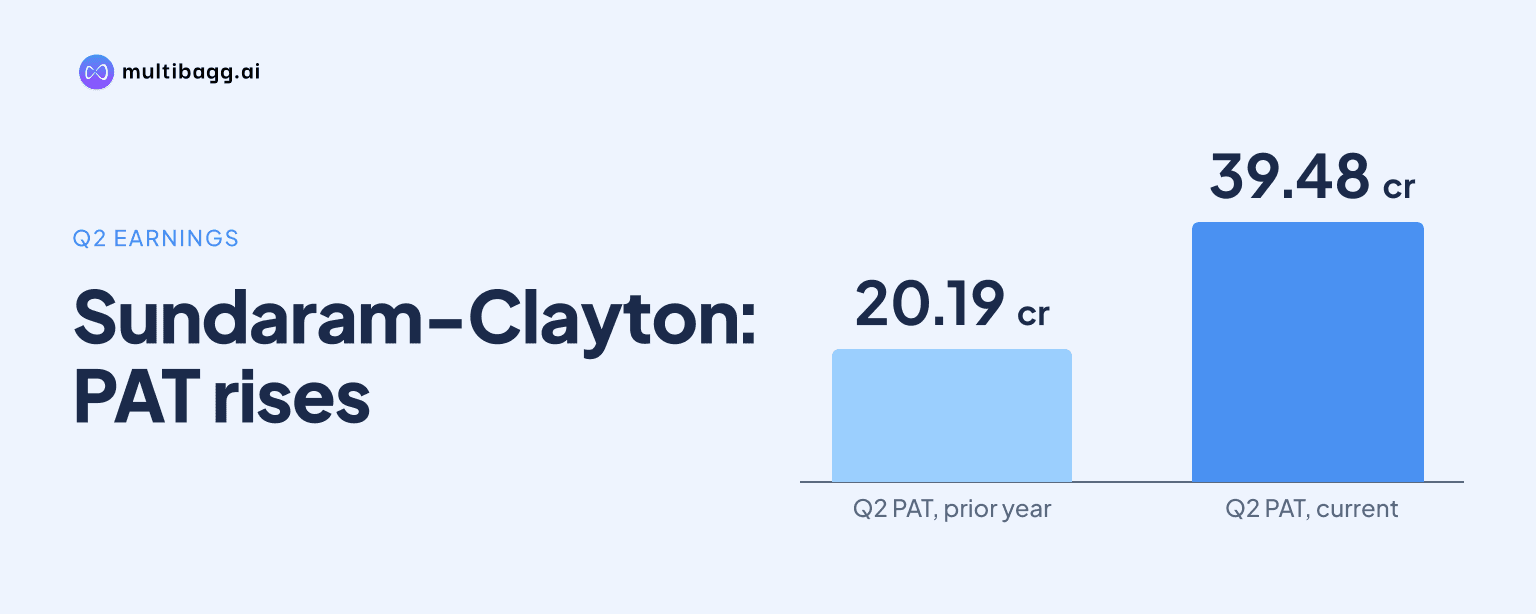
Sundaram-Clayton reported standalone profit after tax of Rs 39.48 crore for the quarter ended September 30, 2026, up 96% from Rs 20.19 crore a year earlier, as revenue from operations increased 37% to Rs 629.38 crore. The filing reports one operating segment, automotive components, and does not disclose EBITDA or customer and export-volume data.
Know Sundaram Clayton inside out
Results, valuation, peers and who's buying, in one view.
What were Sundaram-Clayton's standalone Q2 results?
Sundaram-Clayton recorded total income of Rs 631.87 crore in the quarter ended September 30, 2026, compared with Rs 462.85 crore in the corresponding quarter a year earlier. Revenue from operations was Rs 629.38 crore, while other income was Rs 2.49 crore. Profit before tax rose to Rs 53.17 crore from Rs 25.91 crore, and tax expense increased to Rs 13.69 crore from Rs 5.72 crore.
Sundaram-Clayton's profit after tax was Rs 39.48 crore, compared with Rs 20.19 crore in the September 2025 quarter. Basic and diluted earnings per share, or EPS, were both Rs 17.91, against Rs 9.16 a year earlier; the company stated that the quarterly EPS figures are not annualised. No exceptional item was reported for the September 2026 quarter, leaving profit before tax and profit after exceptional items before tax at Rs 53.17 crore.
Which costs changed in Sundaram-Clayton's September quarter?
Sundaram-Clayton's cost of materials consumed rose to Rs 365.53 crore in the September 2026 quarter from Rs 226.90 crore a year earlier. Other expenses increased to Rs 145.56 crore from Rs 104.52 crore, while employee benefit expense rose to Rs 64.87 crore from Rs 59.85 crore. Changes in inventories of finished goods, work-in-progress and stock-in-trade were negative Rs 42.98 crore, compared with negative Rs 7.51 crore in the prior-year quarter.
Sundaram-Clayton reported finance costs of Rs 16.57 crore, down from Rs 19.90 crore, and depreciation and amortisation of Rs 29.15 crore, down from Rs 33.28 crore. Total expenses nevertheless increased to Rs 578.70 crore from Rs 436.94 crore. The filing identifies automotive components as the sole operating segment but gives no separate data on alloy, energy, logistics, customer demand or export volumes.
How did Sundaram-Clayton perform sequentially and in the half year?
Sundaram-Clayton's September-quarter revenue from operations increased from Rs 524.22 crore in the quarter ended June 30, 2026 to Rs 629.38 crore. Profit after tax rose from Rs 17.04 crore to Rs 39.48 crore over the same three-month comparison, while profit before tax increased from Rs 22.79 crore to Rs 53.17 crore. Other income decreased sequentially to Rs 2.49 crore from Rs 3.73 crore.
For the half year ended September 30, 2026, Sundaram-Clayton reported revenue from operations of Rs 1,153.60 crore, compared with Rs 900.69 crore in the half year ended September 30, 2025. Half-year profit after tax rose to Rs 56.52 crore from Rs 37.20 crore, while profit before tax increased to Rs 75.96 crore from Rs 48.31 crore. Half-year basic and diluted EPS were Rs 25.64, against Rs 16.87, and were not annualised.
Got a follow-up? Ask IRIS
What changed in Sundaram-Clayton's balance sheet?
Sundaram-Clayton's total assets were Rs 3,715.61 crore at September 30, 2026, compared with Rs 3,434.28 crore at March 31, 2026. Inventories increased to Rs 458.50 crore from Rs 342.37 crore and trade receivables rose to Rs 407.20 crore from Rs 343.42 crore. Cash and cash equivalents stood at Rs 38.45 crore, compared with Rs 29.75 crore at the March 2026 year-end.
Sundaram-Clayton reported non-current borrowings of Rs 641.22 crore at September 30, 2026, against Rs 630.27 crore at March 31, 2026. Current borrowings increased to Rs 458.16 crore from Rs 225.90 crore over the same period. Total equity rose to Rs 2,022.29 crore from Rs 1,960.51 crore, while capital work in progress increased to Rs 76.55 crore from Rs 23.41 crore.
What new borrowing authority did Sundaram-Clayton approve?
Sundaram-Clayton's board approved on November 4, 2026 a plan to raise funds through non-convertible debentures, or NCDs, and/or other permissible borrowings of up to Rs 700 crore outstanding at any point in time. The approval is subject to applicable approvals and must remain within borrowing limits authorised under Section 180 of the Companies Act, 2013. The announcement does not state an issuance date, interest cost or intended use of proceeds.
Sundaram-Clayton's standalone results for the quarter and half year ended September 30, 2026 were unaudited and approved by the board on November 4, 2026. Raghavan, Chaudhuri & Narayanan conducted a limited review and said nothing had come to its attention that caused it to believe the standalone statement had failed to make required disclosures or contained a material misstatement. The reviewer noted that a limited review is narrower in scope than an audit.
Conclusion
Sundaram-Clayton's September 2026 standalone result paired revenue from operations of Rs 629.38 crore with profit after tax of Rs 39.48 crore, compared with Rs 458.57 crore and Rs 20.19 crore respectively a year earlier. Materials consumption and other expenses increased, while lower finance costs and depreciation accompanied profit before tax of Rs 53.17 crore.
The next disclosed development to watch is whether Sundaram-Clayton uses the November 4, 2026 authority for up to Rs 700 crore of NCDs and/or other borrowings outstanding. Future results will also show whether the September 2026 levels of inventories at Rs 458.50 crore, trade receivables at Rs 407.20 crore and current borrowings at Rs 458.16 crore change further.