










Sundrop Brands says inventory build drove H1 cash outflow
Key highlights
- Sundrop Brands said H1 operating cash flow was negative by almost Rs 49 crore.
- Management said it increased corn and oats inventory to protect supply availability during Q2 uncertainty.
- Sundrop Brands said days sales outstanding remained constant despite higher receivables.
- Sundrop Brands reported Q2 revenue growth of 21% year on year and overall volume growth close to 10%.
powered by IRIS
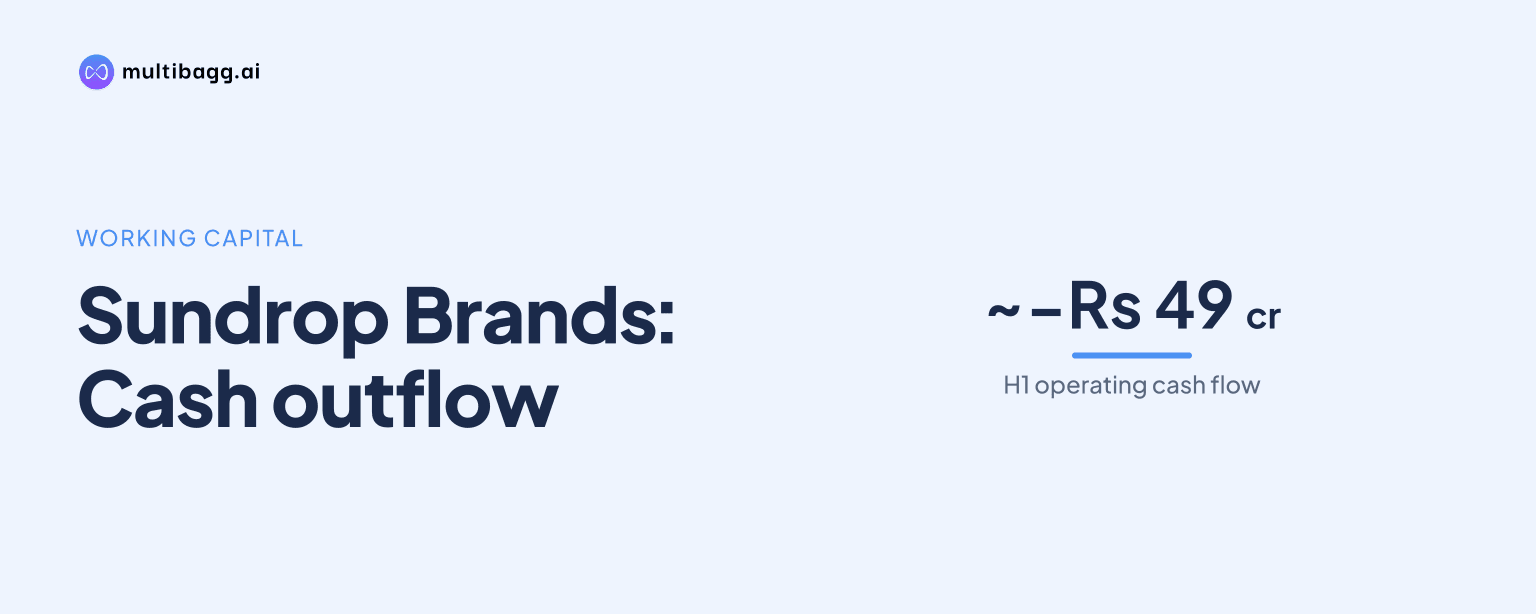
Sundrop Brands said almost Rs 49 crore of negative operating cash flow in H1 resulted primarily from a strategic build of corn and oats inventory during Q2 uncertainty, while its days sales outstanding remained constant. Management said it expects this elevated cash-flow level to come back in Q3 as supply conditions stabilise.
Know Sundrop Brands inside out
Results, valuation, peers and who's buying, in one view.
Why was Sundrop Brands' operating cash flow negative in H1?
Sundrop Brands said the almost Rs 49 crore H1 operating cash outflow reflected higher inventory and sales-linked working-capital needs, rather than a deterioration in collections. Management identified corn and oats as materials where it consciously raised inventory because volatility and availability risks during Q2 could have disrupted supply.
The company described the additional corn and oats stocks as a structural and selective intervention. Its objective was to avoid vulnerability in a period of uncertainty, not to position inventory for raw-material price movements. Management said its broader inventory position remained aligned with requirements and its ability to ensure continuity of supply.
Sundrop Brands did not provide a rupee breakdown of the almost Rs 49 crore outflow between raw-material inventory, finished goods, channel inventory and receivables. It also did not disclose inventory days for corn or oats. The disclosed distinction was between sales-related increases in working capital and the selective inventory build made during Q2.
Did Sundrop Brands' receivables or collection cycle worsen?
No. Sundrop Brands said days sales outstanding, or DSO, remained constant, so it did not attribute the H1 cash outflow to customers taking longer to pay. Receivables increased predominantly because sales were rising, alongside increases in finished-goods and channel inventory associated with that sales momentum.
That distinction is relevant because receivables can rise in rupee terms even when the collection cycle does not lengthen. Sundrop Brands said the DSO measure did not change, while the discrete working-capital action was its additional inventory in corn and oats. Management did not disclose the DSO number or quantify receivables at the end of H1.
The company reported Q2 revenue growth of 21% year on year and overall volume growth close to 10%. Management said core-category volume growth was about 12%, while oil volumes grew about 5%. Those sales increases explain why receivables and normal inventory requirements could rise even without a change in collection discipline.
When does Sundrop Brands expect cash flow to normalise?
Sundrop Brands expects the elevated cash-flow level to come back in Q3, according to management, which said it was seeing signs of stabilisation after the uncertainty encountered in Q2. This was the company's response to a question on whether Q3 would reverse the negative operating cash-flow position.
Management did not give a Q3 operating cash-flow forecast, a rupee target or a date by which corn and oats inventory would return to a specified level. It said only that the higher inventory was intended to protect availability and that the cash-flow level would come back as the company entered Q3.
The pace of normalisation therefore depends on inventory consumption and the persistence of supply stability, neither of which was quantified on the call. Sundrop Brands also said its DSO had not changed, meaning the expected Q3 movement was linked principally to the strategic inventory position rather than a stated plan to shorten customer payment cycles.
Got a follow-up? Ask IRIS
How did sales growth add to Sundrop Brands' working-capital needs?
Sundrop Brands said Q2 revenue rose 21% year on year, made up of nearly 10% overall volume growth, about 3% to 4% from innovation and premiumisation, and about 6% to 7% from price increases passed to consumers. Higher sales increased receivables and inventory in absolute terms, even though the company said DSO was unchanged.
The company said e-commerce represented 19% of sales contribution, with quick commerce supporting impulse-led snacking purchases. In ACT II ready-to-eat products, small packs grew about 23% and large packs about 53%, producing blended growth of about 37%. Management did not quantify the cash-flow effect of those channel and pack changes.
In the popcorn franchise overall, ready-to-cook volume growth was about 5% to 6%, while blended popcorn growth was about 10% to 11%. Management said higher-value packs were gaining traction through e-commerce, while Rs 10 packs helped attract consumers through its home-food-service distribution. These trends formed part of the wider sales momentum behind higher working-capital balances.
What inventory and pricing conditions did Sundrop Brands report?
Sundrop Brands said the corn and oats stock build was a supply-security decision rather than a pricing-led inventory call. Management said it was adequately covered across most raw materials and described the broader input environment as stable, with stability to marginal deflation in oils recently.
In edible oils, management said a reduction in duty in the last week of September had passed some benefit to the industry and consumers. It said it did not anticipate quarter-ahead cost developments that would require broad consumer price increases or materially affect margins, although selective pricing calibration could occur after recent procurement.
Sundrop Brands said selected Del Monte key-account and export contracts are annual arrangements that may come up for renewal between December and March. Management said price increases on those contracts could help margins, with more of the effect expected in Q4 than Q1. This was separate from the Q2 strategic inventory additions in corn and oats.
The company also described multiple sourcing arrangements for popcorn. It said it uses indirect contract farming with Indian growers for popping corn, imports certain varieties for microwave popcorn, and sources Indian corn for ready-to-eat, ready-to-cook and instant-popcorn products. Management said Indian corn is largely grown in Andhra and Chhattisgarh and that sourcing had been diversified for weather and water-level risks.
Conclusion
The almost Rs 49 crore H1 operating cash outflow reflected two linked effects: sales growth raised normal working-capital balances, while Sundrop Brands deliberately increased corn and oats inventory to reduce supply risk in Q2. Management said collection quality did not weaken, because DSO remained constant despite higher receivables.
The next checkpoint is Q3, when management expects the elevated cash-flow level to come back as conditions stabilise and the strategic inventory position normalises. Investors can also watch the December-to-March renewal cycle for selected Del Monte contracts, which management said could have a larger margin effect in Q4.