










Sundrop Brands targets category-beating growth in two quarters
Key highlights
- Sundrop’s peanut-butter decline narrowed from 8% in Q4 to about 1% in Q2.
- Sundrop’s new value-added peanut-butter variants reached 12.4% saliency in Q2, up from 8.3% in Q1.
- Management targets Sundrop e-commerce growth above category growth within two quarters from about 18% growth.
- Sundrop said products launched in the past two years contribute roughly 6% of overall sales.
powered by IRIS
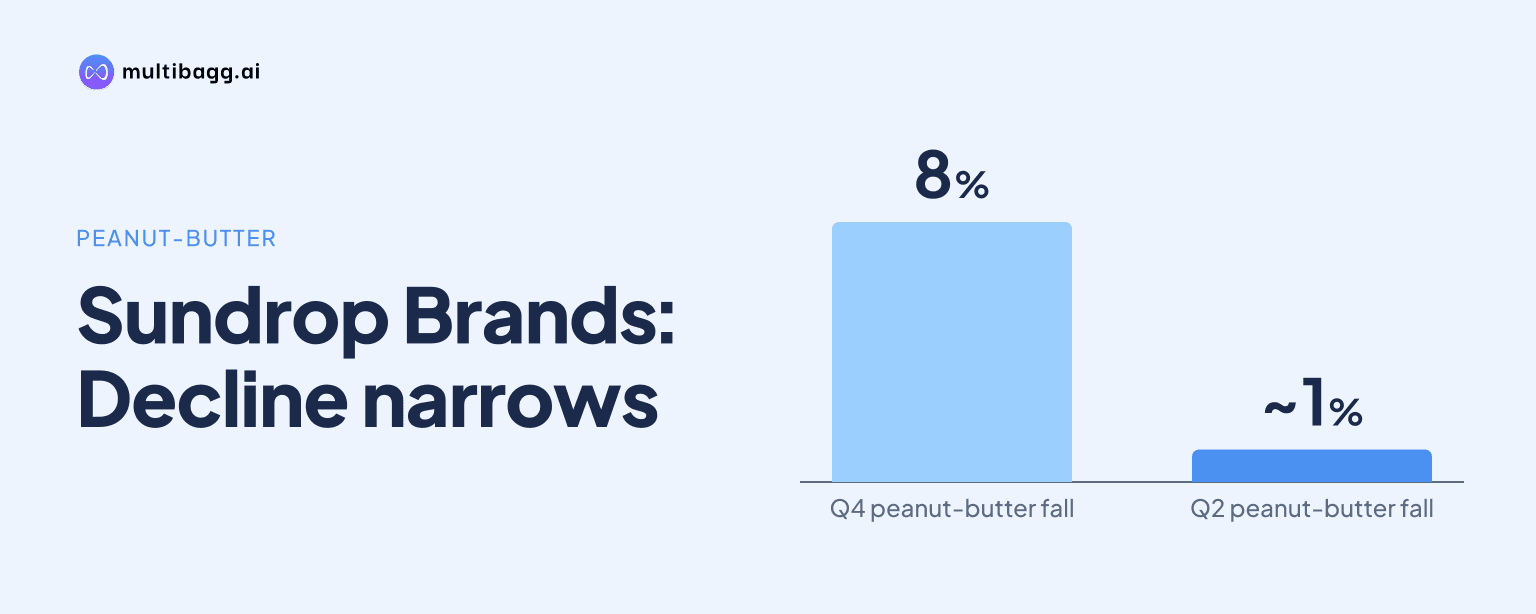
Sundrop Brands said its peanut-butter e-commerce growth should move ahead of category growth within two quarters, supported by value-added variants that reached 12.4% portfolio saliency in Q2. Management said the portfolio’s decline narrowed from 8% in Q4 to about 1% in Q2 as chocolate, high-protein chocolate and zero-separation formats gained consumers.
Know Sundrop Brands inside out
Results, valuation, peers and who's buying, in one view.
How is Sundrop recovering its peanut-butter business?
Sundrop is seeking to recover peanut butter by expanding its value-added range, with chocolate peanut butter, high-protein chocolate peanut butter and zero-separation peanut butter at the centre of the plan. Management said these premium-side products began launching in Q4, while listings were established during Q1.
The reported trend shows that the portfolio decline reduced over three periods. Sundrop’s peanut-butter decline was 8% in Q4, 3% in Q1 and about 1% in Q2. Management said the Q2 outcome indicated that the decline had almost stabilised, while further consumer acquisition in differentiated variants should expand the value-added part of the portfolio.
The change in saliency provides the clearest measure of the new products’ increasing role. New variants accounted for 8.3% of Sundrop’s portfolio in Q1 and 12.4% in Q2, a sequential increase of 4.1 percentage points. Management did not disclose absolute peanut-butter sales, a market-share figure or a numerical share-recovery target.
Which variants are behind Sundrop’s recovery plan?
Sundrop’s recovery plan is based on chocolate, high-protein chocolate and zero-separation peanut-butter formats, which management described as value-added offerings in the premium segment. Their saliency rose to 12.4% in Q2 from 8.3% in Q1 after the Q4 launches and Q1 listing activity.
The variants sit within a wider innovation programme. Management said it had launched more than 120 products over the past two years, including about 24 to 25 products in Q2. Within Sundrop, it identified high-protein spreads and oats as areas under development alongside the differentiated peanut-butter formats.
Management said roughly 6% of overall sales came from products launched during the previous two years. Those new-product developments are currently concentrated in e-commerce and business-to-business channels, with a plan to take many of them into general trade and modern trade over subsequent periods. That route links peanut-butter innovation to wider distribution rather than relying only on online listings.
When does Sundrop expect to outgrow the category online?
Sundrop aims to move its peanut-butter e-commerce growth ahead of category growth within the next two quarters. Management said growth had reached about 18% at the time of the call, but it did not provide the category growth rate against which this target will be assessed.
Management attributed the ambition to two years of changes in e-commerce execution, including a stronger team, technology capability and performance-marketing processes focused on return on investment. It said e-commerce as a channel was growing between 18% and 25%, while its internal investments were intended to help Sundrop grow faster than the category and gain share.
The next distribution phase is planned beyond the two-quarter online objective. Management said it would then take the offerings into general trade and modern trade, particularly modern trade, where value-added products have relatively higher saliency. It described this broader platform expansion as a task for FY ’28.
Got a follow-up? Ask IRIS
What supports Sundrop’s e-commerce growth expectations?
Sundrop’s confidence rests on two years of sustained e-commerce performance and on the expansion of quick commerce, according to management. It said rapid delivery can support snacking and impulse consumption by making convenient formats available when consumers might otherwise have chosen food prepared at home.
An analyst said e-commerce had become 19% of sales, a figure management did not dispute during the call. Management said Sundrop had historically been oriented toward general trade, but had changed its investment approach over the previous two years by adding e-commerce capabilities, technology infrastructure and measured performance-marketing spending.
ACT II data illustrate the pack-upgrading effect management associates with e-commerce. Ready-to-eat small-pack growth was about 23%, while large-pack growth was about 53%, resulting in blended growth of about 37%. Management said the Rs 10 pack supported consumer acquisition through high-frequency-store distribution, while e-commerce helped consumers shift to higher-value packs.
What could affect Sundrop’s recovery timetable?
Sundrop’s two-quarter target depends on sustained consumer acquisition for new variants and progress in e-commerce growth relative to the category. The company has not disclosed its current share of the value-added peanut-butter market, the category’s growth rate, or the revenue contribution represented by the 12.4% Q2 saliency figure.
The wider operating context includes selected inventory building. Management said it increased inventories of inputs including corn and oats because uncertainty could affect availability. It also said days sales outstanding, or DSOs, remained constant, and that higher receivables were mainly consistent with the company’s sales momentum.
Management expects inventory levels to come back as conditions stabilise in Q3. Across the company, it attributed overall growth to about 10% volume growth, 3% to 4% premiumisation and 6% to 7% price increases passed to consumers. That mix indicates that the peanut-butter initiative is part of a broader move toward higher-value products and larger packs.
Conclusion
Sundrop’s disclosed recovery plan has produced two measurable changes: the peanut-butter decline narrowed from 8% in Q4 to about 1% in Q2, and new value-added variants increased saliency from 8.3% to 12.4% over Q1 and Q2. The company is using differentiated products, e-commerce execution and later distribution expansion to rebuild momentum in the value-added segment.
The next point to watch is management’s target to move e-commerce growth ahead of category growth within two quarters, from a stated growth rate of about 18%. Investors can also track whether new-variant saliency continues to rise, whether the portfolio returns to growth, and whether the FY ’28 general-trade and modern-trade rollout proceeds as management outlined.