










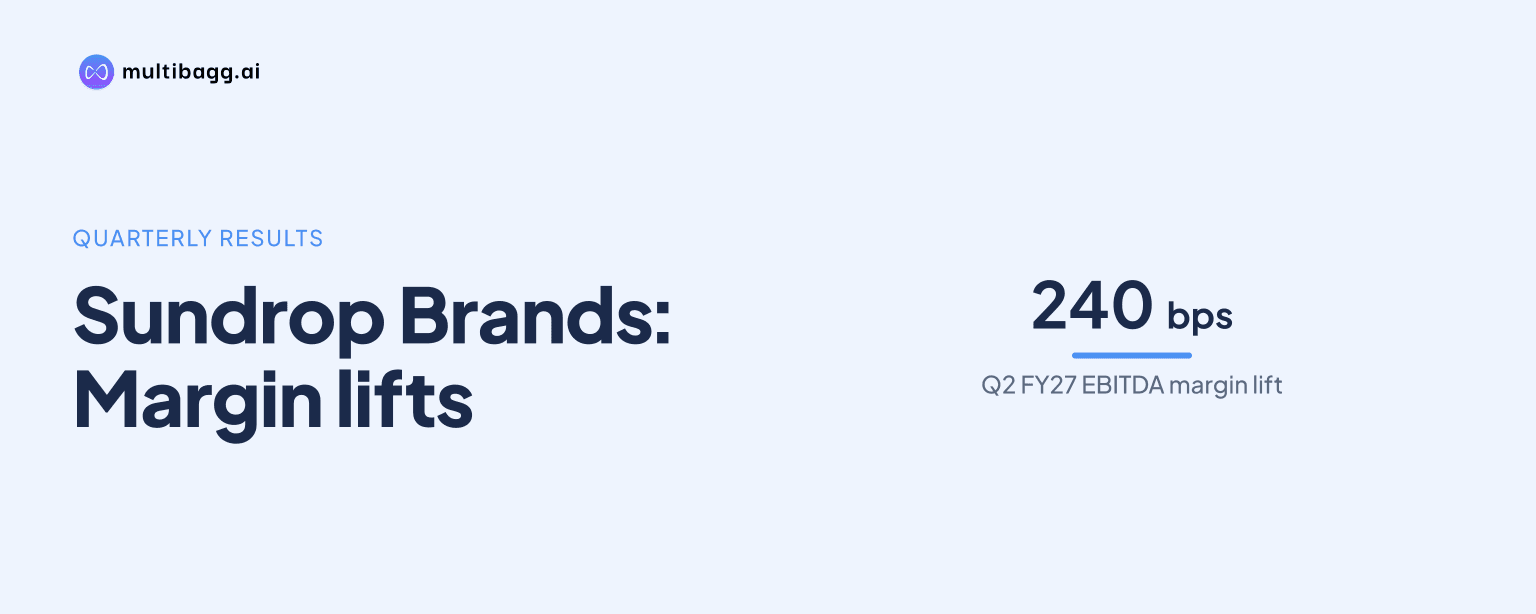
Sundrop Brands lifts normalized EBITDA margin 240 basis points
Key highlights
- Sundrop Brands' normalized EBITDA margin increased by 240 basis points in Q2 FY '27.
- Sundrop Brands' Q2 FY '27 revenue rose 21% year on year to Rs 463 crore.
- Del Monte grew 26% in Q2 FY '27, while the Sundrop business grew 19%.
- Ready-to-eat value growth reached 38% and e-commerce growth reached 43% in Q2 FY '27.
powered by IRIS
Sundrop Brands Limited raised normalized earnings before interest, tax, depreciation and amortisation margin by 240 basis points year on year in Q2 FY '27, while revenue increased 21% to Rs 463 crore, as price corrections, operating-cost efficiencies and scale offset elevated material costs, management said.
Know Sundrop Brands inside out
Results, valuation, peers and who's buying, in one view.
How did Sundrop Brands lift EBITDA margin in Q2 FY '27?
Sundrop Brands lifted normalized EBITDA margin by 240 basis points in Q2 FY '27. Management said the normalized comparison accounted for one-off and project expenses in the prior-year quarter, while an adjusted comparison excluding those prior-year expenses showed a 370-basis-point improvement. The call did not disclose an absolute EBITDA margin or EBITDA amount.
Revenue growth provided the scale behind the improvement. Sundrop Brands reported Q2 FY '27 revenue of Rs 463 crore, up 21% year on year, following H1 FY '27 revenue growth of 18% to Rs 891 crore. Management said the quarter combined growth in core categories and emerging channels with continued investment for future expansion.
What offset Sundrop Brands' material-cost inflation?
Sundrop Brands said price corrections and price increases in relevant categories helped offset inflation in Q2 FY '27. Material-cost inflation was broadly in line with revenue growth, and material margins were slightly lower, according to management. Packaging was among the commodities cited as facing broad-based inflation during the period.
Improvement in employee expenses and other expenses offset the lower material margin, management said. Other expenses include selling, general and administrative costs, manufacturing costs and supply-chain costs. Sundrop Brands attributed the expense improvement to procurement efficiency, manufacturing productivity, premium portfolio mix and the operating leverage created by higher sales.
Which businesses accelerated Sundrop Brands' Q2 growth?
Both disclosed businesses accelerated in Q2 FY '27. The Sundrop business grew 19% year on year in Q2, compared with 17% in H1, while Del Monte grew 26% in Q2, compared with 20% in H1. Del Monte therefore grew faster than the Sundrop business in both disclosed periods, while consolidated Q2 growth of 21% exceeded H1 growth of 18%.
Ready-to-eat products were the fastest-growing disclosed core category, with Q2 value growth of 38% and volume growth of 23%. Ready-to-cook products grew 12% in value and 5% in volume. Management said the combined ready-to-eat and ready-to-cook portfolio produced about 20% to 21% value growth and 10% to 11% volume growth despite the inflationary environment.
How did pricing differ across Sundrop Brands' categories?
Sundrop Brands used a calibrated pricing approach in edible oil, where management said inflation had been particularly high. Q2 edible-oil value growth was 19% and volume growth was 5%. Management said the objective was to protect absolute margins and sustain volume growth of 4% to 5%, rather than seek margin expansion in that category.
The Italian olive-oil and pasta portfolio recorded 30% volume growth and 21% value growth in Q2 FY '27 as pricing stabilized after deflationary conditions in part of Q2 FY '26. The culinary portfolio, including ketchups, mayonnaise, dips and pizza and pasta sauces, grew 13% in volume and 21% in value in Q2, supported by business-to-business momentum and faster business-to-consumer growth.
Got a follow-up? Ask IRIS
Which channels and initiatives support Sundrop Brands' margin plan?
Sundrop Brands reported 18% business-to-consumer growth and 43% e-commerce growth in Q2 FY '27. Management said e-commerce was growing ahead of industry rates and that the company launched 24 new products during the quarter. New popcorn formats, including cheese variants, sweet popcorn and gifting packs, were part of the premiumization effort.
Sundrop Brands also completed Sales Force Automation in Q2 FY '27. Management said the system should improve sales-force productivity and has supported general-trade execution, visibility-spending returns, range and outlet productivity. The company also uses third-party manufacturing sites for some capacity requirements and innovations alongside its existing manufacturing footprint, which management described as part of a more capital-efficient model.
What remains unresolved in Sundrop Brands' portfolio?
Sundrop Brands said peanut butter and spreads remained an area of concern in Q2 FY '27, although its e-commerce business in that category had begun growing about 18% through new launches. Management said volume was still under pressure even as the overall value business had become stable, distinguishing spreads from the 38% value growth in ready-to-eat products.
The company plans to extend peanut-butter initiatives from e-commerce into modern trade and general trade. Management also said it had completed a successful four-quarter distribution experiment for relevant Del Monte categories in eastern India and was considering wider expansion. These plans sit alongside continued investment in general trade, food service and digital channels.
Conclusion
The Q2 FY '27 figures show that Sundrop Brands generated faster growth across both its businesses while managing a mix of category conditions. Ready-to-eat volume grew 23%, Del Monte revenue grew 26% and e-commerce grew 43%, while employee and other expense efficiencies compensated for slightly lower material margins.
Next, investors can watch whether management sustains its 4% to 5% edible-oil volume objective while protecting absolute margins, and whether peanut-butter launches improve volume after e-commerce growth of about 18%. Distribution expansion for Del Monte, further product launches and the completed Sales Force Automation programme are the disclosed mechanisms expected to shape subsequent performance.