










Sungarner Energies Limited funds cash deficit with debt
Key highlights
- Sungarner reported a Rs 6.46 crore operating cash outflow in the half year ended 30 September 2026, versus a Rs 4.36 crore inflow a year earlier.
- Sungarner used Rs 6.83 crore in investing activities, including Rs 6.30 crore for tangible and intangible asset purchases.
- Sungarner increased long-term and short-term borrowings by a combined Rs 14.57 crore during the half year.
- Sungarner's revenue from operations was Rs 56.99 crore and consolidated net profit was Rs 2.29 crore in the September 2026 half year.
powered by IRIS
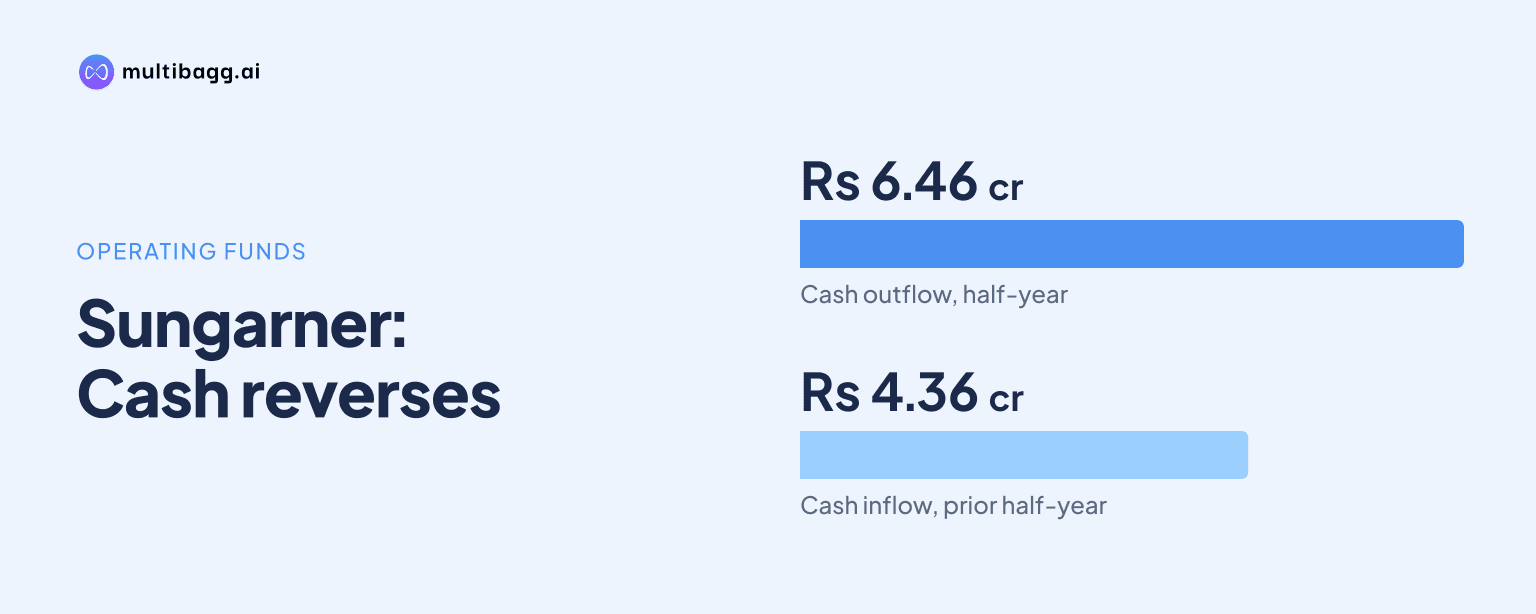
Sungarner funded a Rs 13.29 crore combined operating and investing cash deficit in the half year ended 30 September 2026 with Rs 14.57 crore of additional borrowings, although it reported consolidated net profit of Rs 2.29 crore. Financing activities produced a Rs 13.37 crore net inflow after Rs 1.20 crore of interest and finance costs.
Know Sungarner Energies inside out
Results, valuation, peers and who's buying, in one view.
Why was Sungarner's operating cash flow negative?
Sungarner recorded a Rs 6.46 crore net cash outflow from operating activities for the half year ended 30 September 2026, compared with a Rs 4.36 crore inflow in the corresponding half year ended 30 September 2025. This reversal occurred despite profit before tax rising to Rs 3.38 crore from Rs 1.49 crore, as working-capital movements absorbed cash.
Cash generated before changes in assets and liabilities was Rs 4.99 crore, up from Rs 2.62 crore a year earlier. The 2026 figure included Rs 1.47 crore of interest expense and finance cost, Rs 15.72 lakh of depreciation and amortisation, and a Rs 6.65 lakh provision for expenses. Taxes paid, net of refunds, were Rs 30.40 lakh, taking the operating cash deficit from Rs 6.16 crore to Rs 6.46 crore.
Inventories increased by Rs 5.48 crore and trade receivables rose by Rs 4.62 crore during the 2026 half year. Other assets increased by Rs 2.91 crore and trade payables declined by Rs 3.23 crore, while a Rs 74.35 lakh reduction in loans and advances and a Rs 4.41 crore increase in other liabilities partly offset those uses of cash.
How did Sungarner's revenue and profit change?
Sungarner's revenue from operations rose to Rs 56.99 crore in the half year ended 30 September 2026 from Rs 25.27 crore in the corresponding 2025 period, while net profit increased to Rs 2.29 crore from Rs 1.02 crore. Total income reached Rs 57.08 crore, including Rs 8.72 lakh of other income, against Rs 25.29 crore a year earlier.
Total expenses increased to Rs 53.70 crore from Rs 23.80 crore. Cost of materials consumed rose to Rs 27.51 crore from Rs 13.51 crore, while purchases of stock-in-trade increased to Rs 23.51 crore from Rs 5.06 crore. Finance costs were Rs 1.47 crore, compared with Rs 1.02 crore in the prior-year half.
Profit before tax was Rs 3.38 crore, compared with Rs 1.49 crore, before current tax of Rs 1.06 crore and deferred tax of Rs 1.67 lakh. Sungarner also reported a Rs 80,000 share of loss from associates. The group reported a single segment under Accounting Standard 17, spanning power equipment and appliances, solar equipment, solar power-plant installation and commissioning, and agricultural and food-product trading.
Got a follow-up? Ask IRIS
What did Sungarner spend on investing activities?
Sungarner used Rs 6.83 crore in investing activities during the half year ended 30 September 2026, compared with Rs 9.14 lakh used in the corresponding 2025 period. Purchases of tangible and intangible assets accounted for Rs 6.30 crore, sharply higher than Rs 9.48 lakh in the previous-year half.
The investing outflow also included Rs 74.54 lakh of loans given and Rs 15.88 lakh invested in fixed deposits. Interest received was Rs 37.45 lakh, compared with Rs 34,000 a year earlier, and the cash-flow statement showed no investment made during the 2026 half year.
Property, plant and equipment rose to Rs 18.71 crore at 30 September 2026 from Rs 12.56 crore at 31 March 2026. Total non-current assets increased to Rs 23.62 crore from Rs 16.75 crore, while current assets rose to Rs 66.67 crore from Rs 54.62 crore. These balance-sheet movements occurred alongside the larger capital-asset purchases and working-capital outflows.
How did borrowings fund Sungarner's cash requirement?
Sungarner raised Rs 1.27 crore through net long-term borrowings and Rs 13.29 crore through net short-term borrowings in the 2026 half year. Together, these proceeds were Rs 14.57 crore before financing costs, compared with net repayments in both borrowing categories in the corresponding 2025 half year.
After Rs 1.20 crore of interest and finance costs paid, financing activities generated Rs 13.37 crore of net cash, compared with a Rs 1.65 crore financing outflow a year earlier. That financing inflow broadly offset the Rs 13.29 crore combined operating and investing cash outflow, leaving a Rs 7.61 lakh increase in cash and cash equivalents.
Long-term borrowings stood at Rs 16.45 crore at 30 September 2026, up from Rs 15.18 crore at 31 March 2026. Short-term borrowings increased to Rs 25.37 crore from Rs 12.08 crore over the same dates. Cash and cash equivalents were Rs 96.04 lakh at the end of the half year, versus Rs 88.43 lakh at the beginning; separately, the balance sheet reported cash and bank balances of Rs 1.30 crore at 30 September 2026.
Conclusion
Sungarner's half-year results show that revenue of Rs 56.99 crore and net profit of Rs 2.29 crore did not translate into operating cash generation. Higher inventory, receivables and asset purchases contributed to Rs 13.29 crore of combined operating and investing outflows, which were met principally through Rs 14.57 crore of additional borrowing.
The filing does not disclose a borrowing-reduction target or a cash-flow forecast. The next disclosure to watch is whether inventories of Rs 22.65 crore and trade receivables of Rs 14.31 crore at 30 September 2026 convert into cash while short-term borrowings of Rs 25.37 crore and finance costs of Rs 1.47 crore are managed.