










Sunrakshakk Industries assets rise to Rs 361.67 crore
Key highlights
- Sunrakshakk Industries reported total assets of Rs 361.67 crore at 30 September 2026, versus Rs 323.95 crore at 31 March 2026.
- Property, plant and equipment rose to Rs 105.76 crore from Rs 55.15 crore in six months.
- Inventories increased to Rs 106.87 crore from Rs 55.17 crore at 31 March 2026.
- Net operating cash flow was Rs 18.73 crore in the half year ended 30 September 2026, versus Rs 6.61 crore a year earlier.
powered by IRIS
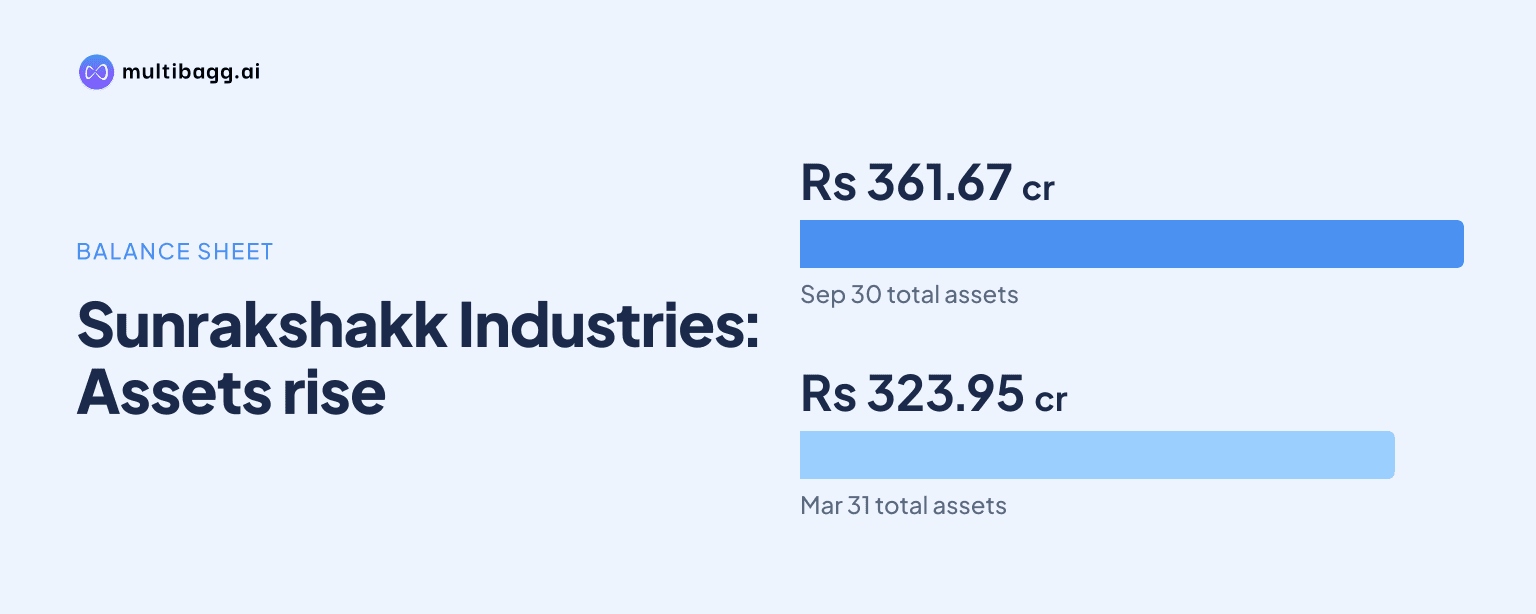
Sunrakshakk Industries India Limited reported consolidated assets of Rs 361.67 crore at 30 September 2026, up Rs 37.72 crore from Rs 323.95 crore at 31 March 2026. The increase included property, plant and equipment of Rs 105.76 crore, inventories of Rs 106.87 crore and trade receivables of Rs 53.16 crore.
Know Sunrakshakk Industries India inside out
Results, valuation, peers and who's buying, in one view.
How did Sunrakshakk Industries’ total assets change?
Sunrakshakk Industries’ total assets rose 11.6% over the six months to 30 September 2026, increasing from Rs 323.95 crore at 31 March 2026 to Rs 361.67 crore. The unaudited consolidated statement separates the September balance into Rs 127.26 crore of non-current assets and Rs 234.40 crore of current assets, compared with Rs 114.12 crore and Rs 209.83 crore, respectively, at the March year-end.
The asset increase was concentrated in operating assets. Property, plant and equipment rose by Rs 50.62 crore to Rs 105.76 crore, while capital work in progress increased by Rs 68.06 lakh to Rs 12.04 crore. Right-to-use assets were Rs 3.43 crore at 30 September 2026, compared with Rs 1.51 crore at 31 March 2026, adding to the increase in non-current assets.
Sunrakshakk Industries also reported a change in the composition of current assets during the six months. Current investments of Rs 50.50 crore at 31 March 2026 were shown as nil at 30 September 2026, while inventories, receivables and cash balances were higher. The filing does not provide a narrative reconciling the disappearance of the current-investment balance with the growth in other asset categories.
What working-capital balances increased at Sunrakshakk Industries?
Sunrakshakk Industries’ inventories increased by Rs 51.70 crore to Rs 106.87 crore at 30 September 2026 from Rs 55.17 crore at 31 March 2026. Trade receivables stood at Rs 53.16 crore at the September reporting date, compared with Rs 15.38 crore in the March balance sheet, based on the reported current-asset line items.
The half-year cash-flow statement records an inventory-related outflow of Rs 23.72 crore for the period ended 30 September 2026, compared with Rs 8.85 crore in the corresponding half year ended 30 September 2025. It separately records an outflow of Rs 2.68 crore for trade and other receivables, against an outflow of Rs 4.20 crore in the prior-year half year.
Other current assets produced a Rs 3.51 crore outflow in the six months to 30 September 2026, compared with a Rs 6.03 crore outflow a year earlier. The balance-sheet statement shows other current assets of Rs 35.11 crore at 30 September 2026, against Rs 32.81 crore at 31 March 2026, indicating that the working-capital movement covered more than inventory and customer receivables.
Cash and cash equivalents were Rs 19.97 crore at 30 September 2026, compared with Rs 15.38 crore at the start of the half year. The cash-flow statement reports a net increase of Rs 4.59 crore during the period, after operating, investing and financing cash movements.
How was Sunrakshakk Industries’ asset expansion financed?
Sunrakshakk Industries reported total equity of Rs 216.03 crore at 30 September 2026, up from Rs 184.98 crore at 31 March 2026. Other equity increased by Rs 31.04 crore to Rs 209.83 crore, while equity share capital was unchanged at Rs 6.20 crore, according to the consolidated statement of assets and liabilities.
Total liabilities were Rs 145.64 crore at 30 September 2026, compared with Rs 138.97 crore at 31 March 2026. Non-current liabilities were Rs 35.95 crore, against Rs 34.58 crore at the March year-end, while the reported current-liability total was Rs 109.69 crore at the September date.
Non-current borrowings were Rs 53.03 crore at 30 September 2026, up from Rs 31.27 crore at 31 March 2026. Current borrowings increased to Rs 18.17 crore from Rs 13.96 crore, meaning the two reported borrowing categories together were Rs 71.21 crore at the half-year date, compared with Rs 45.23 crore at the preceding year-end.
Trade payables due to micro and small enterprises were Rs 5.28 crore at 30 September 2026, compared with Rs 10.91 crore at 31 March 2026. The statement also listed non-current lease liabilities of Rs 3.67 crore and current lease liabilities of Rs 56.54 lakh; it does not identify lenders, borrowing rates, maturities or the purpose of individual facilities.
Got a follow-up? Ask IRIS
What did Sunrakshakk Industries’ operating cash flow show?
Sunrakshakk Industries generated net cash from operating activities of Rs 18.73 crore in the half year ended 30 September 2026, compared with Rs 6.61 crore in the corresponding period of 2025. Cash generated from operations was Rs 23.73 crore before net taxes paid of Rs 5.00 crore, whereas the respective comparable figures were Rs 9.82 crore and Rs 3.21 crore.
Profit before tax was Rs 39.67 crore for the six months ended 30 September 2026, compared with Rs 16.80 crore a year earlier. After adjustments including depreciation, amortisation and depletion of Rs 4.39 crore and finance costs of Rs 2.18 crore, operating profit before working-capital changes was Rs 45.77 crore, up from Rs 23.49 crore in the prior-year half.
The higher operating cash inflow was partly absorbed by investing activity. Sunrakshakk Industries used Rs 14.97 crore in investing activities during the 2026 half year, compared with Rs 105.02 crore during the corresponding 2025 half year, with purchases of tangible and intangible assets amounting to Rs 14.62 crore in 2026.
Capital work in progress used Rs 68.06 lakh of cash in the six months to 30 September 2026, versus Rs 10.48 crore in the prior-year half. Financing activities generated Rs 82.32 lakh, compared with Rs 98.61 crore a year earlier, while interest paid rose to Rs 2.08 crore from Rs 1.82 crore, as shown in the cash-flow statement.
How did segment assets compare at Sunrakshakk Industries?
Sunrakshakk Industries reported textile segment assets of Rs 104.26 crore at 30 September 2026 and PVC segment assets of Rs 257.40 crore. The PVC balance exceeded the textile balance by Rs 153.14 crore and represented the larger portion of the reported total segment assets of Rs 361.67 crore.
The textile segment’s assets were Rs 104.26 crore at 30 September 2026, compared with Rs 107.08 crore at 31 March 2026, while PVC segment assets rose from Rs 216.86 crore to Rs 257.40 crore. The segment schedule therefore attributes the increase in consolidated assets principally to the PVC segment rather than to textile operations.
Segment liabilities were Rs 71.14 crore for textile and Rs 74.99 crore for PVC at 30 September 2026, totalling Rs 146.14 crore in the segment schedule. That total is close to the Rs 145.64 crore total liabilities in the consolidated balance sheet, with the difference reflecting the presentation in separate schedules rather than an explanation provided in the filing.
Conclusion
Sunrakshakk Industries’ September 2026 balance sheet shows a Rs 37.72 crore increase in consolidated assets since 31 March 2026, driven by a Rs 50.62 crore expansion in property, plant and equipment and a Rs 51.70 crore increase in inventories. Operating cash flow of Rs 18.73 crore exceeded the Rs 14.97 crore used in investing activities, while equity increased by Rs 31.04 crore and reported borrowings rose to Rs 71.21 crore.
What to watch next is whether the inventory balance of Rs 106.87 crore and trade receivables of Rs 53.16 crore translate into cash generation, and whether the filing provides further detail on the rise in borrowings. The unaudited half-year results were approved by the board on 14 November 2026, but the statement does not disclose a capital-expenditure target, borrowing repayment schedule or planned investment amount.