










Supreme Court limits NCLAT remands to proven legal defects
Key highlights
- Supreme Court issued the NCLAT remand guardrails on November 16, 2026.
- NCLAT remand requires a legal non-compliance finding under Section 30(2) or Section 61(3)(i).
- Every remand order must require compliance with Code and regulatory timelines.
- A VOVL transaction was approved by 99.96% of the CoC’s voting share.
powered by IRIS
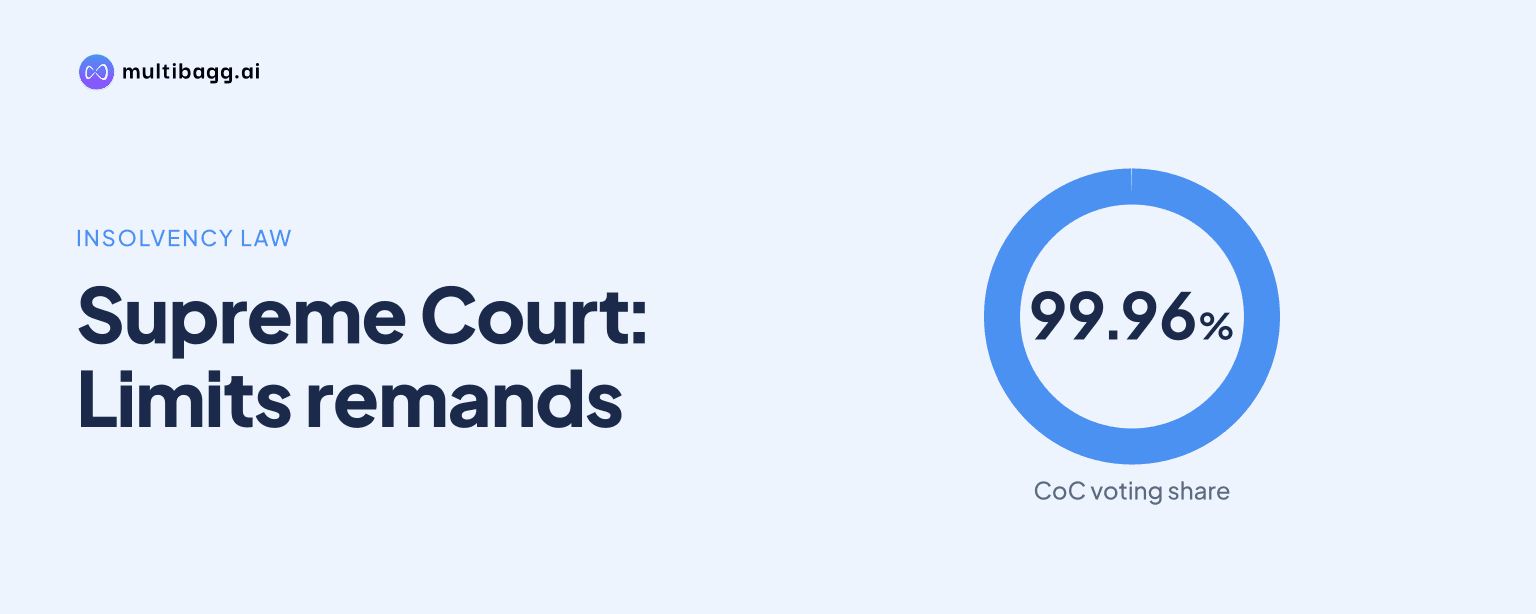
Supreme Court held on November 16, 2026 that the National Company Law Appellate Tribunal, or NCLAT, may remand an approved insolvency resolution plan only after finding legal non-compliance, and that every remand must enforce the timelines under the Insolvency and Bankruptcy Code, 2016, and its regulations.
Know Value Industries inside out
Results, valuation, peers and who's buying, in one view.
When can NCLAT remand an approved resolution plan?
Supreme Court said NCLAT may remand a non-compliant resolution plan to the committee of creditors, or CoC, when doing so furthers the objectives of the Insolvency and Bankruptcy Code, 2016. The Court said remand is not justified merely because the appellate body has the power to make such an order.
The judgment identified three Code objectives that must guide the exercise: keeping the corporate debtor as a going concern, ensuring fair and reasonable recovery for all creditor classes, and maximising the corporate debtor’s asset value during the corporate insolvency resolution process, or CIRP. The Court described liquidation as a last resort within the statutory framework.
Supreme Court explained that an appeal against approval of a plan is confined to the grounds in Section 61(3). NCLAT may dismiss or allow that appeal, but setting aside approval after the CIRP period has run its course would ordinarily push the corporate debtor towards liquidation, making remand relevant where a legally defective plan can be reconsidered.
What legal finding must support an NCLAT remand?
Supreme Court said a remand must rest on a finding of legal non-compliance under Section 30(2) or another law within the meaning of Section 61(3)(i). This requirement follows from the limited statutory grounds available for an appeal against an approved resolution plan.
The Court drew a boundary between legal oversight and commercial decision-making under the CIRP. NCLAT may assess whether the approval process meets the legal requirements of the Code, but it cannot use remand to reopen a plan because another commercial outcome might be preferred.
Supreme Court also identified a corrective use for remand under Section 31. Where the National Company Law Tribunal, or NCLT, encounters a curable defect in a resolution plan but modifies the plan itself rather than returning it to the CoC, NCLAT may remand the matter to restore the statutory allocation of roles.
Why must NCLAT use remands sparingly and on time?
Supreme Court said NCLAT must exercise remand sparingly and with circumspection because the mechanism carries costs in a CIRP. The judgment identified prolonged litigation, reduced certainty, additional financial burden for parties and depletion of asset value as consequences that can undermine the Code’s time-bound design.
Every remand order must therefore contain a strict direction to follow the timelines prescribed by the Code and relevant regulations. Supreme Court did not set a new numerical deadline in its November 16, 2026 judgment, but required NCLAT to ensure that its corrective order does not become a new source of delay.
The Court further held that NCLAT must not use remand in a manner that departs from an express procedure under the Code. This limitation applies alongside the restrictions previously laid down by Supreme Court on the use of inherent and implied powers to do justice.
Got a follow-up? Ask IRIS
How does the judgment divide powers among CIRP participants?
Supreme Court said the resolution professional, CoC, NCLT and NCLAT perform different functions during a CIRP under Sections 31, 61 and 62 of the Code. The resolution professional commences, conducts and concludes the process, while the CoC makes commercial decisions, NCLT reviews compliance at approval, and NCLAT corrects errors in that compliance review.
The Court said these functions are not watertight compartments, because all four participants operate within the same insolvency framework. However, if a defect requires a modification to the commerciality of a plan, neither NCLT nor NCLAT may make that modification because the CoC alone can reconsider the plan on its commercial merits.
On that basis, Supreme Court described remand as a link between legal review and creditor decision-making. NCLAT can identify a legal defect and return the matter to the CoC, which can reconsider the plan, after which NCLT can again examine compliance under Section 31 without the appellate or adjudicating forum rewriting commercial terms.
What did Supreme Court decide in the appeals?
Supreme Court dismissed Civil Appeal Nos. 894, 512 and 509 of 2022 in Part A of its November 16, 2026 judgment, with no order as to costs. The Court also found no ground to interfere with the CIRP of VOVL, including a transaction approved by 99.96% of the CoC’s voting share that had already been concluded.
In Part B, Supreme Court dismissed Civil Appeal No. 1307 of 2022, Civil Appeal Nos. 8659-8661 of 2026 and 8718-8719 of 2026, as well as two diary-numbered appeals. The pending interlocutory applications in those matters were disposed of, and the Court made no order as to costs.
Supreme Court separately disposed of an intervention application by GAIL (India) Ltd. and said its claim would be dealt with by the resolution professional in accordance with the Code and CIRP Regulations. The Court directed NCLAT to decide Company Appeal (AT)(Ins.) No. 908 of 2025 in light of the judgment, while leaving GAIL’s contentions open.
Conclusion
The November 16, 2026 ruling makes remand of an approved resolution plan a limited remedy for established legal non-compliance rather than a general route to revisit creditor decisions. Supreme Court preserved NCLAT’s ability to prevent an otherwise curable defect from leading directly to liquidation, while maintaining the CoC’s role over commercial reconsideration and the Code’s emphasis on time-bound value maximisation.
The next disclosed proceeding is Company Appeal (AT)(Ins.) No. 908 of 2025, which Supreme Court directed NCLAT to decide in light of this judgment. Future remand orders will turn on whether a Section 30(2) or Section 61(3)(i) defect is identified and whether NCLAT attaches strict compliance with the Code’s and regulations’ existing timelines.