










Videocon plan remittal upheld over deferred creditor payouts
Key highlights
- Videocon’s plan offered Rs 200 crore upfront to financial creditors as a class and Rs 2,700 crore of NCDs.
- The NCDs carried a 6.65 per cent coupon and were redeemable from 25 months after closing through the sixth year.
- The ruling recorded a liquidation value of Rs 2,568.13 crore.
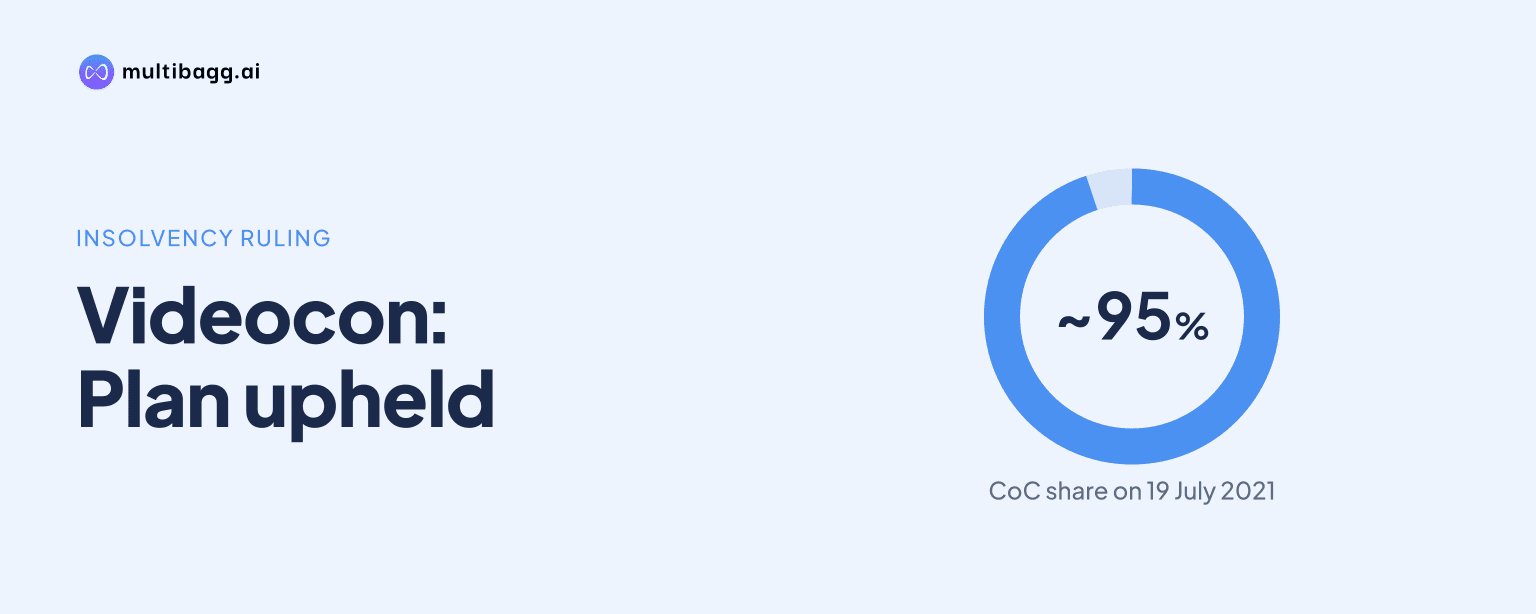
- Videocon’s CoC sought remittance for reconsideration with an approximately 95 per cent majority after the 19 July 2021 stay.
powered by IRIS
Videocon Industries Limited’s resolution plan was rightly remitted to the Committee of Creditors after the Court found that Rs 2,700 crore of non-convertible debentures, redeemable through the sixth year, did not provide dissenting financial creditors the required cash payment and priority. The plan also provided Rs 200 crore upfront to financial creditors as a class.
Know Value Industries inside out
Results, valuation, peers and who's buying, in one view.
Why was Videocon’s resolution plan non-compliant?
Videocon’s resolution plan was non-compliant because it did not expressly provide dissenting financial creditors payment in money as required under Section 30(2)(b) of the Insolvency and Bankruptcy Code. The plan offered financial creditors as a class Rs 200 crore upfront and non-convertible debentures, or NCDs, with a face value of Rs 2,700 crore. The NCDs carried a coupon of 6.65 per cent and were redeemable in instalments beginning 25 months after the closing date and extending to the sixth year.
The Court held that a dissenting financial creditor choosing to leave the corporate debtor cannot be compelled to remain attached through securities or an equivalent non-cash instrument. It found that the plan did not separate dissenting creditors through an express money-payment provision, despite recording a liquidation value of Rs 2,568.13 crore. A payment structure based substantially on six-year NCD redemptions was therefore not “payment” within Section 30(2)(b).
Did Videocon protect dissenting creditors’ payment priority?
Videocon did not secure the priority required for financial creditors that voted against the plan. Regulation 38(1)(b) of the Corporate Insolvency Resolution Process, or CIRP, Regulations requires dissenting financial creditors to be paid in priority over those that voted for the plan. The Court found that the plan did not provide that protection in an enforceable payment structure.
Bank of Maharashtra had argued that the claimed priority was effectively redemption one day before assenting financial creditors. The Court considered this inadequate because both groups remained in the same NCD structure, with instalments continuing until the sixth year. Clause 3.5.7, which said dissenting creditors would be paid under Section 30(2)(b), could not substitute for specific terms setting out the form, timing and method of their payment.
The Court distinguished a general undertaking to comply from compliance contained in the plan itself. Since Videocon’s plan breached both Section 30(2)(b) and Regulation 38(1)(b), it also contravened provisions of law for the purpose of an appeal under Section 61(3) of the Code. The finding concerned the treatment of dissenting lenders, rather than the Rs 200 crore upfront payment available to financial creditors as a class.
Could the NCLT change Videocon’s payment structure itself?
The National Company Law Tribunal, or NCLT, could not cure Videocon’s defective payment structure by changing its terms itself. In its 8 June 2021 order, the NCLT directed that dissenting financial creditors receive their liquidation value in cash, upfront and before any payment to assenting creditors. However, the Rs 200 crore upfront amount was earmarked for financial creditors as a class, so that direction changed both the payment structure and the distribution between creditor groups.
The Court held that the resolution plan could be altered only by the Committee of Creditors, or CoC, through the voting threshold under Section 30(4). The NCLT could identify a statutory defect but could not replace the plan’s debenture-based distribution with its own cash-disbursement structure. The appropriate response was remittance to the CoC for a fresh exercise of its commercial decision-making.
The Insolvency and Bankruptcy Code (Amendment) Act, 2026, identified in the ruling as Act 6 of 2026, inserted a proviso to Section 31(2). It permits the Adjudicating Authority to notify the CoC to rectify defects before rejecting a plan. The Court said its conclusion rested on the law as it stood in this case, while the amendment confirmed the policy of returning a defective plan to the CoC rather than judicially modifying it.
Got a follow-up? Ask IRIS
Why can Videocon’s CoC revisit its earlier approval?
Videocon’s CoC can revisit its approval because the plan did not attain finality during the statutory appeal process. The approval was challenged within a little over a month, and the National Company Law Appellate Tribunal, or NCLAT, on 19 July 2021 stayed the approval and directed maintenance of status quo ante. That order restored the position before approval while the appeals continued.
After the interim order, the CoC sought remittance for reconsideration with an approximately 95 per cent majority. The Court held that the CoC’s authority came from its continuing statutory role, not only from the NCLAT’s stay. Under the CIRP Regulations, the CoC continues until a plan is implemented or a liquidation order is passed, and a plan approved under Section 31 is not final until appeals under Sections 61 and 62 are decided.
The Court also rejected the argument that the CoC had become functus officio after its initial approval. It distinguished cases in which a resolution applicant tried to withdraw from an approved plan, because this case involved a plan found to contravene Section 30(2)(b) and whose approval had been set aside in appeal. The CoC could therefore reconsider the commercial path available after remittance.
Did Videocon obtain the required competition approval?
Videocon had obtained Competition Commission of India, or CCI, approval before the CoC’s voting concluded on 11 December 2020. The successful resolution applicant placed on record a CCI communication dated 8 December 2020. The Court therefore held that the prior-approval requirement in the proviso to Section 31(4) had been met.
This finding separated the competition question from the creditor-payment defect. Although the NCLAT had recorded that prior CCI approval had not been obtained, the 8 December 2020 communication showed that approval preceded the end of voting three days later. The plan remained non-compliant because it did not provide dissenting financial creditors money payment and priority under Section 30(2)(b) and Regulation 38(1)(b).
Conclusion
The ruling means that a CoC’s commercial decision cannot preserve a plan that substitutes six-year NCD payouts for the statutory money-payment protection available to dissenting financial creditors. Videocon’s Rs 200 crore upfront amount was available to financial creditors as a class, while its Rs 2,700 crore NCDs began redemption only after 25 months. The Court therefore upheld remittance instead of allowing the NCLT to rewrite the plan.
The next matter to watch is the CoC’s choice after remittance. The Court said it could not direct the CoC to consider only a modified existing plan or require it to invite fresh plans. Any revised approach must specify how, when and in what form dissenting financial creditors will be paid, consistent with the rectification route reflected in the 2026 Section 31(2) proviso.