










Suraksha network pairs 19 hubs with 227 collection points
Key highlights
- Suraksha’s FY27 timeline reports 77+ centres, up from 68 in FY26 and 53 in FY25.
- Suraksha’s network included 19 hub centres and 227 sample collection centres as of 30 September 2026.
- Suraksha operated one central laboratory and seven satellite laboratories co-located with hub centres.
- West Bengal generated 95.5% of Suraksha’s FY26 revenue from operations and contained 73 centres.
powered by IRIS
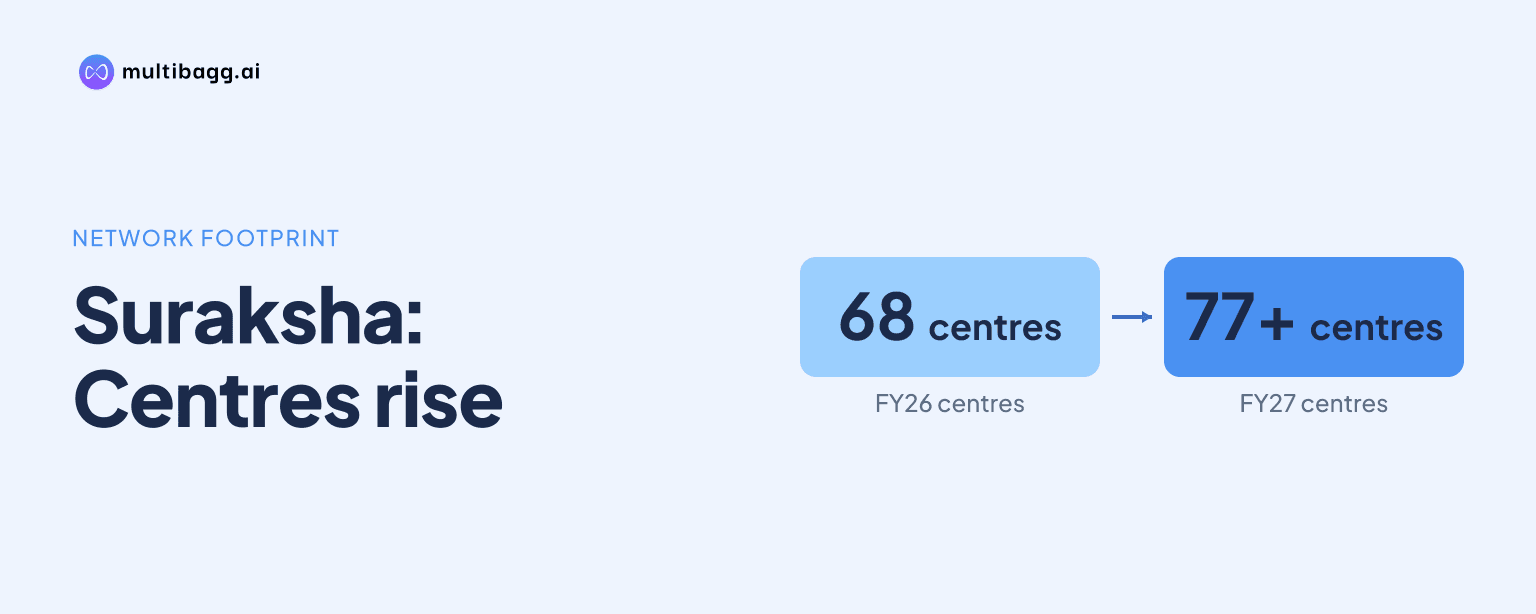
Suraksha Diagnostic Limited’s FY27 presentation says its network has reached 77+ centres and, as of 30 September 2026, shows 19 hub centres linked to 227 sample collection centres, one central laboratory and seven satellite laboratories. This configuration centralises laboratory and radiology capacity while extending patient access through spokes, particularly in West Bengal.
Know Suraksha Diagnostic inside out
Results, valuation, peers and who's buying, in one view.
How is Suraksha’s hub-and-spoke network structured?
Suraksha structures its network around one central laboratory, seven satellite laboratories co-located with hub centres, 19 hubs and 227 sample collection centres as of 30 September 2026. The operational-network slide also lists 12 medium spoke centres, 40 small spoke centres and six public-private partnership, or PPP, locations. On that presentation of the network, the 19 hubs, 12 medium spokes, 40 small spokes and six PPP locations add to 77 centres.
Suraksha’s slides use two ways to describe the spoke estate. The 30 September 2026 operating-network diagram lists 12 medium, 40 small and six PPP locations, while the patient-flow chart lists 52 spoke centres alongside 19 hubs and 227 collection centres. The presentation does not explain whether the six PPP locations are included in or separate from the 52 spokes, although its FY27 timeline states “77+ centres.”
Where is Suraksha’s network concentrated?
Suraksha is concentrated in West Bengal, where it reports 73 centres and where 95.5% of FY26 revenue from operations was generated. The company describes West Bengal as India’s fourth-most populous state and characterises its diagnostic-centre market as fragmented, with low penetration of chained diagnostic centres. This concentration means the network’s scale is principally tied to one state rather than evenly distributed across India.
Within West Bengal, the disclosed centre map shows the largest counts in North 24 Parganas, with 26 centres, and Kolkata, with 19. Hooghly has eight centres, Birbhum has five, and Purba Bardhaman and South 24 Parganas have four each. The map also identifies two centres in Darjeeling and one each in Jalpaiguri, Cooch Behar, Murshidabad, Paschim Medinipur and East Medinipur, showing that the footprint extends beyond the Kolkata cluster.
Suraksha’s network expanded from 53 centres and nine laboratories in FY25 to 68 centres in FY26, followed by 77+ centres in FY27 on its corporate timeline. The FY26 increase occurred alongside the acquisition of a 63% stake in Fetomat Wellness Private Limited and the launch of Suraksha Genomics. The presentation does not assign individual new centres to the acquisition, so the centre-growth figures should not be read as an acquisition-only measure.
Got a follow-up? Ask IRIS
What can Suraksha’s hubs and spokes offer patients?
Suraksha’s 19 hub centres are designed to conduct pathology sample collection and both basic and advanced radiology tests, whereas spoke centres offer pathology, basic radiology and intermediate radiology. This distinction places higher-complexity diagnostic capability at hubs while retaining routine patient-facing access at smaller locations. The collection-centre network is equipped for pathology sample collection and certain basic and intermediate radiology tests.
Large hub centres provide magnetic resonance imaging, or MRI, gastroenterology, dual-energy X-ray absorptiometry, mammography, computed tomography, or CT, neurology, ultrasonography, or USG, X-ray, cardiology and pathology. They employ 30 to 40 doctors and employees per centre and occupy 5,000 to 8,000 square feet. Medium hub centres offer CT, neurology, USG, X-ray, cardiology and pathology, with 20 to 25 doctors and employees across 2,500 to 5,000 square feet.
Small spoke centres offer USG, X-ray, cardiology and pathology in 1,500 to 3,500 square feet, with 12 to 15 doctors and employees per centre. This is a narrower modality set than a large hub, which includes MRI and gastroenterology. The operating model therefore separates the broadest imaging and specialist capacity from smaller sites designed around more limited diagnostic services.
How does Suraksha route samples and reports across its network?
Suraksha routes customers and samples through hub centres, 52 spoke centres, 227 collection centres and home collection, with the patient-flow chart also identifying one flagship reference laboratory and seven satellite laboratories. The chart depicts patient and sample flows connecting doctors, polyclinic doctors and hospitals with the network. The company says this arrangement is intended to enhance brand penetration, serve more customers and unlock economies of scale.
For reporting, Suraksha uses a Laboratory Information Management System, or LIMS, to process samples and deliver reports through barcoded labels and bi-directional analyser integration. Its Radiology Information System, or RIS, and Picture Archiving and Communication System, or PACS, connect imaging workflow with registration and dispatch. PACS includes Digital Imaging and Communications in Medicine, or DICOM, viewers with maximum-intensity projection, multi-planar reconstruction and three-dimensional tools for image analysis across locations.
Suraksha also states that its enterprise resource planning system handles billing, inventory, procurement and equipment use across diagnostic centres. It says automation reduces errors and improves turnaround-time tracking, but the presentation provides no numerical turnaround-time metric or error-rate comparison. Patient-access services include home collection, online bookings, report access, SMS alerts and polyclinic chambers that host outpatient doctors.
Conclusion
Suraksha’s disclosed operating model combines central diagnostic infrastructure with a dispersed access network: one central laboratory, seven satellite laboratories, 19 hubs, spoke locations and 227 sample collection centres. The model distinguishes advanced radiology at hubs from narrower spoke offerings, while its geographic concentration is clear in the 73 West Bengal centres and the state’s 95.5% share of FY26 revenue from operations.
The next item to watch is how Suraksha reports its FY27 centre count and reconciles the 52-spoke figure with the separate six PPP locations shown in the 30 September 2026 network diagram. Its corporate timeline reports 77+ centres in FY27, so subsequent disclosures can show whether additions broaden coverage beyond the 73 centres already reported in West Bengal.