








Systango sets 12-16 week GenAI path from use case to production
Max Plan at ₹4,999/yr₹8,999

Find your next multibaggerBe a Pro Investor
Research stocks and track your picks on the go. Download the app.
Key highlights
- Systango states a 12-16 week GenAI Studio schedule from use-case selection to production rollout.
- GenAI Studio has 4 stages: Intake & Prioritise, Prototype Sprint, Review & Enable, and Embed & Scale.
- Systango assigns Product, AI and ML, Engineering and DevOps to one integrated delivery pod.
- Systango lists 6 AI solution categories, including intelligent document processing and custom AI agents.
powered by IRIS
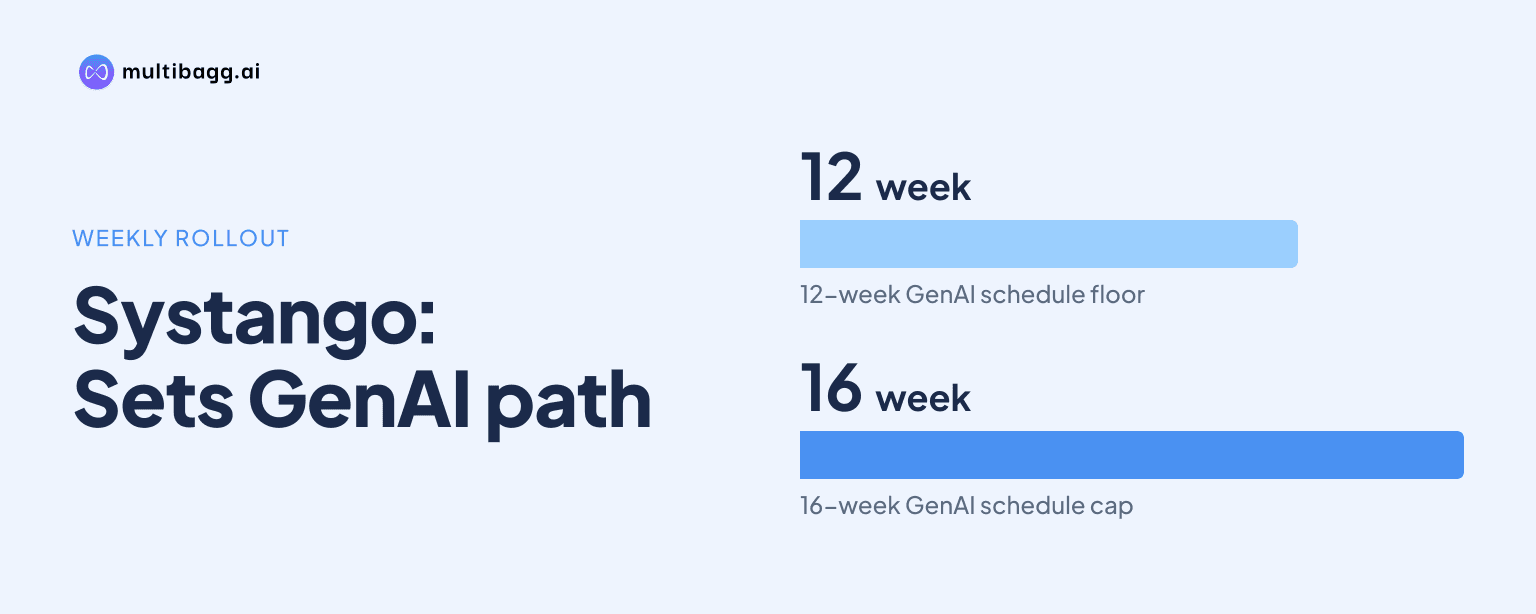
Systango says its GenAI Studio can take a selected artificial intelligence, or AI, use case from prioritisation through prototype, review and production rollout on a 12-16 week schedule. The model uses pre-built agents and components, one cross-functional delivery pod, security checks, governance controls and deployment on a customer’s existing cloud, models and tools.
Know Systango Technologies inside out
Results, valuation, peers and who's buying, in one view.
What is Systango’s GenAI Studio delivery model?
Systango’s GenAI Studio is a four-stage development model that starts with selecting a viable AI use case and ends with solution rollout, monitoring, training and support. The four stages are Intake & Prioritise, Prototype Sprint, Review & Enable, and Embed & Scale. Systango presents the model as a way to improve workflow efficiency and pilot ideas quickly while maintaining security and governance standards.
Intake & Prioritise aligns customer goals, assesses maturity and constraints, and identifies the first viable use case. Prototype Sprint then requires a dedicated pod to create a working prototype, a clickable experience and a test plan on the customer’s technology stack. The stated 12-16 week schedule is therefore attached to an initial prioritised use case, rather than to an unspecified enterprise-wide AI programme.
Review & Enable assesses prototype outcomes against baseline metrics, conducts security checks and creates a production plan. Embed & Scale covers rollout, monitoring enablement, training and support. By separating prototype creation from review and deployment, Systango describes production rollout as a later decision point rather than an automatic result of a working prototype.
How does Systango target a 12-16 week rollout?
Systango attributes its 12-16 week schedule to a single integrated pod spanning Product, AI and machine learning, or ML, Engineering and DevOps. The presentation says this cross-functional structure ensures zero handoffs. It contrasts the proposed pace with solutions delivered in weeks rather than quarters, while giving 12-16 weeks as its stated schedule.
Prototype Sprint is central to the delivery process because its specified outputs are a working prototype, clickable experience and test plan. Systango does not allocate a number of weeks to intake, prototyping, review or rollout separately. The schedule should consequently be read as the company’s overall stated timeframe for the four-stage process, not as a stage-by-stage timetable or a customer-specific guarantee.
Stack alignment is the other stated timing mechanism. Systango says the Studio is built on the customer’s cloud, models and tools, with the aim of supporting faster approvals and seamless integration. This approach is designed to fit the selected use case into the customer’s existing technology environment during the prototype and production-planning stages.
Got a follow-up? Ask IRIS
What governance controls does Systango include before launch?
Systango says GenAI Studio incorporates access controls, audit logs and clear go or no-go processes before launch. These governance-by-design features accompany Review & Enable, in which the company says outcomes are measured against baseline metrics and security checks are completed before a production plan is prepared.
The presentation identifies access controls and audit logs as its specific control mechanisms, while the go or no-go process establishes a formal pre-launch decision. It does not name a compliance framework, a security certification or a quantitative security result for GenAI Studio. Systango’s stated proposition is that security and governance standards are maintained while pre-built agents and components are used to speed up AI pilots.
Baseline metrics provide the comparison point for the Review & Enable stage, and the test plan is created earlier during Prototype Sprint. Systango does not disclose which measures would apply to every engagement, the baseline values used or the threshold for approval to production. Its disclosed process links testing, metric review and security checks to the later production-plan decision.
Which Systango services and products support the AI strategy?
Systango places GenAI Studio within five technology service verticals: Generative AI & Machine Learning, Data Engineering, Cloud, Blockchain & Web3, and App Development. The mix is relevant to the Studio’s customer-stack model because AI and ML work is presented alongside cloud, data and engineering capabilities. The presentation does not disclose revenue, customer numbers or contract values for GenAI Studio or any of the five verticals.
The company lists six AI-powered product and solution categories: crypto options trading platforms, Generative Business Intelligence, Skill Up learning management, intelligent document processing, custom AI agents and a wealth management platform. These categories cover FinTech, data analytics, learning and document workflows. Systango presents them as examples of customised industry use cases, not as a quantified list of GenAI Studio deployments.
Custom AI agents are described as using large language models, or LLMs, including GPT, Gemini and Llama, and integrating with existing systems to automate workflows. Intelligent document processing combines AI, natural language processing, optical character recognition and Generative AI to extract information from documents. Both product descriptions are consistent with the Studio’s stated emphasis on integrating with customer tools and systems.
Generative Business Intelligence is described as unifying diverse data sources and using predictive AI to identify patterns and support self-service analytics. Skill Up is a white-label learning management platform designed to deliver, track and optimise training under an organisation’s brand. Systango does not provide deployment dates, adoption levels, return-on-investment figures or client-specific performance data for these products.
Conclusion
Systango’s GenAI Studio sets out a defined 12-16 week route from selecting one viable use case to production rollout. Its delivery proposition combines four stages, a pod covering Product, AI and ML, Engineering and DevOps, plus stack alignment, baseline-metric review, security checks, access controls and audit logs. The six listed AI solution categories indicate that Systango is presenting the model across trading, analytics, learning, document processing, AI agents and wealth management.
What to watch next is evidence from the Review & Enable and Embed & Scale stages, particularly the baseline metrics used, security-check outcomes, production rollouts and monitoring results. Systango identifies production planning, training and long-term support as components of the model, but the presentation does not disclose client deployment dates, measured results or the number of completed GenAI Studio engagements.

