








VIESL adds road delivery to its equipment service model
Max Plan at ₹4,999/yr₹8,999

Find your next multibaggerBe a Pro Investor
Research stocks and track your picks on the go. Download the app.
Key highlights
- VIESL reported Rs 391 crore in H1FY27 revenue from operations, up 39% year on year.
- VIESL’s H1FY27 fleet comprised 571 equipment units.
- VIESL reported H1FY27 EBITDA of Rs 102 crore and PAT of Rs 43.50 crore.
- VIESL management expects more than 30% year-on-year revenue growth from its dual-engine model.
powered by IRIS
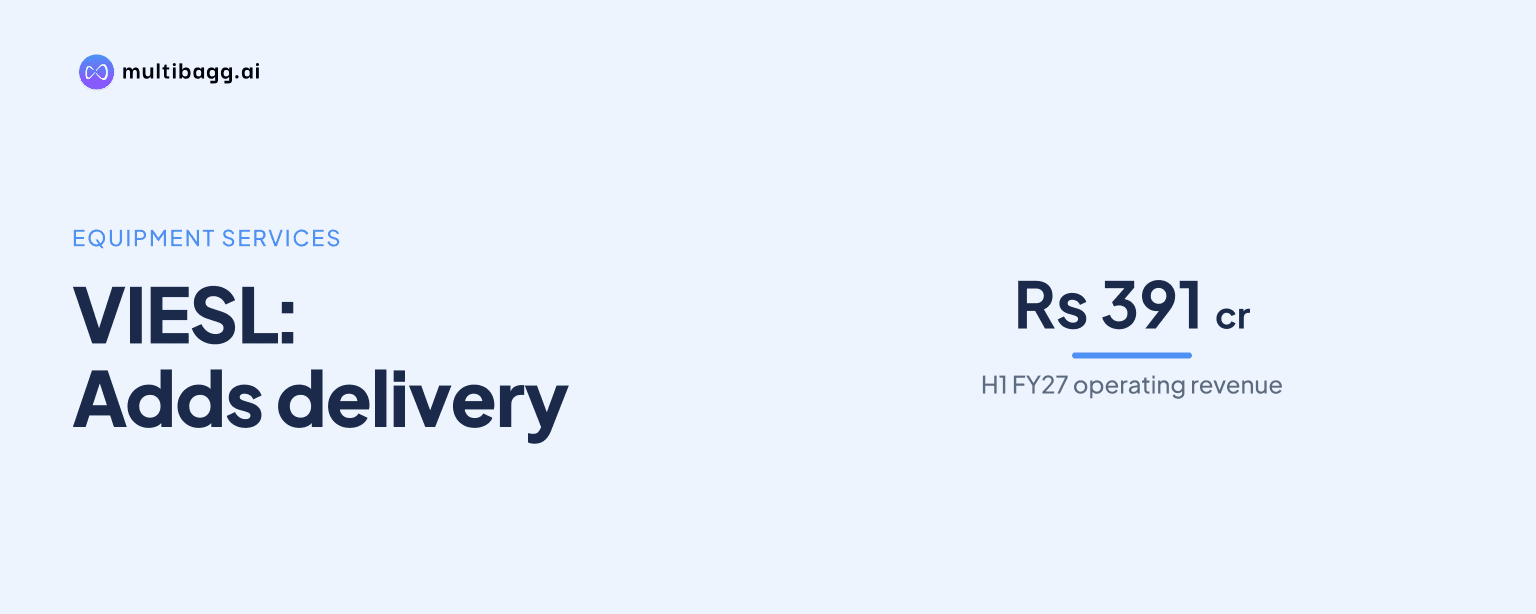
Vision Infra Equipment Solutions Limited is extending its equipment-service model into asphalt and concrete road delivery, combining deployment, materials plants, transport and laying; it reported Rs 391 crore of revenue from operations in H1FY27, with a fleet of 571 equipment units and 39% year-on-year revenue growth.
Know Vision Infra Equipment Solutions inside out
Results, valuation, peers and who's buying, in one view.
How does VIESL’s dual-engine model work?
VIESL operates a dual-engine model that combines Equipment-as-a-Service with refurbishment and resale. Its service business has two charging structures: time-based deployment, under which clients pay for equipment-use duration, and output-linked deployment, under which fees are tied to project output. The company says the first model supports recurring cash flow and equipment utilisation, while the second allows revenue to scale with project performance.
The second engine extends and monetises equipment life through refurbishment and resale. VIESL says it refurbishes machinery to extend its lifecycle and maintain performance, and sources equipment through channel-partner relationships. This activity serves pan-India and overseas markets, adding a resale route alongside equipment deployment during the asset’s operating life.
VIESL’s management expects revenue growth of more than 30% year on year from this dual-engine model. That expectation is a management outlook rather than a reported result, and the presentation does not provide a revenue split between deployment, refurbishment and resale for H1FY27.
What equipment services does VIESL provide?
VIESL provides specialised equipment services in mobile crushing, milling, asphalt paving, pavement-quality concrete, or PQC, paving, and soil stabilisation. Its H1FY27 fleet comprised 571 equipment units, while the presentation identifies specialised assets, skilled workforce and a pan-India network as the components used to serve infrastructure, industrial and government projects.
VIESL’s output-linked scope includes equipment, manpower and operational support from delivery and setup through maintenance during the service period. Its milling work covers rehabilitation, bitumen overlay, micro milling and related work; piling-rig services are aimed at deep-foundation projects, including metro and city-elevated construction. Crushing operations range from single-stage to four-stage activities using mobile and stationary units.
The company also identifies micro surfacing and soil stabilisation as road-maintenance and road-construction activities. Micro surfacing uses polymer-modified bitumen emulsion and fine aggregates in a thin overlay to restore skid resistance and seal cracks. Soil stabilisation blends cement or lime into in-situ soil to strengthen sub-grade and sub-base; VIESL describes its soil-stabiliser fleet as one of India’s largest and as having the country’s highest capacity in that category.
How is VIESL moving into end-to-end road delivery?
VIESL is moving into end-to-end road delivery by joining equipment activities with material production, transport and laying. Its asphalt-road workflow has four stages: milling, transportation, asphalt batch-mix plant operations and laying. Its concrete-road workflow also has four stages: concrete plant operations, production, transportation and laying.
The 2025 additions mark a change from VIESL’s earlier equipment-rental focus. Its timeline says road-construction equipment rental was added in 2013, followed by milling, crushing and over-measuring services in 2016. In 2025, it added asphalt batching plants, concrete batching plants, end-to-end paving and laying solutions, and piling rigs.
These additions broaden the stated scope from supplying individual machines to delivering linked road-construction processes. A client can use time-based deployment for a defined equipment period or use output-linked services involving equipment, people, setup, maintenance and operational assistance. VIESL says the asphalt and concrete services are intended to diversify revenue streams and deepen client relationships, but it does not disclose separate revenue or order-book figures for these services.
Got a follow-up? Ask IRIS
What do VIESL’s latest reported financial indicators show?
VIESL reported H1FY27 revenue from operations of Rs 391 crore, earnings before interest, tax, depreciation and amortisation, or EBITDA, of Rs 102 crore, and profit after tax, or PAT, of Rs 43.50 crore. It reported a 26% EBITDA margin and 39% year-on-year revenue growth in the half year, alongside its 571-unit fleet.
The presentation’s milestone timeline records highest-ever revenue of Rs 622 crore in 2026, while separately reporting a debt-to-equity ratio of 1.36 times for FY26. Because it does not state a like-for-like H1FY26 revenue figure, the disclosed 39% H1FY27 growth rate cannot be converted into a prior-period rupee amount using the supplied material.
The comparison shows that H1FY27 supplies the latest operating, profitability and fleet indicators, whereas the FY26 or 2026 disclosures provide a full-year revenue milestone and balance-sheet ratio. The presentation does not state whether the 2025 road-delivery additions contributed to the Rs 391 crore H1FY27 revenue figure.
What demand backdrop does VIESL identify for road services?
VIESL identifies public infrastructure spending and road-project activity as demand drivers for equipment deployment, refurbishment and specialised execution. The presentation cites Union capital expenditure of Rs 12.20 lakh crore in FY27, compared with Rs 11.20 lakh crore in FY26, and a Ministry of Road Transport and Highways, or MoRTH, outlay of Rs 3.10 lakh crore for FY27, about 8% higher than FY26.
The presentation also cites a national-highway network of 1.46 lakh kilometres as of FY26. VIESL’s stated demand chain runs from higher public capital expenditure to more expressway, greenfield-corridor, bridge and maintenance projects, then to equipment utilisation by engineering, procurement and construction contractors and demand for specialised rental and refurbished equipment.
These market indicators describe the backdrop rather than VIESL’s contracted work. The presentation gives no customer concentration, utilisation rate, order-book amount or project pipeline for the 571-unit H1FY27 fleet, so the scale of demand captured by the new asphalt and concrete activities is not disclosed.
Conclusion
VIESL is broadening its business model from equipment deployment and asset-life extension into integrated road-delivery workflows. The H1FY27 result of Rs 391 crore in revenue, Rs 102 crore in EBITDA and 39% year-on-year revenue growth provides the latest financial context, while the 2025 addition of plants, paving and piling expands the services that can sit within an output-linked project scope.
The next item to watch is management’s stated expectation of more than 30% year-on-year revenue growth, and whether VIESL discloses separate revenue, utilisation or order-book data for asphalt batching, concrete batching and end-to-end laying. The presentation identifies the 2025 service additions and a 571-unit H1FY27 fleet, but leaves their individual financial contribution unresolved.

