










Talbros Automotive retains FY27 target as Q2 EBITDA rises 33%
Key highlights
- Talbros Automotive’s Q2 FY27 revenue increased 23% year on year to Rs 267 crore.
- Talbros Automotive’s Q2 FY27 EBITDA rose 33% to Rs 47 crore and its margin reached 17.6%.
- Talbros Automotive’s H1 FY27 PAT increased 39% year on year to Rs 63 crore.
- Talbros Automotive deployed Rs 41 crore of its planned Rs 103 crore FY27 capex by H1.
powered by IRIS
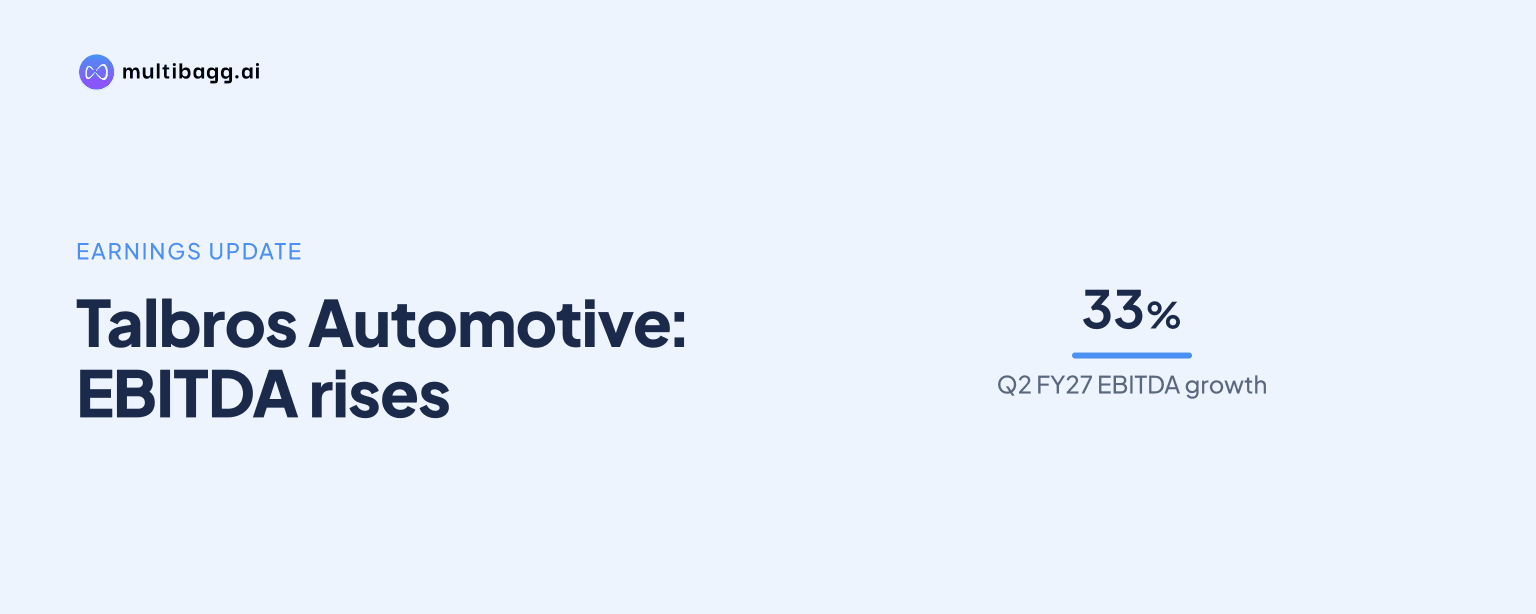
Talbros Automotive Components Limited retained its FY27 organic revenue-growth guidance of 18%-20% after Q2 FY27 EBITDA increased 33% year on year to Rs 47 crore, ahead of a 23% rise in revenue to Rs 267 crore. Management attributed the faster profit growth to operating leverage, product mix and cost management despite higher input and freight costs.
Know Talbros Automotive Components inside out
Results, valuation, peers and who's buying, in one view.
How did Talbros Automotive perform in Q2 and H1 FY27?
Talbros Automotive reported Q2 FY27 consolidated revenue of Rs 267 crore and EBITDA, or earnings before interest, tax, depreciation and amortisation, of Rs 47 crore, which management described as its strongest quarterly performance. Revenue rose from Rs 217 crore in Q2 FY26, while EBITDA increased from Rs 36 crore and the EBITDA margin expanded by 120 basis points to 17.6%.
For H1, or the first half, of FY27, Talbros Automotive recorded revenue of Rs 510 crore, up 19% from Rs 427 crore in H1 FY26. H1 EBITDA rose 28% to Rs 90 crore from Rs 70 crore, while profit after tax, or PAT, increased 39% to Rs 63 crore from Rs 45 crore, meaning both profit measures grew faster than sales over the six-month period.
Why did Talbros Automotive’s profit rise faster than revenue?
Talbros Automotive said Q2 EBITDA rose 33%, compared with 23% revenue growth, because of operating leverage, cost-management initiatives and a better product mix. Management said the 17.6% Q2 EBITDA margin also reflected operational improvements, although steel, aluminium, labour and freight costs increased during H1 FY27.
Management attributed part of the cost pressure to geopolitical tensions in West Asia and said it was pursuing customer price recoveries. It said around 40%-45% of increased costs in the Gasket business would be recovered in the quarter, with a further 30%-35% recovery expected in other areas, and expected to maintain the H1 EBITDA margin of 17.6% in the following six months or improve it.
The earnings trend differed between operating divisions. Gasket and Heat Shield Q2 sales increased 23% to Rs 176 crore and EBITDA rose 38%, whereas Forging revenue also grew 23% to Rs 92 crore but EBITDA increased 19% to Rs 15 crore. The comparison indicates that the reported group-level margin expansion was not matched evenly by each division.
Which Talbros Automotive businesses led first-half growth?
Talbros Automotive’s Gasket and Heat Shield division was its largest contributor in H1 FY27, reporting revenue of Rs 340 crore and EBITDA of Rs 63 crore. Revenue rose 22% from Rs 278 crore and EBITDA grew 35%, while the division accounted for 51% of revenue; management cited original equipment manufacturer, or OEM, demand, higher content per vehicle and premium and export platforms.
The Heat Shield business contributed about Rs 35 crore of H1 FY27 revenue within the division. Talbros Automotive said its lightweight aluminium heat shields provide noise reduction, emission control and thermal insulation for new-generation engines, including hybrid and electric vehicles, while its Gasket business was a single-source supplier for five key customers.
Forging generated H1 FY27 revenue of Rs 171 crore, up 13% from Rs 150 crore, while EBITDA increased 13% to Rs 29 crore from Rs 26 crore. Exports accounted for about 57% of Forging revenue, and management said Rs 500 crore of new forging orders included a significant portion from a newly onboarded major European global OEM.
Got a follow-up? Ask IRIS
How are Talbros Automotive’s joint ventures progressing?
Marelli Talbros Chassis Systems reported H1 FY27 revenue of Rs 226 crore, up 49% from Rs 152 crore, and EBITDA of Rs 36 crore, up 31% from Rs 28 crore. More than 90% of its revenue came from passenger vehicles, while electric-vehicle revenue rose 43% to Rs 33 crore from Rs 23 crore.
Management said Marelli Talbros Chassis Systems’ margin was temporarily affected by extra manpower and piece-by-piece checks during a production ramp-up. It expected sales to rise without a comparable increase in manpower cost after that initial phase, and said the Indian joint venture was not affected by Marelli’s U.S. court bankruptcy process.
Talbros Marugo Rubber Private Limited, the 50-50 venture with Marugo Japan, reported H1 FY27 revenue of Rs 86 crore, up 32% from Rs 65 crore. Its EBITDA rose 37% to Rs 10 crore, and management said about 90% of the venture’s revenue came from passenger vehicles.
What supports Talbros Automotive’s FY27 growth target?
Talbros Automotive retained its FY27 organic revenue-growth guidance of 18%-20%, with management identifying new-order commercialisation, rising export volumes, increased OEM share and added capacity as the supporting drivers. The company said it was moving from winning orders to executing them through timely delivery, capacity ramp-up and quality control.
Talbros Automotive invested Rs 41 crore in H1 FY27 against its planned full-year capital expenditure, or capex, of Rs 103 crore. The capex spans Gasket, Heat Shield and Forging operations and is intended to support orders from domestic and global OEMs, including electric-vehicle platforms.
Exports represented more than one-quarter of H1 FY27 revenue, while the Forging division supplies customers including JCB, DANA, Carraro, GKN Driveline, Musashi and JLR. Management said global inquiries remained strong despite geopolitical cost pressures, but did not quantify export revenue expected in the second half of FY27.
What did management say about FY28 growth?
Management forecast about 17% growth for the Gasket and Heat Shield division in FY27 and about 15%-16% in FY28. It said the division’s first four months of FY27 had been muted because of the goods and services tax impact in September, while the subsequent six months were better.
For Forging, management told an analyst that full-year FY27 growth should exceed 20%, after revenue growth of 10% in the first quarter and 23% in Q2. It said operational issues were largely resolved and new machinery was being installed, with the order book described by management as strong.
Management also said its data-centre-related business could generate Rs 50 crore to Rs 60 crore in the next financial year, depending on the order book. It identified Cummins, Kirloskar and TAFE as the three main customers, while saying product samples in the Lohum joint venture had been approved by Apollo Tyres and MRF.
Conclusion
Talbros Automotive’s Q2 FY27 results showed EBITDA and H1 PAT increasing faster than revenue, while the Q2 EBITDA margin rose to 17.6% despite higher material, labour and freight costs. Gasket and Heat Shield delivered the largest first-half revenue and EBITDA contribution, and both joint ventures reported revenue growth above the consolidated company’s 19% H1 increase.
The next measures are delivery against the Rs 103 crore FY27 capex plan, of which Rs 41 crore was deployed by H1, and conversion of new orders into revenue. Investors can also watch management’s stated 18%-20% FY27 organic growth target, customer price recoveries and the installation of new Forging capacity.