










Talbros’ Marelli JV Targets ₹120 Crore-Plus Stellantis Revenue
Key highlights
- Talbros’ Marelli JV reported H1 FY27 revenue of ₹226 crore, up 49% year on year.
- Talbros expects the Stellantis programme to exceed ₹120 crore of revenue in the next financial year.
- Marelli JV Q2 FY27 revenue rose 54% year on year to ₹122 crore.
- Talbros expects JLR programme revenue of ₹75 crore to ₹80 crore in the current year.
powered by IRIS
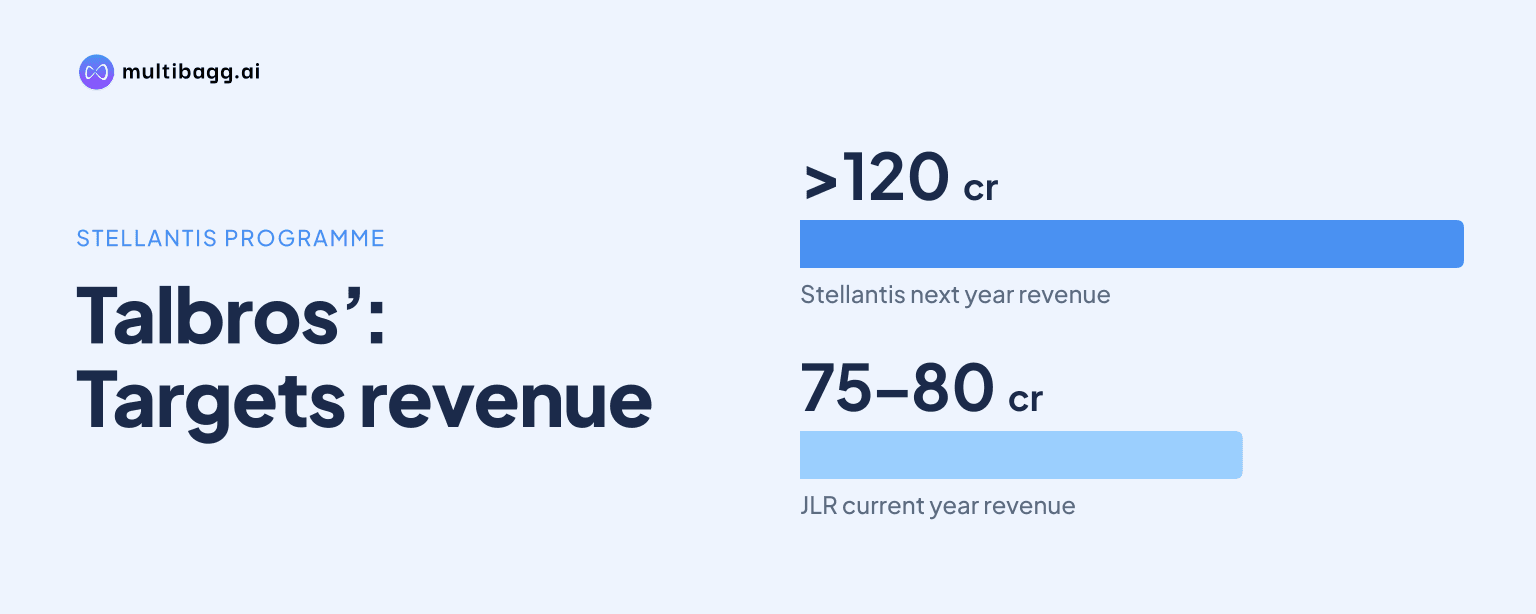
Talbros Automotive Components Limited expects Stellantis revenue at Marelli Talbros Chassis Systems, its joint venture (JV), to exceed ₹120 crore next financial year after ₹15.85 crore of sales from the end-June launch through September. The JV reported first-half fiscal year 2027 (H1 FY27) revenue of ₹226 crore, up 49% year on year.
Know Talbros Automotive Components inside out
Results, valuation, peers and who's buying, in one view.
How fast is Talbros’ Marelli JV growing?
Talbros’ Marelli JV is growing faster than Talbros’ consolidated business, with H1 FY27 revenue rising 49% year on year to ₹226 crore and earnings before interest, tax, depreciation and amortisation (EBITDA) increasing 31% to ₹36 crore. Talbros’ consolidated H1 FY27 revenue increased 19% to ₹510 crore, while EBITDA rose 28% to ₹90 crore.
The JV’s second-quarter fiscal year 2027 (Q2 FY27) revenue rose 54% year on year to ₹122 crore from ₹79 crore, while EBITDA increased 31% to ₹19 crore. Management attributed the quarterly profit improvement to higher volumes and improved operating efficiency, although additional manpower during programme ramp-ups limited the rate of EBITDA growth relative to revenue.
Passenger vehicles account for more than 90% of the Marelli JV’s revenue, according to Talbros. Electric-vehicle revenue within the JV rose to ₹33 crore in H1 FY27 from ₹23 crore a year earlier, a 43% increase that contributed to the division’s higher volumes.
What will Stellantis add to Talbros’ Marelli JV revenue?
Talbros expects the Stellantis programme to cross ₹120 crore of revenue in the next financial year, subject to the planned production ramp. The programme began at the end of June and generated about ₹15.85 crore of sales through September, when management said it was handling initial start-up issues.
For the next six months, management expects Stellantis sales of about ₹35 crore. The projected increase reflects the programme moving beyond its launch phase, rather than a disclosed forecast for industry-wide passenger-vehicle demand.
The timetable implies a larger contribution once the business operates for a full year, but Talbros did not disclose a programme-specific margin, vehicle volume, model list or contract value for Stellantis. The ₹120 crore-plus figure is therefore management’s revenue expectation, not reported sales or a formal company-wide guidance measure.
The Stellantis ramp is part of a broader Marelli order-execution cycle. Talbros said its major ₹500 crore Marelli order would begin contributing from January, the final quarter of FY27, and would be in full force in the next financial year.
Got a follow-up? Ask IRIS
Which programmes besides Stellantis support Talbros’ Marelli JV expansion?
Talbros identified Jaguar Land Rover (JLR) and a separate export programme as two other material revenue drivers for the Marelli JV. Management expects JLR revenue of ₹75 crore to ₹80 crore in the current year, compared with ₹47 crore to ₹48 crore last year, as one electric-vehicle model has started and two to three further models are due to begin within six months.
The export programme is expected to contribute ₹10 crore to ₹12 crore in FY27 and about ₹90 crore in the next financial year, according to management. An additional ₹20 crore of equipment was expected by the end of December or in January, following which production of flanges and starter boxes was due to expand from the existing 2,500-tonne capacity.
The three programmes are at different stages. Stellantis was in its launch period, JLR was adding electric-vehicle models, and the export business was awaiting equipment commissioning and further commercial supplies. Management said the export programme’s main capital expenditure was otherwise more or less in place.
The programme mix also helps explain why management expects export contribution to increase. Talbros said exports represented 26.5% of overall revenue in the quarter discussed and projected that share could exceed 35% by the final quarter of FY28, with JLR operating at full force and Stellantis rising.
Why did Talbros’ Marelli JV margins flatten during the ramp-up?
Talbros said the Marelli JV’s margin was temporarily affected by additional quality manpower deployed while production was scaled up. Management said staff were inspecting each piece during the initial stage to prevent defects, which raised manpower cost as the standard business was ramped.
Management said this quality-checking phase was over and expected revenue to rise in coming quarters without a similar increase in manpower cost. It characterised the margin impact as about 0.5 to 0.75 percentage point and said margins should recover as the added manpower requirement falls; this remains management’s expectation.
The reported earnings figures show the difference between revenue and EBITDA growth. In H1 FY27, revenue rose 49% to ₹226 crore while EBITDA rose 31% to ₹36 crore; in Q2 FY27, revenue increased 54% to ₹122 crore while EBITDA grew 31% to ₹19 crore. Those differences are consistent with management’s explanation of launch-related labour costs.
Talbros also said the Indian JV was not affected by the Marelli matter being handled in United States courts. Management described the situation as work in progress and said it would provide an update within one to one-and-a-half months, leaving the parent-company matter unresolved.
Conclusion
Talbros’ reported Marelli JV growth is being driven by named programme launches rather than a single broad auto-demand assumption. H1 FY27 revenue of ₹226 crore, up 49%, provides the current base, while management’s ₹120 crore-plus Stellantis expectation, ₹75 crore to ₹80 crore JLR outlook and roughly ₹90 crore export forecast point to a larger contribution next financial year if the production schedules proceed.
The next disclosed checkpoints are about ₹35 crore of Stellantis sales expected over the following six months, the arrival of ₹20 crore of export equipment by December-end or January, and the planned January contribution from the wider ₹500 crore Marelli order. Talbros also plans to update investors within one to one-and-a-half months on the Marelli parent matter and expects the temporary quality-manpower cost to reduce as ramps mature.