










Tankup Engineers Limited Reports 52.1% H1 FY27 Revenue Growth
Key highlights
- Tankup Engineers reported H1 FY27 revenue from operations of ₹33.0 crore, up 52.1% year on year.
- H1 FY27 net profit was ₹2.4 crore, up 20.0% from ₹2.0 crore in H1 FY26.
- Tankup Engineers reported an operating margin of 9.6% in H1 FY27, versus 11.3% a year earlier.
- Lalit Gupta resigned as internal auditor on 14 November 2026, and Avisha Sinha was appointed from 15 November 2026.
powered by IRIS
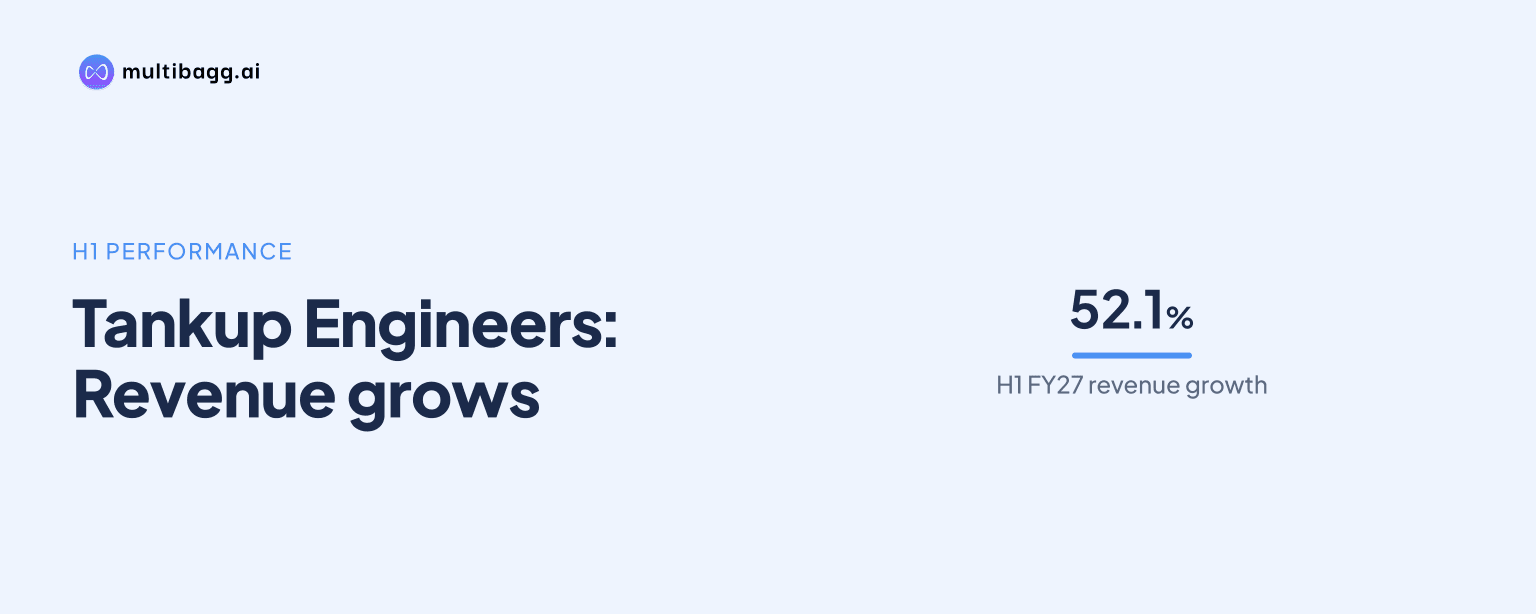
Tankup Engineers Limited reported H1 FY27 revenue from operations of ₹33.0 crore, up 52.1% year on year, and net profit of ₹2.4 crore, up 20.0%. The company also disclosed the resignation of internal auditor Lalit Gupta from 14 November 2026 and appointed Avisha Sinha from 15 November 2026.
Know Tankup Engineers inside out
Results, valuation, peers and who's buying, in one view.
What did Tankup Engineers report for H1 FY27?
Tankup Engineers reported revenue from operations of ₹33.0 crore for H1 FY27, compared with ₹21.7 crore in H1 FY26. Total income stood at ₹33.3 crore, against ₹22.2 crore a year earlier, with other income declining to ₹0.2 crore from ₹0.5 crore.
Net profit rose to ₹2.4 crore from ₹2.0 crore in H1 FY26. Profit before exceptional items and tax was ₹3.2 crore, compared with ₹2.5 crore in the previous corresponding half year. Profit before tax was also ₹3.2 crore. The reported operating margin was 9.6%, compared with 11.3% in H1 FY26.
The results were for the half year ended 30 September 2026. Tankup Engineers had earlier informed the exchange that its board would meet on 14 November 2026 to consider and approve unaudited half-yearly financial results, along with the auditor's limited review report.
Why did Tankup Engineers change its internal auditor?
Tankup Engineers disclosed that internal auditor Lalit Gupta resigned with effect from 14 November 2026. Avisha Sinha was appointed as the new internal auditor with effect from 15 November 2026.
The supplied disclosure does not state the reason for Gupta's resignation or provide further information on the appointment process. The auditor transition was disclosed alongside the board's approval of the half-year financial results. Investors therefore have confirmation of the effective dates, but no stated explanation for the change.
Internal audit appointments are part of a company's governance and control framework. In this case, the disclosed change took place immediately after the half-year reporting date and at the time of the board's consideration of the September 2026 financial results.
How do the H1 FY27 figures compare with earlier periods?
Tankup Engineers' H1 FY27 revenue was higher than both H1 FY26 revenue of ₹21.7 crore and the ₹35.6 crore reported in H2 FY26 on a half-year basis. The year-on-year increase in revenue from operations was 52.1%, while net profit increased 20.0% from the previous corresponding half year.
The comparison also shows that profit growth was lower than revenue growth, alongside a lower reported operating margin. Operating margin was 9.6% in H1 FY27, versus 11.3% in H1 FY26, though it was marginally above the 9.5% reported for H2 FY26. The figures indicate that revenue expanded substantially while the reported margin remained below the year-earlier level.
The longer half-yearly data set shows that sales increased from ₹11.45 crore in March 2024 to ₹35.60 crore in March 2026. Over the same dates, reported net profit increased from ₹1.52 crore to ₹2.74 crore. These historical figures provide context for the higher revenue base reported in the latest half year.
Got a follow-up? Ask IRIS
What are the implications for investors and company disclosures?
For investors, the key financial development is the 52.1% year-on-year increase in H1 FY27 revenue and the 20.0% increase in net profit. At the same time, the operating-margin comparison is relevant because the 9.6% reported in H1 FY27 was below the 11.3% reported in H1 FY26.
The source material does not provide a share-price movement, investor reaction, order-book update, customer impact, or operational guidance following the results. It also does not disclose any financial effect from the internal auditor transition. As a result, the available information supports assessment of the reported financial figures and governance change, but not conclusions about the market's immediate response.
Tankup Engineers had also stated that the trading window would remain closed from 1 October 2026 until 48 hours after the declaration of results for the half year ended 30 September 2026. The company submitted its financial results to the exchange on 14 November 2026, the same date as the board meeting referenced in its intimation.
What is the broader context for Tankup Engineers' latest results?
The H1 FY27 result follows a period of growth in the company's reported half-yearly sales. Sales were ₹21.66 crore in September 2025 and increased to ₹35.60 crore in March 2026, according to the historical half-yearly data. H1 FY27 revenue from operations of ₹33.0 crore remains materially above the September 2025 level.
Profitability has varied across these periods. Historical operating profit margin was 12.05% in September 2025 and 12.95% in March 2026, while the separately reported H1 FY27 operating margin was 9.6%. The current disclosure does not explain the factors behind the margin movement, so the figures should be read as reported rather than attributed to a particular cost or business driver.
Conclusion
Tankup Engineers delivered year-on-year growth in H1 FY27, with revenue from operations rising to ₹33.0 crore and net profit reaching ₹2.4 crore. The results also showed a lower reported operating margin than H1 FY26, while the company confirmed an internal auditor change effective 15 November 2026.
Investors can watch for subsequent exchange disclosures on financial performance, profitability trends and any additional information regarding the internal audit appointment. The available announcement identifies the appointment dates and the completed half-year results process, but does not disclose the reason for the auditor resignation or future operational targets.