










Tankup Engineers H1 profit rises 19% despite revenue dip
Key highlights
- Tankup Engineers reported standalone profit after tax of Rs 2.4226 crore for the half year ended 30 September 2026, up from Rs 2.0379 crore a year earlier.
- Standalone revenue from operations was Rs 33.0256 crore, below Rs 35.5988 crore in the half ended 31 March 2026.
- Standalone finance cost increased to Rs 1.7842 crore from Rs 1.3239 crore in the preceding half.
- Standalone trade receivables rose to Rs 48.2812 crore at 30 September 2026 from Rs 38.556 crore at 31 March 2026.
powered by IRIS
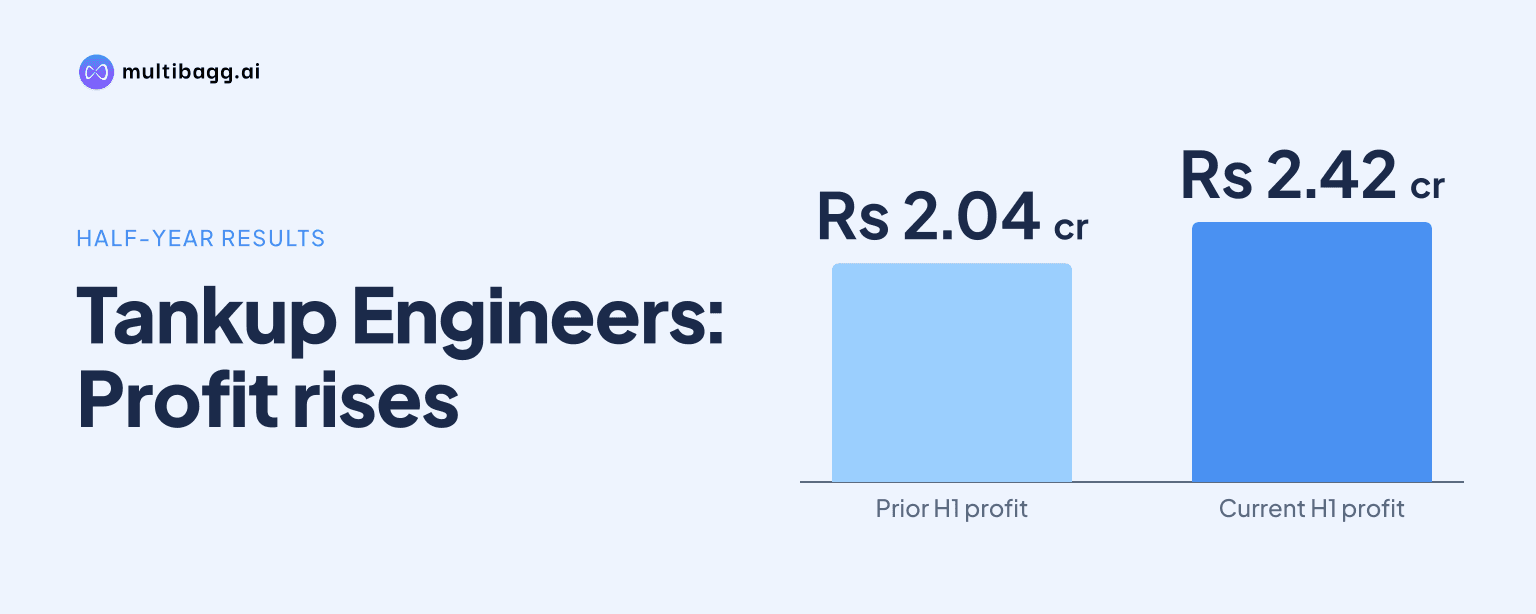
Tankup Engineers Limited reported standalone profit after tax of Rs 2.4226 crore for the half year ended 30 September 2026, up 19% from Rs 2.0379 crore a year earlier, although revenue from operations fell to Rs 33.0256 crore from Rs 35.5988 crore in the immediately preceding half. Finance cost rose and operating activities used cash during the period.
Know Tankup Engineers inside out
Results, valuation, peers and who's buying, in one view.
How did Tankup Engineers perform in the September 2026 half?
Tankup Engineers reported standalone revenue from operations of Rs 33.0256 crore for the half year ended 30 September 2026, up from Rs 21.655 crore in the half year ended 30 September 2025 but below Rs 35.5988 crore in the half year ended 31 March 2026. Revenue increased 53% year on year and declined 7% sequentially.
Total income was Rs 33.2707 crore, including other income of Rs 24.51 lakh, compared with Rs 22.1701 crore a year earlier and Rs 35.8419 crore in the preceding half. Profit before tax was Rs 3.235 crore, higher than Rs 2.4771 crore in the September 2025 half but lower than Rs 3.4053 crore in the March 2026 half.
Tankup Engineers’ tax expense was Rs 81.24 lakh for the September 2026 half, versus Rs 43.92 lakh in the year-earlier period and Rs 66.56 lakh in the preceding half. Basic and diluted earnings per share were Rs 4.58, compared with Rs 4.02 a year earlier and Rs 5.20 in the March 2026 half; the filing reported no exceptional or extraordinary items in the three half-year periods shown.
Why did Tankup Engineers’ profit decline from the preceding half?
Tankup Engineers’ sequential profit decline reflected a Rs 2.5732 crore decrease in revenue from operations, while total expenses decreased by Rs 2.4009 crore. The reduction in expenses therefore did not fully offset the Rs 2.5712 crore decline in total income between the March 2026 and September 2026 halves.
Cost of materials consumed fell to Rs 17.9166 crore from Rs 24.9092 crore, and other direct manufacturing expenses declined to Rs 2.1441 crore from Rs 4.3628 crore. However, the changes in inventories line was an expense of Rs 4.7691 crore in the September half, compared with a credit of Rs 2.2118 crore in the preceding half.
Finance cost increased to Rs 1.7842 crore from Rs 1.3239 crore sequentially and from Rs 55.52 lakh a year earlier. Employee benefit expense was Rs 2.2009 crore, close to Rs 2.1867 crore in the March half, while other expenses fell to Rs 1.1163 crore from Rs 1.745 crore and depreciation and amortisation declined to Rs 10.45 lakh from Rs 12.08 lakh.
Got a follow-up? Ask IRIS
What do Tankup Engineers’ balance sheet and cash flow show?
Tankup Engineers had standalone trade receivables of Rs 48.2812 crore at 30 September 2026, compared with Rs 38.556 crore at 31 March 2026. Inventories declined to Rs 12.9396 crore from Rs 16.5556 crore, while short-term loans and advances rose to Rs 12.8513 crore from Rs 6.4239 crore.
Cash and bank balances were Rs 2.6595 crore at 30 September 2026, down from Rs 7.3793 crore at 31 March 2026. Short-term borrowings increased to Rs 37.4482 crore from Rs 35.8062 crore, and long-term borrowings rose to Rs 13.7424 crore from Rs 24.62 lakh; reserves and surplus increased to Rs 26.8135 crore from Rs 24.3906 crore.
Tankup Engineers used Rs 1.2616 crore in standalone operating activities during the half year ended 30 September 2026. The cash-flow statement records a Rs 9.7252 crore increase in trade receivables as an outflow, partly offset by a Rs 3.616 crore reduction in inventories; its comparison column is the full year ended 31 March 2026, when operating activities used Rs 34.3622 crore.
Investing activities used Rs 16.8125 crore in the September 2026 half, while financing activities generated Rs 17.2838 crore. Financing inflows included Rs 13.4965 crore from increased long-term borrowings and Rs 1.642 crore from increased short-term borrowings, while cash and cash equivalents closed at Rs 4.17 lakh against an opening balance of Rs 83.20 lakh.
What did Tankup Engineers disclose on consolidated results and internal audit?
Tankup Engineers reported consolidated revenue from operations of Rs 49.0748 crore and consolidated profit after tax of Rs 3.0987 crore for the half year ended 30 September 2026. It described this as its first year of consolidation and therefore did not present prior-period consolidated comparative figures.
Consolidated profit before tax was Rs 3.9538 crore, and basic and diluted earnings per share were Rs 5.85. The consolidated cash-flow statement showed operating cash outflow of Rs 93.71 lakh, investing cash outflow of Rs 24.5785 crore and financing cash inflow of Rs 24.9125 crore for the September half.
Tankup Engineers said the board noted internal auditor Lalit Gupta’s resignation from close of business on 14 November 2026, citing increased professional commitments and responsibilities. The board approved the appointment of Avisha Sinha, a chartered accountant, as internal auditor from 15 November 2026 until 31 March 2027, and approved the unaudited results at its 14 November 2026 meeting.
Conclusion
Tankup Engineers’ September-half standalone accounts combine a 19% year-on-year increase in profit after tax with a sequential decline in revenue and profit before tax. The reporting period also showed finance cost of Rs 1.7842 crore, higher receivables of Rs 48.2812 crore and operating cash outflow of Rs 1.2616 crore.
The next disclosed item to watch is the internal-audit transition, with Avisha Sinha appointed until 31 March 2027 following Lalit Gupta’s 14 November 2026 resignation. Subsequent financial disclosures will show how receivables, borrowings and cash equivalents of Rs 4.17 lakh change after 30 September 2026.