










Swastik Pipe H1 loss widens to Rs 49.29 crore on sales fall
Key highlights
- Swastik Pipe reported a Rs 49.29 crore loss for the half year ended 30 September 2026, versus a Rs 9.68 crore loss a year earlier.
- Revenue from operations fell 48.15% year on year to Rs 124.57 crore in the half year ended 30 September 2026.
- Swastik Pipe recorded a Rs 28.15 crore provision for doubtful debts during the half year.
- The auditor cited a Rs 46.35 crore cash loss and unquantified borrowing costs in its qualified conclusion.
powered by IRIS
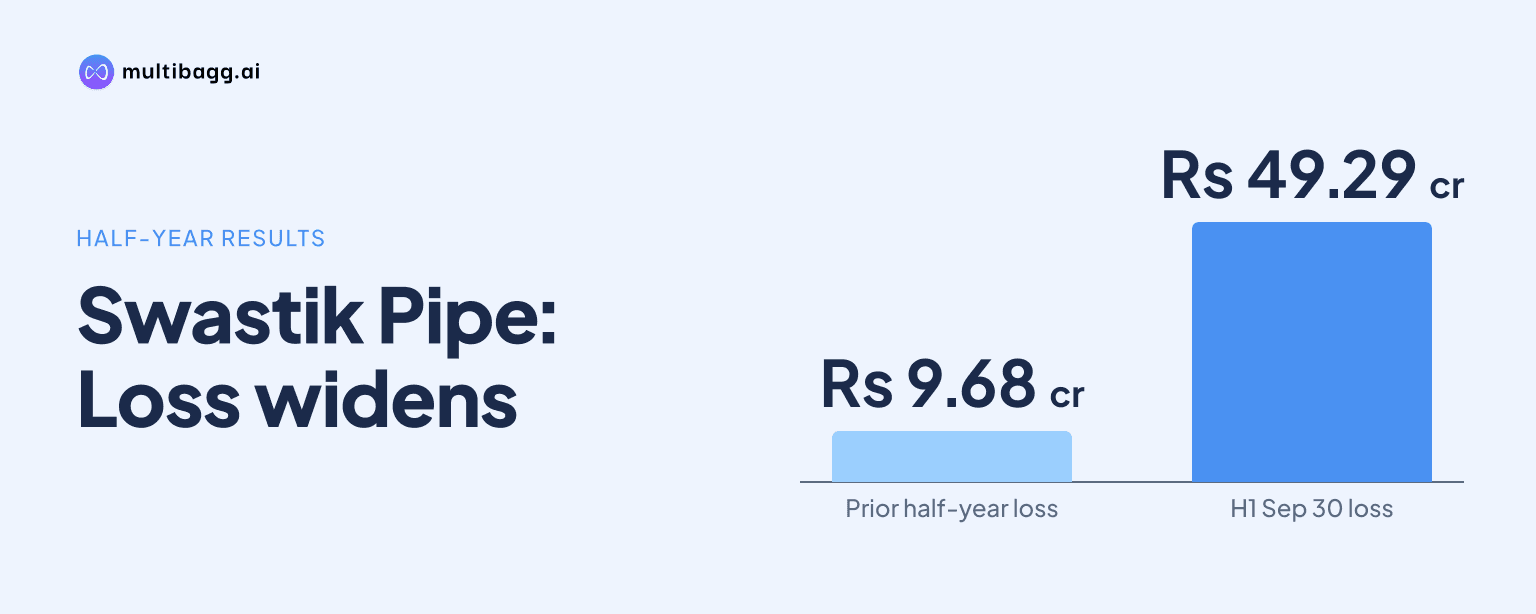
Swastik Pipe Limited reported a Rs 49.29 crore loss for the half year ended 30 September 2026, compared with a Rs 9.68 crore loss a year earlier, as revenue from operations fell 48.15% to Rs 124.57 crore. A Rs 28.15 crore provision for doubtful debts was recorded during the period.
Know Swastik Pipe inside out
Results, valuation, peers and who's buying, in one view.
How did Swastik Pipe’s H1 revenue and loss change?
Swastik Pipe’s reported loss widened by Rs 39.61 crore year on year in the half year ended 30 September 2026 as revenue from operations fell by Rs 115.70 crore. Total income, which includes other income, declined to Rs 128.17 crore from Rs 242.95 crore, while the basic and diluted loss per share increased to Rs 21.22 from Rs 4.17 on paid-up equity share capital of Rs 23.23 crore.
The September 2026 loss was also above the Rs 47.88 crore loss reported in the preceding half year ended 31 March 2026. Revenue was Rs 146.07 crore in that preceding period, making the September 2026 figure Rs 21.50 crore lower. Other income declined to Rs 3.60 crore from Rs 5.23 crore, although the latest period included Rs 2.44 crore recognised from a Hero FinCorp Limited settlement waiver.
Which costs contributed to Swastik Pipe’s H1 loss?
Swastik Pipe recorded other expenses of Rs 46.77 crore for the half year ended 30 September 2026, up from Rs 20.04 crore a year earlier despite the decline in revenue. The cash-flow statement records a Rs 28.15 crore provision for doubtful debts during the period, compared with Rs 30.97 lakh for the financial year ended 31 March 2026. Trade receivables were Rs 70.50 crore at 30 September 2026.
The company also recognised Rs 4.10 crore as an expense under the Haryana Local Area Development Tax settlement scheme. It paid Rs 1.60 crore during the period and reported a remaining Rs 2.50 crore payable, against an originally disputed liability of Rs 19.50 crore. The accounting treatment will be determined after settlement formalities are completed under the scheme’s terms.
Material-consumption costs fell to Rs 107.24 crore from Rs 151.08 crore, while employee-benefit expense declined to Rs 4.98 crore from Rs 7.80 crore. Finance costs decreased to Rs 9.58 crore from Rs 12.52 crore and depreciation fell to Rs 2.94 crore from Rs 3.10 crore. These reductions did not offset the higher other expenses and lower income.
Got a follow-up? Ask IRIS
What changed in Swastik Pipe’s financial position?
Swastik Pipe’s total assets fell to Rs 295.17 crore at 30 September 2026 from Rs 345.71 crore at 31 March 2026. Trade receivables declined to Rs 70.50 crore from Rs 113.29 crore, inventories fell to Rs 41.36 crore from Rs 47.83 crore, and property, plant, equipment and intangible assets decreased to Rs 83.02 crore from Rs 86.17 crore.
Cash and cash equivalents increased to Rs 13.79 crore at 30 September 2026 from Rs 4.62 crore at the previous year-end. The cash-flow statement reported Rs 23.65 crore of net cash generated from operating activities, Rs 1.17 crore generated from investing activities and Rs 15.66 crore used in financing activities, producing a Rs 9.16 crore increase in cash.
Reserves and surplus fell by Rs 49.29 crore over the six-month period to Rs 76.16 crore, while share capital remained Rs 23.23 crore. Short-term borrowings declined to Rs 136.50 crore from Rs 142.67 crore, but other current liabilities rose to Rs 17.97 crore from Rs 7.72 crore. The company classified relevant bank and financial-institution borrowings as current liabilities pending settlement discussions or regularisation.
What did the qualified review conclude about Swastik Pipe?
The statutory auditor issued a qualified conclusion on Swastik Pipe’s unaudited standalone results for the half year ended 30 September 2026. It said finance costs and corresponding liabilities may be understated because additional interest, penal interest and charges imposed by lenders had not been recognised and could not be quantified without updated statements and reconciliations.
Swastik Pipe recognised Rs 764.20 lakh of interest on bank borrowings classified as non-performing assets, or NPAs, based on rates in sanction letters. The auditor said banks had charged higher NPA card rates, penal interest and other charges, while interest on certain non-banking financial company borrowings was not recognised. The auditor therefore said the reported loss could be understated and net worth overstated by an unquantified amount.
The auditor also cited unconfirmed and unreconciled receivables, payables, loans, advances, assets, liabilities, certain non-banking financial company balances and bank balances. Swastik Pipe provided 50% against disputed debtors and 40% against undisputed debtors outstanding for more than six months. The auditor said it could not determine whether further provision was required and identified material uncertainty over going concern after a Rs 46.35 crore cash loss in the period.
Conclusion
Swastik Pipe’s half-year result combines a 48.15% fall in revenue with a larger reported loss, led by the Rs 28.15 crore doubtful-debt provision and higher other expenses. The qualified review means that the reported Rs 49.29 crore loss does not capture an unquantified amount of lender interest, penal charges and possible balance-sheet adjustments.
The next disclosures to watch are progress in one-time settlement discussions with lenders, reconciliation of borrowing costs and balances, and any binding promoter funding commitment. Management has said it is pursuing settlements, exploring promoter support and continuing core operations supported by its existing order book; the auditor said two one-time settlements had been concluded but cash-flow projections and binding funding commitments were not available for review.