










Swastik Pipe H1 FY27 Results: Net Loss Widens to ₹49.3 Crore
Key highlights
- Swastik Pipe reported a ₹49.3 crore net loss in H1 FY27, compared with a ₹9.7 crore loss in H1 FY26.
- Revenue from operations fell 48.1% year on year to ₹124.6 crore in H1 FY27.
- Total income declined 47.3% year on year to ₹128.2 crore for the half year ended September 30, 2026.
- Operating margin deteriorated to negative 38.5% in H1 FY27 from negative 6.4% a year earlier.
powered by IRIS
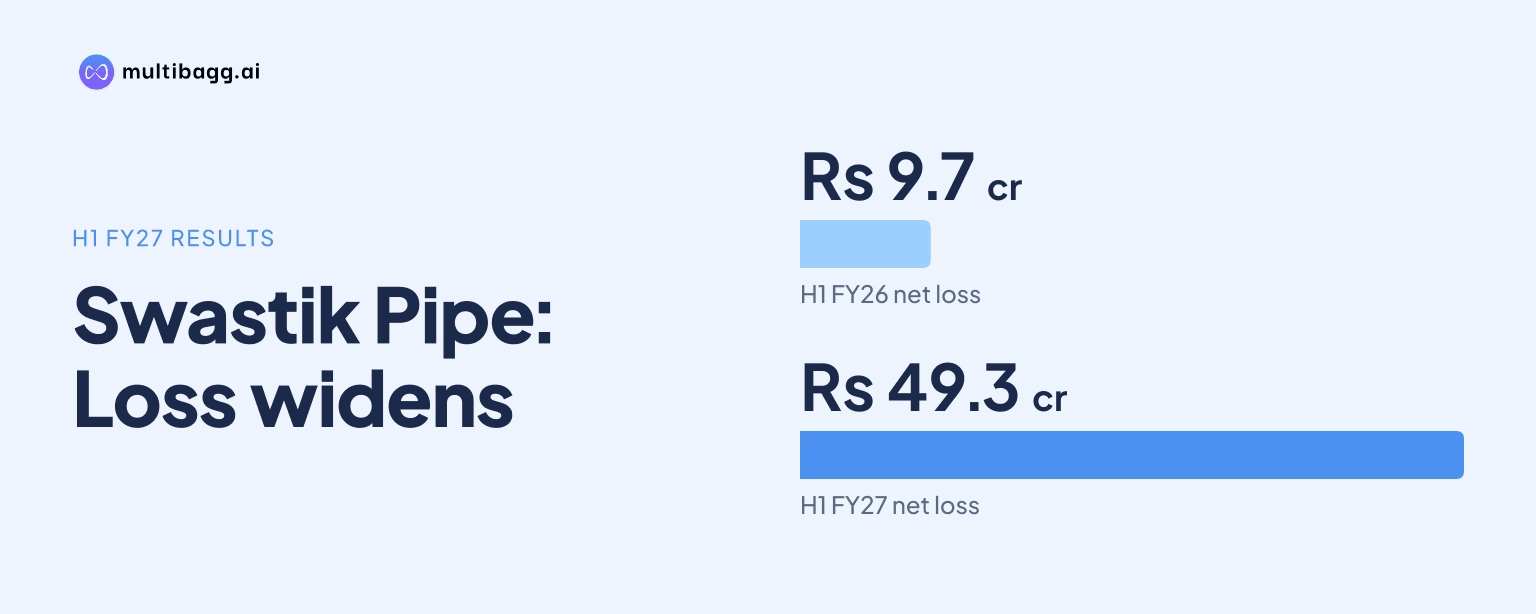
For H1 FY27 ended September 30, 2026, Swastik Pipe Ltd reported a standalone net loss of ₹49.3 crore, widening from ₹9.7 crore a year earlier, as revenue from operations declined 48.1% year on year to ₹124.6 crore. The results also included a qualified audit opinion and disclosures of material uncertainty regarding going concern.
Know Swastik Pipe inside out
Results, valuation, peers and who's buying, in one view.
What did Swastik Pipe report for H1 FY27?
Swastik Pipe reported total income of ₹128.2 crore for H1 FY27, compared with ₹243.0 crore in H1 FY26. Revenue from operations was ₹124.6 crore, down from ₹240.3 crore in the previous-year half. Other income increased to ₹3.6 crore from ₹2.7 crore, but it was not sufficient to offset the fall in operating revenue.
The company recorded a loss before exceptional items and tax of ₹49.3 crore, against a loss of ₹24.2 crore in H1 FY26. As no exceptional item was reported for H1 FY27, the loss before tax and net loss were both ₹49.3 crore. The filing reported negative earnings per share of ₹21.22 for the half year.
How did the half-year loss widen?
Swastik Pipe's loss widened alongside the decline in revenue and a deterioration in operating performance. The operating margin was negative 38.5% in H1 FY27, compared with negative 6.4% in H1 FY26. The results summary defines operating profit as excluding other income, which means the operating-margin measure reflects the performance of the core business before other income.
On a sequential comparison provided in the results summary, H1 FY27 revenue from operations of ₹124.6 crore was lower than ₹146.1 crore reported for H2 FY26. Total income also declined from ₹151.3 crore in H2 FY26. However, the H1 FY27 net loss of ₹49.3 crore was higher than the ₹47.9 crore loss reported in H2 FY26.
The company reported no exceptional items in H1 FY27. In H1 FY26, exceptional items of ₹8.6 crore were reported, while H2 FY26 included an exceptional loss of ₹0.7 crore. These items affect comparability between the periods, although the loss before exceptional items and tax also widened materially in H1 FY27.
Why did the auditors raise going-concern concerns?
The statutory auditors issued a qualified opinion that highlighted material uncertainty related to Swastik Pipe's ability to continue as a going concern. The audit observations cited defaults on bank borrowings, unrecognised penal and higher non-performing asset interest charges, and unconfirmed balances with counterparties.
Management stated that continuation of core operations was supported by the existing order book as part of its going-concern assessment. The available disclosure does not quantify the order book, order inflow, or pending orders. It also states that the company is pursuing One-Time Settlement, or OTS, negotiations to regularise its debt obligations.
The auditor's observations are significant because they relate to debt servicing, interest recognition and the confirmation of balances, rather than only the half-year revenue decline. The results statement does not provide an earnings-call transcript for the quarter, so the disclosed figures and audit comments remain the stated basis for assessing the period.
Got a follow-up? Ask IRIS
How do these results affect investors and operations?
For investors, the H1 FY27 filing shows simultaneous pressure on revenue, profitability and financial obligations. Revenue from operations nearly halved year on year, while the negative operating margin widened by 32.1 percentage points from H1 FY26. The ₹49.3 crore net loss was more than five times the prior-year half-year loss of ₹9.7 crore.
For business operations, management's reference to the existing order book indicates that core activity continued during the period. But the company has not disclosed a value for that order book in the material provided. As a result, the filing does not establish how much revenue coverage or visibility pending orders may provide.
The company had informed the exchange that its board meeting on November 14, 2026 would consider financial results for the period ended September 30, 2026. The reported H1 FY27 numbers were subsequently presented as standalone results. The filing does not provide a timeline or final terms for the proposed OTS negotiations.
What should be monitored after the H1 FY27 filing?
The key reported developments to monitor are the progress of OTS negotiations, treatment of penal and higher NPA interest, and resolution of unconfirmed counterparty balances. These matters were specifically identified in the qualified opinion and are relevant to the company's debt obligations and going-concern assessment.
Investors may also track whether revenue from operations recovers from the ₹124.6 crore reported in H1 FY27, and whether the negative operating margin narrows from 38.5%. Any subsequent result, exchange filing or annual report that quantifies the order book, borrowing defaults or settlement process would provide further context on the operating and financial position.
Conclusion
Swastik Pipe's H1 FY27 results showed a sharp fall in revenue and a wider net loss, with revenue from operations down 48.1% year on year to ₹124.6 crore and the net loss rising to ₹49.3 crore. The qualified audit opinion adds importance to the reported debt defaults, interest-related observations and going-concern uncertainty.
The next disclosed issue to watch is the company's OTS negotiation process to regularise debt obligations. Future filings will also be relevant for updates on auditor observations, the status of borrowing defaults, the unquantified order book and any change in operating performance.