










TARC projects ₹10,000 crore cashflow, FY30 near ₹4,000 crore
Key highlights
- TARC projects about ₹10,000 crore of cashflows over the next five years, including existing and upcoming developments.
- FY30 cashflow guidance is about ₹4,000 crore, compared with ₹1,600 crore to ₹1,800 crore in FY27.
- TARC reported H1FY27 pre-sales of ₹955 crore and collections of ₹462 crore across three active developments.
- Kailasa and Ishva are slated to begin revenue recognition in FY2029 and FY2030 at about ₹8,000 crore combined.
powered by IRIS
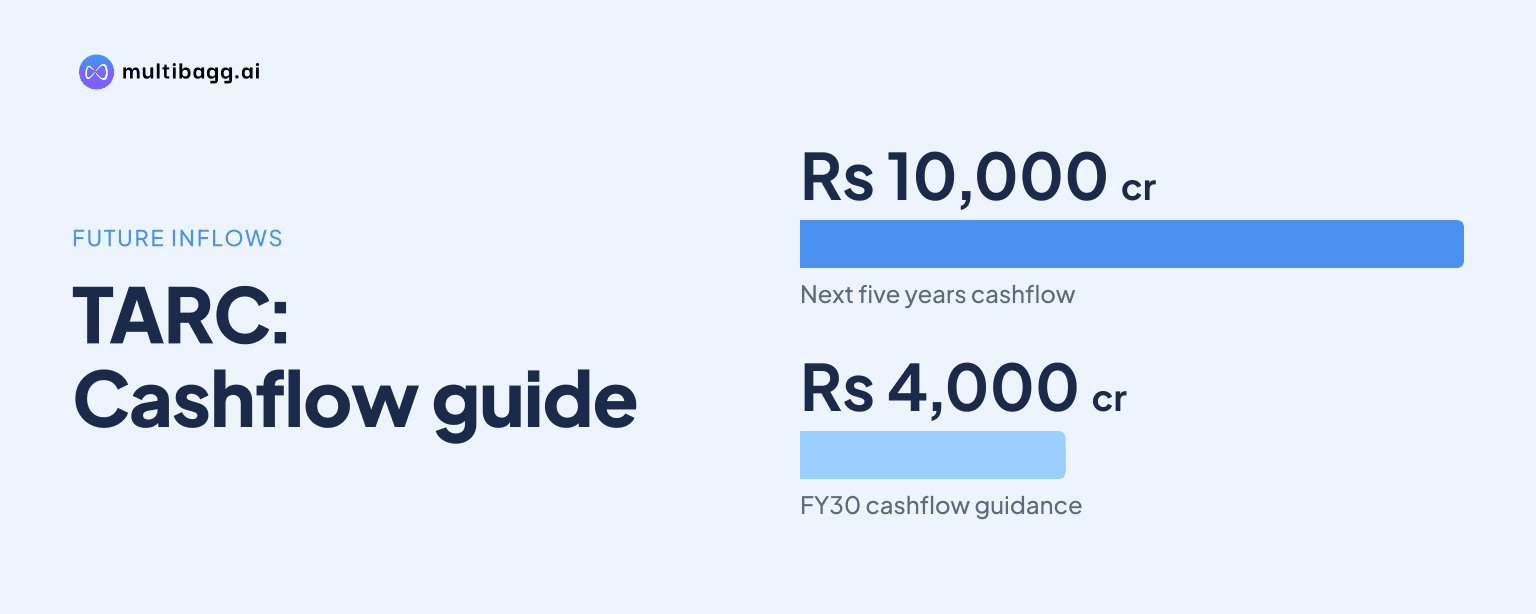
TARC LIMITED projects about ₹10,000 crore of cashflows over the next five years, including existing and upcoming developments, with annual cashflow projected at about ₹4,000 crore in FY30. TARC’s stated schedule begins at ₹1,600 crore to ₹1,800 crore in FY27 and rises to ₹2,300 crore to ₹2,500 crore in FY29.
Know TARC inside out
Results, valuation, peers and who's buying, in one view.
What cashflow does TARC project through FY30?
TARC projects annual cashflow of ₹1,600 crore to ₹1,800 crore in FY27, ₹1,800 crore to ₹2,000 crore in FY28, ₹2,300 crore to ₹2,500 crore in FY29 and about ₹4,000 crore in FY30. The company labels the overall projection as about ₹10,000 crore over the next five years and says it includes existing and upcoming developments.
The FY30 figure is more than double the upper end of the FY27 range. The four annual rows total about ₹9,700 crore to ₹10,300 crore using the stated ranges and the approximate FY30 figure; however, the presentation describes a five-year outlook while listing FY27 through FY30 only, without a separate fifth-year annual figure.
What supports TARC's cashflow ramp?
TARC’s milestone plan places revenue recognition from TARC Tripundra at more than about ₹1,000 crore in FY2026-27, alongside new launches and debt reduction. This makes Tripundra the development specifically identified for recognition during the first year of the cashflow schedule, FY27.
The later milestone is larger: TARC says revenue recognition for Kailasa and Ishva, together, begins in FY2029 and FY2030 at about ₹8,000 crore. Kailasa has gross development value, or GDV, of ₹4,400 crore and Ishva has GDV of ₹3,600 crore, versus ₹1,000 crore for Tripundra. Revenue recognition and cashflow are separately presented measures, so the presentation does not allocate annual cashflow guidance by project.
TARC also lists improved cashflows and becoming cash positive as FY2027-28 milestones, followed by potential new investments in joint development agreements, or JDAs, joint ventures, or JVs, and land. These are management’s disclosed plans rather than quantified cashflow contributions, and no investment amount or timing is provided for the proposed JDA, JV or land activity.
How are TARC's active projects converting sales into collections?
TARC reported ₹955 crore of pre-sales and ₹462 crore of collections across Tripundra, Kailasa and Ishva in H1FY27. Ishva led pre-sales at ₹494 crore, followed by Kailasa at ₹428 crore, while Tripundra contributed ₹33 crore; the mix differs from their GDV figures of ₹3,600 crore, ₹4,400 crore and ₹1,000 crore, respectively.
Collections were highest at Ishva, at ₹211 crore, compared with ₹168 crore at Kailasa and ₹83 crore at Tripundra. Tripundra’s collections exceeded its H1FY27 pre-sales, whereas Kailasa and Ishva recorded collections below their pre-sales in the same half-year. TARC attributes its sales momentum to demand across its luxury developments and says collections efficiency supports construction pace.
Got a follow-up? Ask IRIS
What financial base does TARC report before the guidance period?
TARC reported Q2 FY2026-27 revenue of ₹128.81 crore, up from ₹6.87 crore in Q2 FY2025-26, and reported profit after tax of ₹4.39 crore, compared with a ₹15.77 crore loss a year earlier. Q2 earnings before interest, tax, depreciation and amortisation, or EBITDA, were ₹2.80 crore against negative ₹8.41 crore, while the EBITDA margin was 2.09% versus negative 24.66%.
For H1 FY2026-27, revenue was ₹345.94 crore compared with ₹82.77 crore in H1 FY2025-26, but reported profit after tax was ₹27.04 crore versus ₹38.45 crore. Other income declined to ₹6.84 crore from ₹246.70 crore, while H1 EBITDA was ₹44.57 crore compared with ₹90.75 crore. Finance costs increased to ₹31.31 crore from ₹26.51 crore over the same periods.
What upcoming developments are included in TARC's outlook?
TARC identifies three planned Delhi developments in its ultra-luxury residential strategy, and each is described as having approvals in place with design finalisation in progress. TARC V has about 1.0 million square feet of development potential on about 7 acres, TARC VI has about 0.5 million square feet on about 3 acres, and TARC VII has about 1.0 million square feet on about 7 acres.
Together, the three named developments represent about 2.5 million square feet and about 17 acres, based on the presentation’s rounded figures. TARC’s five-year cashflow statement says upcoming developments are included, but does not state how much of the ₹10,000 crore projection comes from TARC V, TARC VI or TARC VII, or provide launch dates and GDV for those schemes.
TARC separately identifies FY2031 and FY2032 as the period for additional revenue recognition from upcoming developments. That timeline follows the stated beginning of Kailasa and Ishva recognition in FY2029 and FY2030, placing design finalisation and subsequent project progression after the schedule disclosed for Tripundra recognition in FY2026-27.
Conclusion
TARC’s guidance presents a stepped cashflow profile, moving from ₹1,600 crore to ₹1,800 crore in FY27 to about ₹4,000 crore in FY30. The disclosed project base includes ₹9,000 crore of GDV across Tripundra, Kailasa and Ishva, while H1FY27 pre-sales of ₹955 crore and collections of ₹462 crore show the current sales and collection activity behind that development portfolio.
The next disclosed milestones are Tripundra revenue recognition of more than about ₹1,000 crore in FY2026-27, the FY2027-28 cash-positive milestone, and the beginning of Kailasa and Ishva recognition in FY2029 and FY2030. The presentation does not provide a separate fifth-year annual cashflow figure or project-level cashflow contributions from TARC V, TARC VI and TARC VII, which remain in design finalisation.