










Tarini International half-year profit falls 36% to Rs 21.83 lakh
Key highlights
- Tarini International’s standalone net profit fell 36% to Rs 21.83 lakh for the six months ended September 30, 2026.
- Revenue from operations was unchanged at Rs 99.00 lakh, while employee benefits expense rose 47% to Rs 45.45 lakh.
- Operating activities used Rs 49.21 lakh of cash in the September 2026 half year, leaving cash and cash equivalents at Rs 10.64 lakh.
- The auditor said a provision against the Rs 1.22 crore subsidiary investment would have changed pre-tax profit into a Rs 82.34 lakh loss.
powered by IRIS
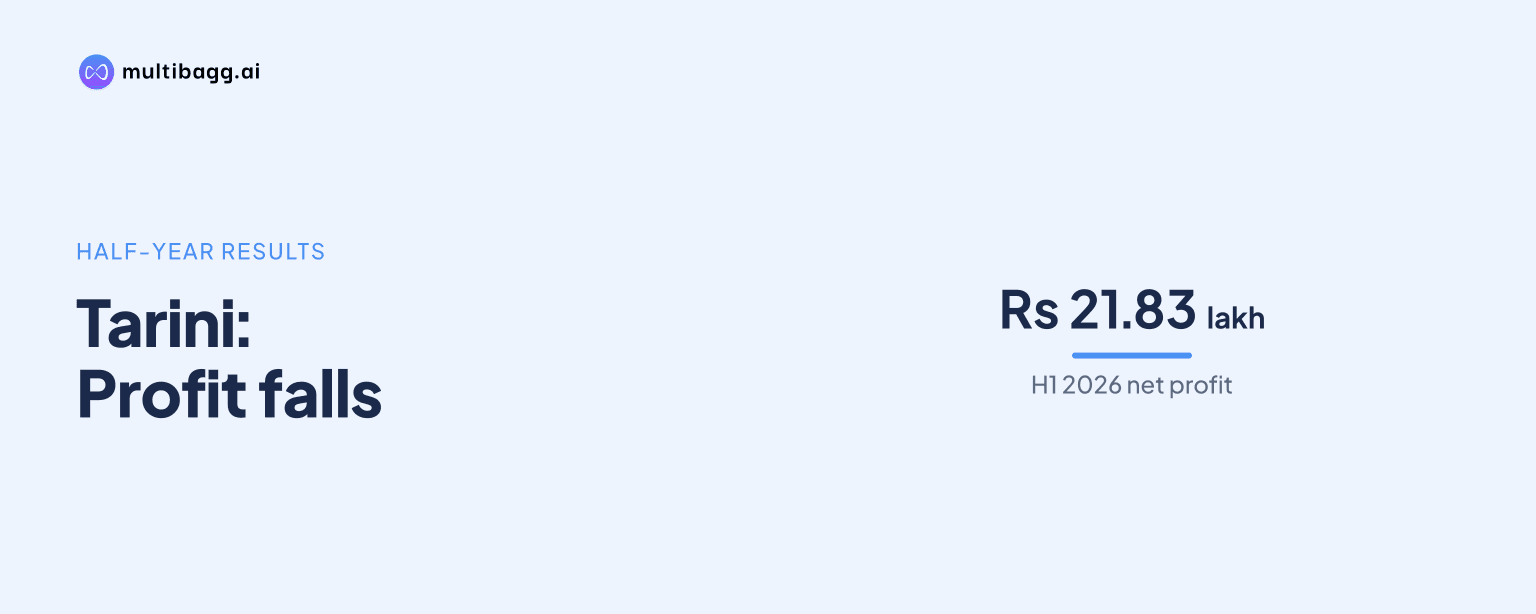
Tarini International Limited reported standalone net profit of Rs 21.83 lakh for the six months ended September 30, 2026, down 36% from Rs 34.09 lakh a year earlier, as revenue from operations stayed at Rs 99.00 lakh and employee benefits expense increased to Rs 45.45 lakh from Rs 30.96 lakh.
Know Tarini International inside out
Results, valuation, peers and who's buying, in one view.
Why did Tarini International’s half-year profit fall?
Tarini International’s half-year profit fell because expenses increased while total income declined in the six months ended September 30, 2026. Total income decreased 3% to Rs 1.16 crore from Rs 1.20 crore in the corresponding 2025 period, while total expenses rose 13% to Rs 77.10 lakh from Rs 68.42 lakh. Profit before tax consequently fell 24% to Rs 39.25 lakh from Rs 51.49 lakh.
Employee benefits expense was the largest reported cost movement, increasing 47% to Rs 45.45 lakh from Rs 30.96 lakh. Other expenses declined 18% to Rs 27.24 lakh from Rs 33.23 lakh, which partly offset the employee-cost increase. Depreciation and amortisation rose to Rs 4.19 lakh from Rs 4.01 lakh, while finance cost was Rs 21,000 compared with Rs 22,000.
Tax expense was Rs 17.42 lakh in the September 2026 half year, compared with Rs 17.39 lakh a year earlier, despite the lower pre-tax profit. Current tax declined to Rs 10.52 lakh from Rs 13.25 lakh, while deferred tax increased to Rs 6.90 lakh from Rs 4.14 lakh. Basic and diluted earnings per share both fell to Rs 0.17 from Rs 0.26.
How did Tarini International’s revenue and income mix change?
Tarini International’s revenue from operations was unchanged at Rs 99.00 lakh in each of the two six-month periods, so lower other income accounted for the decline in total income. Other income decreased 17% to Rs 17.35 lakh for the half year ended September 30, 2026, from Rs 20.91 lakh in the half year ended September 30, 2025. The Rs 3.56 lakh reduction occurred alongside unchanged operating revenue.
Tarini International reported no cost of materials consumed, purchases of stock in trade, or inventory movement for either half year. Its disclosed expense base consisted of employee benefits, finance cost, depreciation and amortisation, and other expenses. The company also said it does not have more than one reportable primary segment under Accounting Standard 17, so it did not publish segment-wise revenue or profit data.
The September 2026 half-year revenue of Rs 99.00 lakh was less than half of the Rs 2.09 crore reported for the year ended March 31, 2026. Total income of Rs 1.16 crore compared with Rs 2.50 crore for that full year. These are comparisons between a six-month period and a 12-month period, and Tarini International did not provide revenue guidance for the remainder of the financial year.
Got a follow-up? Ask IRIS
What does Tarini International’s cash flow show?
Tarini International reported negative cash flow from operating activities of Rs 49.21 lakh for the half year ended September 30, 2026, despite profit before tax of Rs 39.25 lakh. Operating profit before working-capital changes was Rs 26.30 lakh after depreciation of Rs 4.19 lakh, interest expense of Rs 21,000 and interest income of Rs 17.35 lakh.
Working-capital movements drove the operating cash outflow. The cash-flow statement records a Rs 3.14 crore decrease in current assets, which added cash, and a Rs 3.89 crore decrease in current liabilities, which used cash. The net result was an operating outflow of Rs 49.21 lakh, compared with an outflow of Rs 83.78 lakh reported for the year ended March 31, 2026; the two periods are not like-for-like.
Investing activities generated Rs 17.35 lakh, entirely from interest income, while financing activities generated Rs 25,000 after loan movements and interest expense. Net cash and cash equivalents declined by Rs 31.64 lakh from Rs 42.27 lakh at the start of the half year to Rs 10.64 lakh on September 30, 2026. The reported closing cash balance was therefore lower than the Rs 42.28 lakh balance at March 31, 2026.
What balance-sheet and review matters did Tarini International disclose?
Tarini International reported total standalone assets and liabilities of Rs 34.30 crore at September 30, 2026, down from Rs 37.80 crore at March 31, 2026. Short-term loans and advances decreased to Rs 15.42 crore from Rs 18.76 crore, while trade receivables increased to Rs 1.73 crore from Rs 1.53 crore. Short-term borrowings declined to Rs 2.85 crore from Rs 6.51 crore.
The statutory auditor’s limited-review report included a basis for qualification concerning Tarini International’s Rs 1.22 crore investment in subsidiaries with accumulated losses and net capital deficiency. Management considered the investment good and made no provision for diminution. The auditor said that, had the provision been made, the reported pre-tax profit of Rs 39.25 lakh would have become a loss of Rs 82.34 lakh.
The filing said receivables, loans, advances and other assets remained subject to confirmation, although management considered them recoverable. The auditor also drew attention to the provisional attachment of a farmhouse, for which Tarini International said it obtained a Delhi High Court stay on March 6, 2018. Tarini International’s appeal against a Securities Appellate Tribunal order imposing a Rs 5.05 crore penalty was admitted by the Supreme Court and is to be listed for final hearing, while nine Registrar of Companies cases have been dismissed.
Conclusion
Tarini International’s September 2026 standalone half-year result combines unchanged operating revenue of Rs 99.00 lakh with higher employee benefits expense and lower other income. These movements reduced net profit to Rs 21.83 lakh from Rs 34.09 lakh, while operating activities used Rs 49.21 lakh of cash and closing cash and cash equivalents fell to Rs 10.64 lakh.
The next reported period will show whether revenue improves from the Rs 99.00 lakh recorded in the first half and whether working-capital movements reverse the operating cash outflow. Other disclosed matters to watch include the Supreme Court listing for the admitted appeal, confirmation of receivable and advance balances, and management’s position that no provision is necessary for the Rs 1.22 crore subsidiary investment.