










Tarini International Limited provision would create Rs 82.34 lakh loss
Key highlights
- Tarini’s auditor said a Rs 121.59 lakh subsidiary-investment provision would turn Rs 39.25 lakh of pre-tax profit into an Rs 82.34 lakh loss.
- Tarini reported standalone profit after tax of Rs 21.83 lakh for the half year ended September 30, 2026, versus Rs 34.09 lakh a year earlier.
- Cash and cash equivalents fell to Rs 10.64 lakh at September 30, 2026 from Rs 42.27 lakh at March 31, 2026.
- Tarini disclosed an admitted Supreme Court appeal against a Rs 5.05 crore Securities Appellate Tribunal penalty.
powered by IRIS
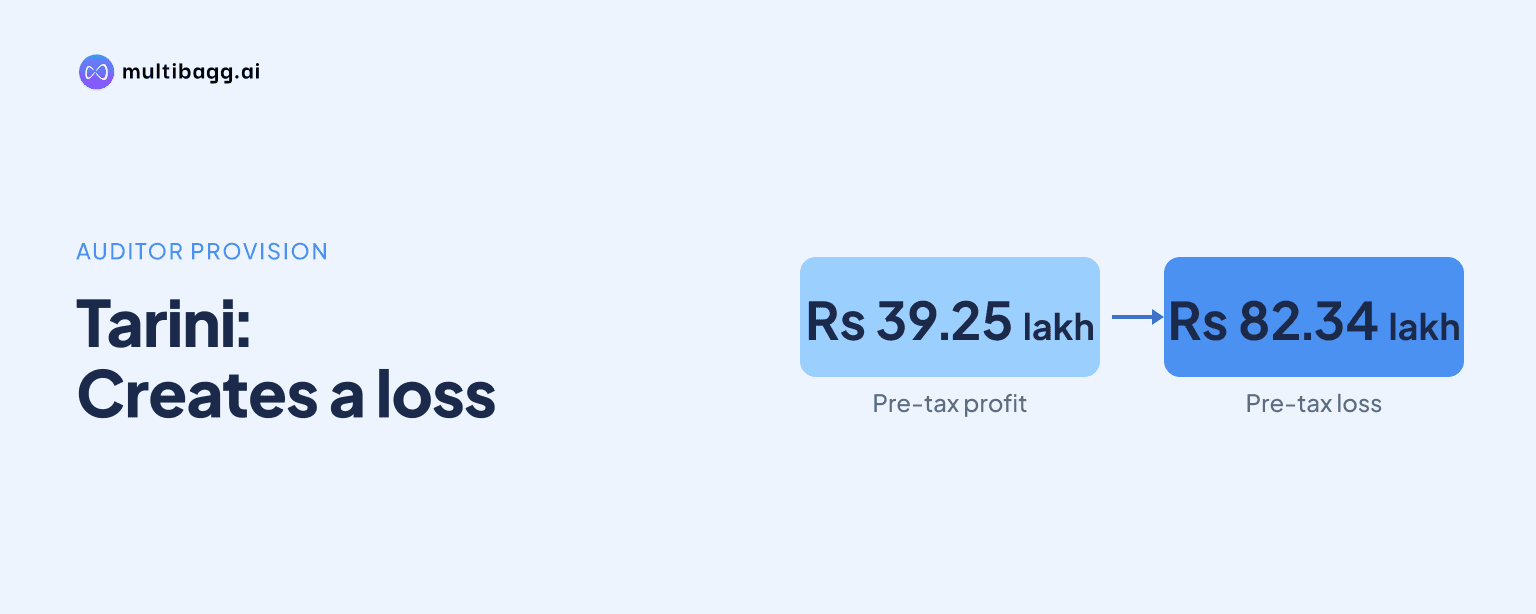
Tarini International Limited’s auditor said that recording a Rs 121.59 lakh provision against investments in loss-making subsidiaries would turn its standalone pre-tax profit of Rs 39.25 lakh for the half year ended September 30, 2026 into an Rs 82.34 lakh loss. The auditor cited recurring losses, accumulated losses and net-capital deficiencies at the subsidiaries.
Know Tarini International inside out
Results, valuation, peers and who's buying, in one view.
What did Tarini’s auditor qualify in the September 2026 review?
Tarini’s auditor qualified the limited-review conclusion because management did not provide for diminution in Rs 121.59 lakh of investments in subsidiaries with recurring losses, accumulated losses and net-capital deficiencies. M. Modi & Associates said these conditions raised substantial doubt about the subsidiaries’ ability to continue as going concerns, while management had considered the investments good.
The qualification applies to Tarini’s unaudited standalone financial results for the six months ended September 30, 2026. The auditor conducted its review under Standard on Review Engagements 2410, which provides moderate assurance and is narrower in scope than an audit, and said its conclusion was subject to the possible effects of the matters in paragraphs 4 and 5 of the report.
Tarini said the Rs 121.59 lakh investment in subsidiary companies was long term and that no provision for diminution in value was necessary. Management said it expected improvement in the subsidiaries’ future operations, even though their accumulated losses had eroded net worth as of September 30, 2026, and their financial statements were prepared on a going-concern basis.
How would the provision change Tarini’s half-year profit?
The Rs 121.59 lakh provision would change Tarini’s Rs 39.25 lakh profit before tax into an Rs 82.34 lakh loss before tax for the six months ended September 30, 2026. The auditor quantified this outcome directly, linking the full investment provision to the difference between the reported pre-tax result and the hypothetical loss.
Tarini reported profit after tax of Rs 21.83 lakh for the September 2026 half year, compared with Rs 34.09 lakh for the six months ended September 30, 2025. Reported profit before tax declined to Rs 39.25 lakh from Rs 51.49 lakh in the comparable period, while the filing showed no exceptional or extraordinary items in either half-year column.
Total income was Rs 1.16 crore in the September 2026 half year, compared with Rs 1.20 crore a year earlier. Total expenses increased to Rs 77.10 lakh from Rs 68.42 lakh, as employee-benefit expense rose to Rs 45.45 lakh from Rs 30.96 lakh, although other expenses fell to Rs 27.24 lakh from Rs 33.23 lakh.
Interest income was Rs 17.35 lakh in the latest half year, down from Rs 20.91 lakh a year earlier, while finance cost was Rs 21,000 against Rs 22,000. Basic and diluted earnings per share were Rs 0.17 for the September 2026 half year, compared with Rs 0.26 in the corresponding 2025 period.
What did Tarini disclose about receivables and advances?
Tarini disclosed that receivables, loans and advances were subject to confirmation, while management considered them good and recoverable at their reported values. The auditor said it could not comment on the extent to which the balances were recoverable, having regard to the age of those balances and the absence of confirmations.
Trade receivables stood at Rs 1.73 crore at September 30, 2026, up from Rs 1.53 crore at March 31, 2026. Short-term loans and advances fell to Rs 15.42 crore from Rs 18.76 crore over the same period, a reduction of Rs 3.34 crore in the balance-sheet category singled out by the auditor.
Tarini reported other non-current assets of Rs 16.31 lakh at September 30, 2026, compared with Rs 16.38 lakh at March 31, 2026. Management stated that current and non-current receivables, loans, advances and other assets had approximately the realisable values reflected in the accounts, subject to the stated confirmation process.
The auditor treated the confirmation and recoverability issue as an emphasis-of-matter item rather than a basis for qualification. Its report explicitly said the conclusion was not modified for this matter, unlike the Rs 121.59 lakh subsidiary-investment provision that formed the basis for qualification.
Got a follow-up? Ask IRIS
How did Tarini’s balance sheet and cash flow change?
Tarini’s cash and cash equivalents fell to Rs 10.64 lakh at September 30, 2026 from Rs 42.27 lakh at March 31, 2026. The standalone cash-flow statement recorded a net decrease of Rs 31.64 lakh during the half year, ending with the reported September cash balance.
Operating activities used Rs 49.21 lakh of cash in the half year ended September 30, 2026, compared with an outflow of Rs 83.78 lakh in the year ended March 31, 2026. The latest period included a Rs 3.89 crore decrease in current liabilities and a Rs 3.14 crore decrease in current assets, after operating profit before working-capital changes of Rs 26.30 lakh.
Investing activities generated Rs 17.35 lakh of cash through interest income in the September 2026 half year, while financing activities generated Rs 25,000. Tarini reported no purchase or sale of property, plant and equipment and no investment purchase in the cash-flow statement for the six-month period.
Total assets were Rs 34.30 crore at September 30, 2026, down from Rs 37.80 crore at March 31, 2026. Short-term borrowings declined to Rs 2.85 crore from Rs 6.51 crore, while reserves and surplus rose to Rs 17.81 crore from Rs 17.59 crore and share capital remained Rs 13.00 crore.
What legal and asset matters remain disclosed by Tarini?
Tarini said a company farmhouse was provisionally attached by the Enforcement Directorate in October 2017 and that it obtained a stay from the High Court of Delhi on March 6, 2018. The filing did not state the carrying value of the farmhouse, and the auditor included the asset matter in its emphasis-of-matter section.
Tarini stated that it was not an accused in any form when the farmhouse attachment occurred. The September 2026 filing did not disclose a later court outcome, valuation change or release of the asset beyond the High Court stay dated March 6, 2018.
Tarini also disclosed an appeal to the Supreme Court under Section 15-Z of the Securities and Exchange Board of India Act, 1992, against a Securities Appellate Tribunal order dated May 2, 2022. The order imposed a Rs 5.05 crore penalty, and Tarini said its appeal had been admitted and was to be listed for final hearing under an order dated December 18, 2024.
The Registrar of Companies had also filed complaints following show-cause notices under various provisions of the Companies Act, 2013, Tarini said. The company reported that the respective courts had dismissed nine such cases in its favour, but the filing did not specify whether any additional complaints remained pending.
What does Tarini’s investment balance show?
Tarini reported non-current investments of Rs 11.75 crore at both September 30, 2026 and March 31, 2026. The Rs 121.59 lakh subsidiary investment addressed in the qualification is therefore part of a larger unchanged non-current investment balance, although the filing does not identify the individual subsidiaries or provide an investment-by-investment break-up.
The qualified amount represents management’s assessment that the relevant subsidiary investments retain their value despite the subsidiaries’ net-capital deficiencies. The auditor did not state that every non-current investment required a provision; its quantified observation was limited to the Rs 121.59 lakh invested in the subsidiaries described in Note 5.
Tarini’s reported reserves and surplus increased by Rs 21.83 lakh between March 31, 2026 and September 30, 2026, matching the reported half-year profit after tax. The auditor’s observation concerns profit before tax and does not provide a revised profit-after-tax figure, earnings-per-share figure or revised reserves balance if the provision were recorded.
The company said it has only one reportable primary segment under Accounting Standard 17, Segment Reporting, and did not provide segment-wise financial results. As a result, the September 2026 filing does not separate the Rs 99 lakh revenue from operations or the Rs 17.35 lakh other income by business activity.
Conclusion
Tarini’s reported standalone September 2026 half-year profit is subject to a quantified audit qualification: a Rs 121.59 lakh provision for investments in subsidiaries with recurring losses and net-capital deficiencies would convert Rs 39.25 lakh of pre-tax profit into an Rs 82.34 lakh pre-tax loss. Separately, profit after tax fell to Rs 21.83 lakh from Rs 34.09 lakh a year earlier, and cash declined to Rs 10.64 lakh.
The next disclosed matters to watch are whether Tarini retains its view that no diminution provision is needed for the subsidiary investments, whether confirmations support the reported Rs 1.73 crore of trade receivables and Rs 15.42 crore of short-term loans and advances, and the listing for final hearing of its Supreme Court appeal against the Rs 5.05 crore penalty.