










Tasty Bite Eatables Limited Q2 revenue rises 33%, profit 148%
Key highlights
- Tasty Bite reported Q2 FY2027 revenue of Rs 184.2 crore, up 33% year on year.
- Q2 FY2027 PAT rose 148% year on year to Rs 9 crore, while earnings per share reached Rs 35.
- Total affiliate revenue increased 65% to Rs 84.9 crore in Q2 FY2027, led by 107% growth in MARS Affiliates.
- Management said H1-FY27 EBITDA grew 22%, below 31% revenue growth, due to Cheffin and Food Service investment and cost pressure.
powered by IRIS
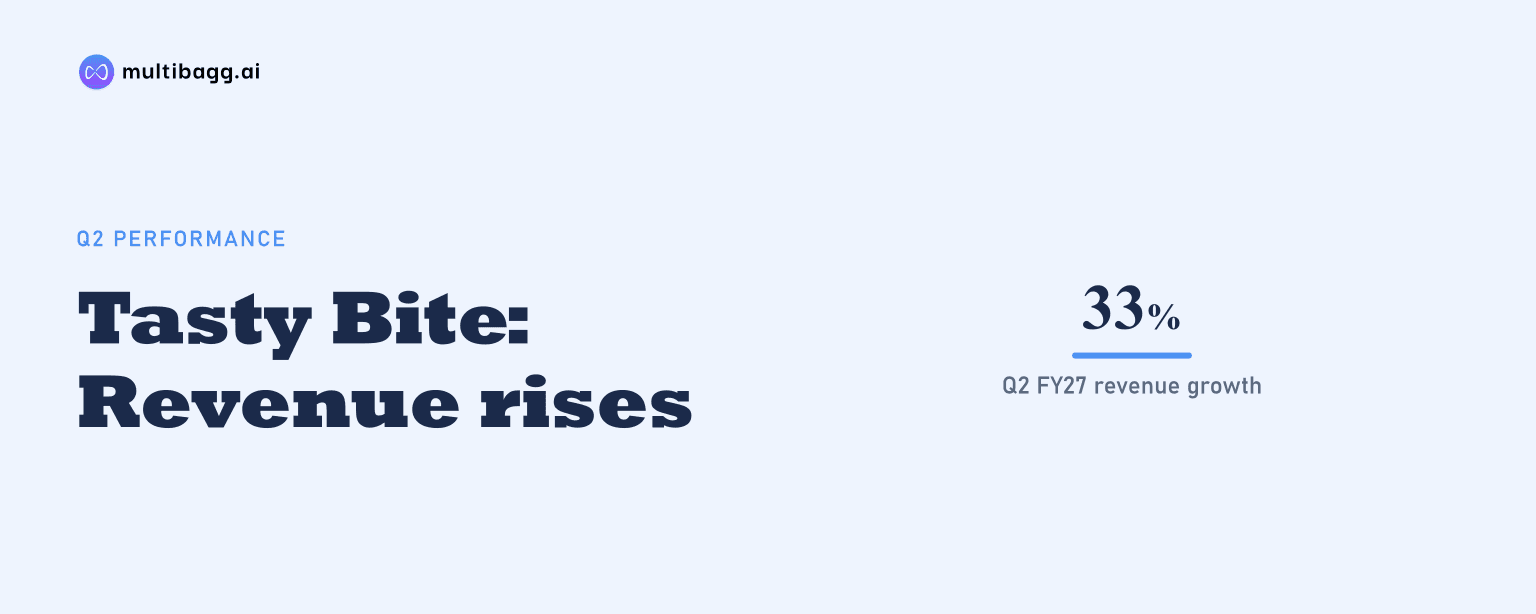
Tasty Bite Eatables Limited reported Q2 FY2027 revenue of Rs 184.2 crore, up 33% year on year, while profit after tax rose 148% to Rs 9 crore. Tasty Bite’s earnings growth outpaced sales, but management said H1 EBITDA grew 22%, below the 31% revenue increase, as it invested in Cheffin and HoReCa while facing input and logistics cost pressure.
Know Tasty Bite Eatables inside out
Results, valuation, peers and who's buying, in one view.
How did Tasty Bite perform in Q2 FY2027?
Tasty Bite increased total revenue to Rs 184.2 crore in Q2 FY2027 from Rs 138.6 crore in Q2 FY2026, a year-on-year increase of 33%. Revenue was also 14% above the Rs 161.6 crore reported on 30-Jun-26, as both affiliate and third-party businesses contributed to the quarter-on-quarter increase.
Profit after tax, or PAT, was Rs 9 crore in Q2 FY2027, compared with Rs 3.6 crore a year earlier and Rs 8.8 crore on 30-Jun-26. That produced 148% year-on-year PAT growth and 2% sequential growth. Earnings per share rose to Rs 35 from Rs 14 in Q2 FY2026, also a 148% increase, and was Rs 34 in the preceding quarter.
For H1-FY27, Tasty Bite recorded revenue of Rs 345.8 crore, against Rs 263.8 crore in H1-FY26, a 31% increase. H1-FY27 PAT reached Rs 17.8 crore from Rs 11.8 crore, up 51%, while earnings per share increased to Rs 69 from Rs 46. Management attributed the H1-FY27 bottom-line improvement in part to lower finance costs resulting from cash-flow and financial management.
Which businesses drove Tasty Bite’s revenue growth?
Tasty Bite’s affiliate business was the largest disclosed revenue-growth contributor in Q2 FY2027, with revenue rising 65% year on year to Rs 84.9 crore from Rs 51.6 crore. Within affiliates, PBI Affiliates grew 40% to Rs 46 crore, while MARS Affiliates more than doubled, increasing 107% to Rs 38.9 crore from Rs 18.8 crore.
Third-party revenue rose at a slower 14% rate to Rs 99.3 crore in Q2 FY2027 from Rs 87 crore in Q2 FY2026. Food Service, including Cheffin, contributed Rs 60 crore, up 21%, whereas Premier Foods declined 4% to Rs 30.9 crore. Other income increased 36% to Rs 8.3 crore, compared with Rs 6.1 crore a year earlier.
The same split was evident in H1-FY27. Total affiliate revenue rose 55% to Rs 161.7 crore, while third-party revenue increased 15% to Rs 184.1 crore. PBI Affiliates generated Rs 92.1 crore, up 26%, and MARS Affiliates generated Rs 69.5 crore, up 124%; Food Service rose 12% to Rs 109.9 crore. Management said Food Service had achieved its 12th consecutive quarter of growth.
Got a follow-up? Ask IRIS
Why did Tasty Bite’s EBITDA growth lag revenue growth?
Tasty Bite’s EBITDA, or earnings before interest, tax, depreciation and amortisation, rose 22% in H1-FY27, compared with the 31% increase in revenue. Management said this 9-percentage-point gap primarily reflected continued investment in the Cheffin consumer brand and Food Service business, as well as cost inflation linked to geopolitical uncertainty including the Middle East crisis.
Management identified raw materials, packaging materials and logistics as cost categories affected by external pressure during H1-FY27. The company did not disclose an EBITDA amount or margin in the presentation, so the available evidence establishes the relative growth rates rather than absolute operating profit or the size of any margin movement.
Tasty Bite said it plans to address these pressures through sourcing initiatives, cost optimisation, operational efficiencies, value leadership initiatives and disciplined cost management. Its Value Leadership Initiatives, or VLS, are described as part of the governance framework supporting financial discipline and operational execution, while management continues to frame Cheffin and Food Service spending as necessary to create future growth platforms.
What is Tasty Bite doing with Cheffin and Food Service?
Tasty Bite is expanding Cheffin, its business-to-consumer convenience-food brand, across digital commerce while investing in brand building, innovation, distribution and market development. Cheffin began selling on Amazon in August 2025, expanded to Zepto in March 2026, and is now available on Blinkit and Swiggy Instamart as well.
The company launched four Asian Noodles variants during Q2 FY2027, adding to Cheffin’s range of three-step cooking kits. The product proposition includes a three-pouch format, preparation in five to eight minutes, vegetarian products and no preservatives. Management said the spending objective is to establish a differentiated consumer brand with a sustainable and scalable model, rather than simply maximise near-term growth.
In Food Service, Tasty Bite’s Xclusive business serves quick-service restaurants, cafés and emerging foodservice formats through own-label products designed to customer requirements. The portfolio includes freezer-to-fryer items and sauces and gravies, with features including portion control, low wastage and menu applications. Management said the Food Service platform is gaining traction through portfolio expansion and Formed Frozen Products, and it intends to build customer relationships and offerings further.
Conclusion
Tasty Bite’s Q2 FY2027 results show that the Rs 45.6 crore year-on-year revenue increase was led by affiliates, particularly the Rs 20.1 crore increase in MARS Affiliates, while Food Service added Rs 11.2 crore. PAT grew faster than revenue, and management linked H1-FY27’s 51% PAT increase to reduced finance costs, but operating profit growth remained behind sales growth because of investment and inflationary costs.
The next items to watch are execution of Cheffin’s four new Asian Noodles variants across Amazon, Zepto, Blinkit and Swiggy Instamart, and whether Food Service can extend its run beyond 12 consecutive growth quarters. Management has also disclosed plans for sourcing, efficiency and cost-management initiatives, while warning that geopolitical uncertainty, inflation and investments in emerging platforms may continue to influence near-term profitability.