










Tata Power Bhutan pipeline reaches 5,533 MW, two projects advance
Key highlights
- Tata Power’s Bhutan MoU portfolio totals 5,533 MW and 16,790 GWh of stated design energy.
- The 600 MW Khorlochhu HPP is under construction and expected to be commissioned in CY 2029.
- The 1,125 MW Dorjilung HPP has started pre-construction and is expected to be commissioned in FY 2032.
- Tata Power holds 40% stakes in both Khorlochhu and Dorjilung.
powered by IRIS
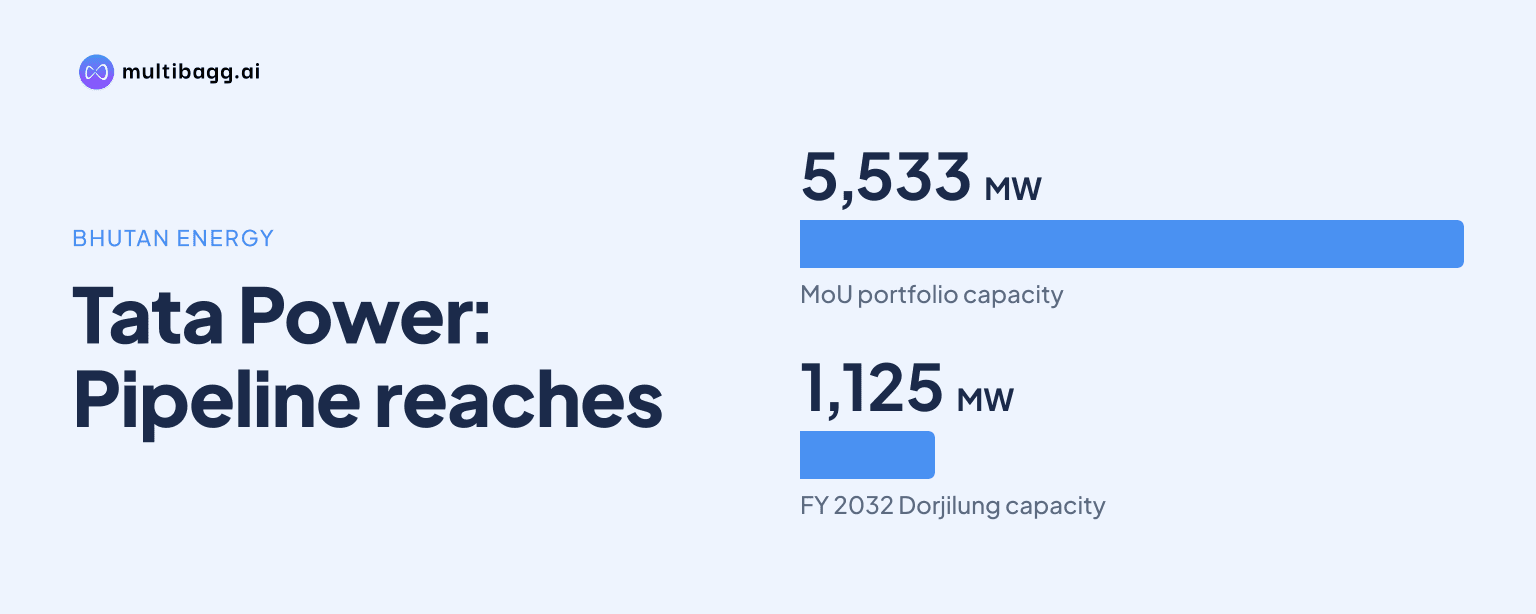
Tata Power’s Bhutan clean-energy pipeline totals 5,533 MW, led by the 600 MW Khorlochhu HPP under construction for CY 2029 and the 1,125 MW Dorjilung HPP in pre-construction for FY 2032. The listed projects have 16,790 GWh of design energy, excluding a solar generation figure that was not disclosed.
Know Tata Power Company inside out
Results, valuation, peers and who's buying, in one view.
What does Tata Power’s Bhutan agreement include?
Tata Power has signed a memorandum of understanding with Druk Green Power to develop a 5,533 MW Bhutan portfolio across hydropower, pumped storage and solar. The programme includes six named hydro or pumped-storage developments and a 500 MW solar project. The presentation identifies varying project stages but does not disclose an aggregate investment figure, a final construction timetable or a commissioning date for the whole 5,533 MW portfolio.
The portfolio is set against Bhutan’s stated 2040 vision of 15 GW of hydropower and 5 GW of solar capacity. Bhutan has 2.4 GW of installed capacity, 2.8 GW under execution and 10.9 GW of proposed projects in the presentation. Tata Power’s 5,533 MW list is therefore a development pipeline, rather than reported operating generation capacity, because several projects remain at memorandum, detailed-project-report or pre-feasibility stages.
Tata Power’s two projects with disclosed ownership, Khorlochhu and Dorjilung, total 1,725 MW. Tata Power holds a 40% stake in each of these plants, while the presentation gives no equivalent ownership disclosure for the 404 MW Merak Amari I and II, 740 MW Gongri, 1,800 MW Jeri Pumped Storage, 364 MW Chamkharchhu-IV or 500 MW solar project. This separates the equity information for the first two hydro plants from the wider MoU pipeline.
Which Tata Power hydro projects are moving forward?
Tata Power’s Khorlochhu HPP is in construction and Dorjilung HPP has begun pre-construction, making them the two most advanced projects in the Bhutan list. Khorlochhu has 600 MW of installed capacity and projected design energy of 2,524 GWh, with commissioning expected in CY 2029. Dorjilung is larger at 1,125 MW and 4,504 GWh of design energy, but its expected commissioning is later, in FY 2032.
Khorlochhu has a 30-year power purchase agreement with Tata Power Trading Company Ltd, with Uttar Pradesh Power Corporation Ltd identified as the offtaker. Its levelised tariff is Rs 6.75 per kilowatt-hour, including the trading margin of Tata Power Trading Company Ltd. The presentation provides this specific offtake term and tariff for Khorlochhu, but does not disclose comparable power-sale arrangements for Dorjilung or the other Bhutan assets.
Dorjilung has signed World Bank financing agreements and is described by Tata Power as Bhutan’s largest public-private partnership hydro-power project. Infrastructure and pre-construction works have been awarded, while the main civil-works package is scheduled for award in Q4 FY27. The CY 2029 target for Khorlochhu and FY 2032 target for Dorjilung correspond with their disclosed stages, with one in construction and the other progressing through pre-construction packages.
Got a follow-up? Ask IRIS
What projects make up Tata Power’s 5,533 MW portfolio?
Tata Power’s listed capacity is distributed across projects from construction through to pre-feasibility. Khorlochhu and Dorjilung together account for 1,725 MW, or about 31% of the 5,533 MW total, and 7,028 GWh of the 16,790 GWh design-energy total. The 500 MW solar project is included in total capacity, although the presentation does not state its design energy or development status.
Jeri Pumped Storage is the largest individual development at 1,800 MW, exceeding Dorjilung’s 1,125 MW by 675 MW and Khorlochhu’s 600 MW by 1,200 MW. However, Jeri remains at the detailed project report, or DPR, stage, the same stage as the 740 MW Gongri HPP. Merak Amari I and II have a signed MoU, while the 364 MW Chamkharchhu-IV HPP is at the pre-feasibility-study, or PFS, stage.
The disclosed design-energy figures also differ by project. Dorjilung’s 4,504 GWh is the highest listed figure, ahead of Jeri’s 3,942 GWh, while Khorlochhu’s 2,524 GWh is below Gongri’s 2,721 GWh despite Gongri being only 140 MW larger. The presentation gives no design-energy number for the 500 MW solar project, so the 16,790 GWh total is based on the six hydro and pumped-storage entries.
How are Tata Power’s first two Bhutan projects structured?
Tata Power holds 40% stakes in both Khorlochhu and Dorjilung, but the presentation discloses different commercial milestones for each. Khorlochhu’s key disclosed arrangement is its 30-year power purchase agreement through Tata Power Trading Company Ltd, with Uttar Pradesh Power Corporation Ltd as offtaker and a levelised tariff of Rs 6.75 per kilowatt-hour. Dorjilung’s disclosed progress instead centres on World Bank financing agreements and awarded infrastructure and pre-construction works.
The source does not state Tata Power’s capital commitment, debt-equity mix or construction cost for either the 600 MW Khorlochhu plant or the 1,125 MW Dorjilung plant. It also does not give Dorjilung a disclosed tariff, power purchase agreement or named offtaker. These omissions mean that the presentation supports a comparison of capacity, ownership, status and target dates, but not a like-for-like comparison of project funding or contracted revenue terms.
The wider 3,808 MW balance of the Bhutan portfolio has less developed information than the first two plants. Merak Amari I and II are at a signed-MoU stage, Gongri and Jeri are progressing DPRs, Chamkharchhu-IV is in PFS, and the solar project has no status disclosed. Tata Power has therefore identified a 5,533 MW opportunity set, while project-specific contracting and execution evidence is concentrated in the 1,725 MW Khorlochhu and Dorjilung pair.
Conclusion
Tata Power’s Bhutan plan combines a 5,533 MW clean-energy development portfolio with two hydro projects that have moved beyond early studies. Khorlochhu has begun construction, a 30-year power purchase agreement and a CY 2029 target, while Dorjilung has started pre-construction, signed financing agreements and an FY 2032 target. The remaining projects account for 3,808 MW and are mainly at MoU, DPR, PFS or undisclosed stages.
The next disclosed milestone is Dorjilung’s main civil-works package award in Q4 FY27, followed by Khorlochhu’s expected commissioning in CY 2029 and Dorjilung’s expected commissioning in FY 2032. Tata Power’s future disclosures on financing, ownership, offtake, construction approvals and schedules for the 404 MW Merak Amari I and II, 740 MW Gongri, 1,800 MW Jeri, 364 MW Chamkharchhu-IV and 500 MW solar projects will determine how the wider pipeline progresses.