










Tata Power installs 426 MWp as residential sales rise
Key highlights
- Tata Power installed 426 MWp of rooftop solar in Q2 FY27, compared with 370 MWp in Q2 FY26.
- Tata Power’s residential rooftop revenue rose to Rs 2,203 crore in H1 FY27 from Rs 1,306 crore in H1 FY26.
- Tata Power’s rooftop C&I revenue was Rs 503 crore in H1 FY27, compared with Rs 649 crore a year earlier.
- Tata Power had a Rs 501 crore third-party rooftop order book, 736 channel partners and more than 3,800 retailers in Q2 FY27.
powered by IRIS
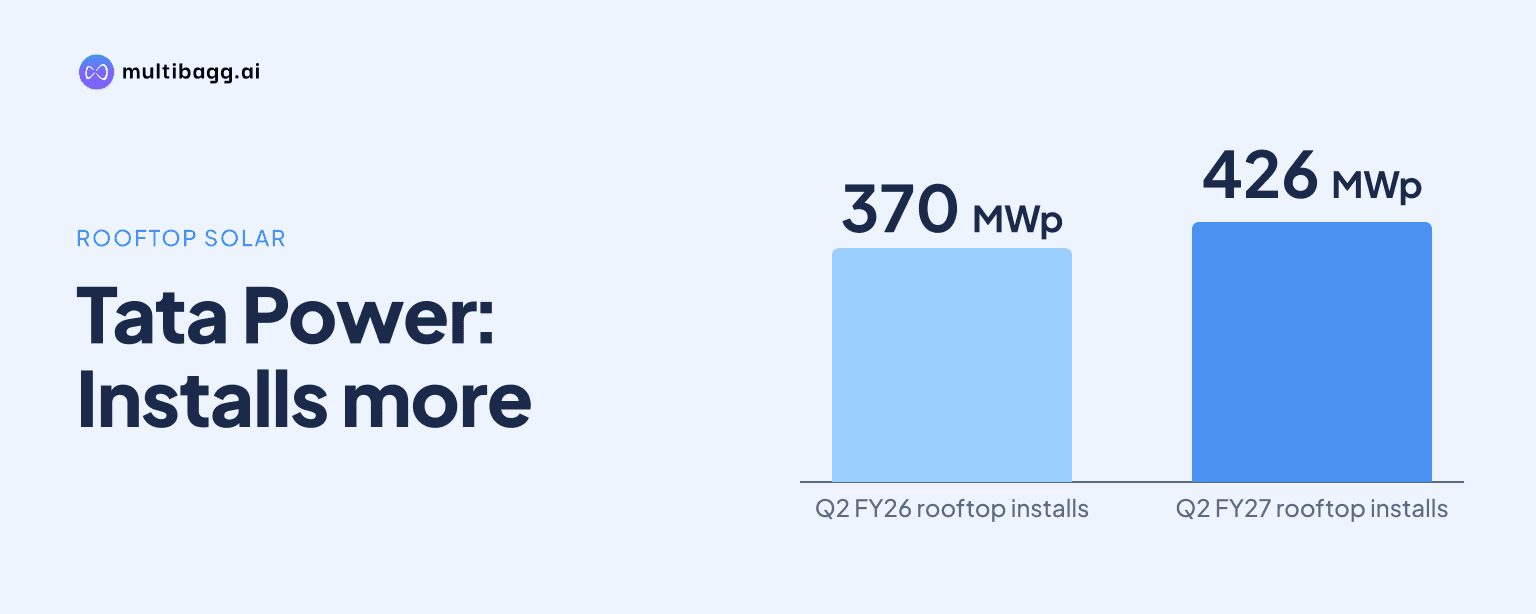
Tata Power installed 426 MWp of rooftop solar in Q2 FY27, compared with 370 MWp a year earlier, while residential rooftop revenue reached Rs 2,203 crore in H1 FY27 versus Rs 503 crore from commercial and industrial rooftop sales. The company said the residential segment is higher margin and its share increased year on year.
Know Tata Power Company inside out
Results, valuation, peers and who's buying, in one view.
How much rooftop solar did Tata Power install in Q2 FY27?
Tata Power installed 426 MWp of solar rooftop capacity in Q2 FY27, 56 MWp above the 370 MWp installed in Q2 FY26. The presentation also reported a Rs 501 crore third-party rooftop order book at Q2 FY27, providing the disclosed backlog position alongside quarterly execution.
Tata Power billed 798 MWp of rooftop orders in H1 FY27, of which residential projects accounted for 78% and commercial and industrial, or C&I, projects made up 22%. The presentation does not give an H1 FY26 billed-capacity figure, so it does not allow a like-for-like comparison of the change in billed MWp.
Rooftop revenue was Rs 1,356 crore in Q2 FY27, compared with Rs 1,350 crore in Q1 FY27 and Rs 1,133 crore in Q2 FY26. The Q2 FY27 result was Rs 376 crore below the Rs 1,732 crore reported in Q4 FY26, which was the highest quarterly rooftop revenue figure in the nine-quarter series shown.
Why did residential rooftop revenue exceed C&I revenue?
Tata Power did not disclose a causal explanation, but it reported Rs 2,203 crore of residential rooftop revenue and Rs 503 crore of C&I rooftop revenue in H1 FY27. The company labels residential rooftop as a high-margin segment and said its share increased year on year.
The segment comparison changed materially from H1 FY26. Residential rooftop revenue increased from Rs 1,306 crore to Rs 2,203 crore, while C&I revenue decreased from Rs 649 crore to Rs 503 crore. The combined revenue of the two disclosed categories increased from Rs 1,955 crore in H1 FY26 to Rs 2,706 crore in H1 FY27.
Tata Power’s disclosed figures show that the mix shift accompanied both residential revenue growth and a decline in C&I revenue during the two half-year periods. The presentation does not provide segment-level gross margin, profit, customer count or installed capacity for residential and C&I rooftop businesses, so the earnings effect of the stated higher-margin mix is not quantified.
What happened to Tata Power’s third-party rooftop order book?
Tata Power’s third-party rooftop order book was Rs 501 crore at the end of H1 FY27, down from Rs 898 crore at the end of Q4 FY26. During H1 FY27, the company received Rs 2,363 crore of orders and reported Rs 2,760 crore of revenue.
The disclosed opening order book, orders received and reported revenue reconcile to the Rs 501 crore H1 FY27 closing balance. Reported revenue exceeded new orders by Rs 397 crore, matching the decline from the Rs 898 crore opening balance. As this metric covers third-party rooftop business, it is not a measure of all Tata Power rooftop activity.
Tata Power had 736 channel partners and more than 3,800 retailers in Q2 FY27. The company said installers and dealers across Tier 1, Tier 2 and Tier 3 cities provide asset-light scale, but it did not disclose comparable prior-period partner or retailer counts to measure network growth.
Got a follow-up? Ask IRIS
How is Tata Power supporting rooftop solar execution?
Tata Power describes its rooftop offering as an integrated platform covering solar-cell and solar-module manufacturing, design and engineering, engineering procurement and construction, financing, long-term warranty and service, and battery-storage integration. For C&I customers, its offering includes rooftop solar, battery energy storage systems and energy management.
In Q2 FY27, Tata Power produced 1,000 MW of solar modules and 906 MW of cells, with module yield of 97% and cell yield of 87%. The plant generated Rs 2,180 crore of revenue, Rs 512 crore of earnings before interest, tax, depreciation and amortisation, and Rs 276 crore of profit after tax, although the company did not identify the portion of manufacturing output supplied to rooftop projects.
Tata Power also cited its customer access in Mumbai, Odisha and Delhi as part of its rooftop model, alongside its 736-partner channel network. Management said existing customer relationships can reduce acquisition costs, accelerate conversion and raise customer lifetime value, but the presentation provides no figures for these operating measures.
What rooftop goals has Tata Power set for 2030?
Tata Power has set aspirations to serve 30 lakh households and generate about Rs 30,000 crore of cumulative rooftop revenue by 2030. These are management aspirations, rather than reported results or annual guidance, and the presentation provides no annual household or revenue milestones.
The Q2 FY27 operating base included 426 MWp installed, 736 channel partners and more than 3,800 retailers. Residential projects represented 78% of the 798 MWp of rooftop orders billed in H1 FY27, but Tata Power did not disclose the number of households served by Q2 FY27, leaving progress toward the 30 lakh-household aspiration unquantified.
Conclusion
Tata Power’s rooftop data for Q2 FY27 shows increased installation activity and a revenue mix led by residential customers. Quarterly installations rose to 426 MWp from 370 MWp a year earlier, while H1 FY27 residential rooftop revenue rose to Rs 2,203 crore and C&I revenue declined to Rs 503 crore.
The next disclosed indicators are conversion of the Rs 501 crore third-party order book and the reach of the 736-partner, more-than-3,800-retailer network. Over the longer term, management’s 2030 aspirations of 30 lakh households served and about Rs 30,000 crore of cumulative rooftop revenue provide the stated benchmarks, although no annual milestones were disclosed.