










Tata Power sets 100% Clean & Green capacity target by 2045
Key highlights
- Tata Power's roadmap moves Clean & Green capacity from 44% in 2025 to 100% in 2045.
- Tata Power reported about 49% Clean & Green capacity in 2Q FY27 and about 67% after project completions.
- Scope 1 and Scope 2 emissions were 29 million tonnes of carbon-dioxide equivalent in 2026, down from 43.1 million tonnes in 2024.
- Tata Power's S&P Corporate Sustainability Assessment score was 77 in 2025-26, against a target of 80 by 2027.
powered by IRIS
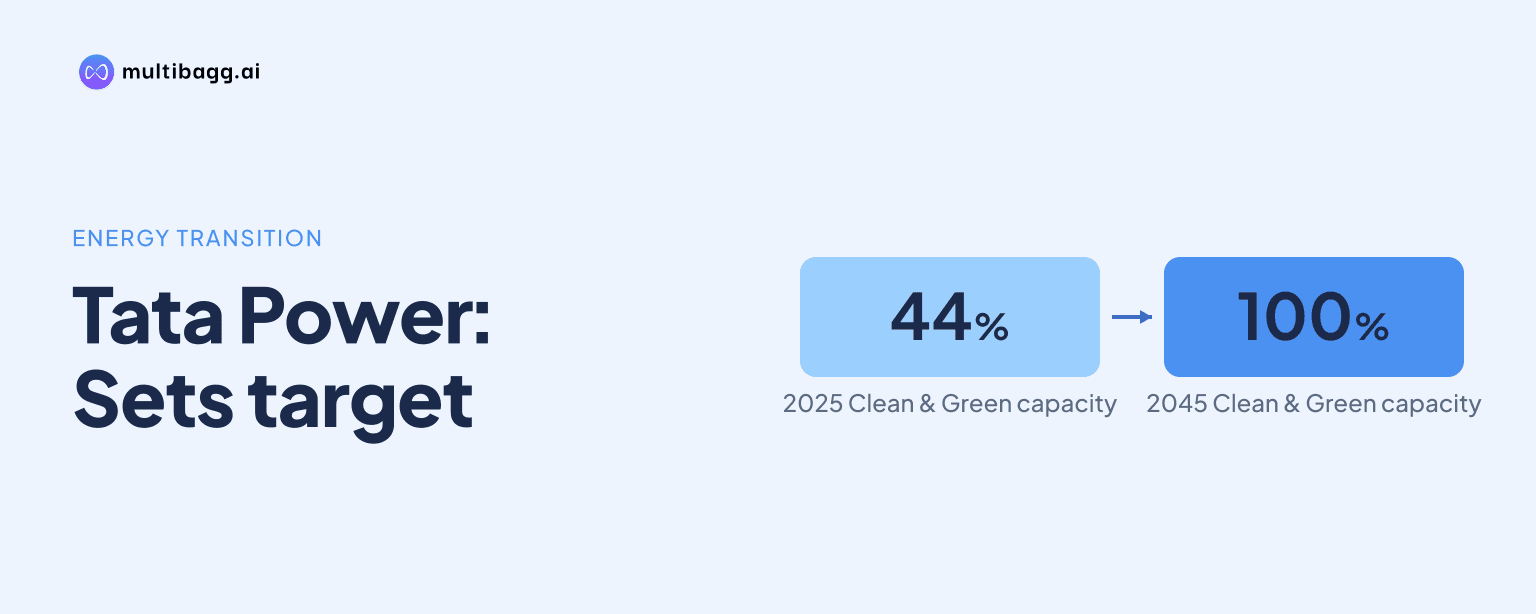
Tata Power targets 100% Clean & Green capacity by 2045, following a roadmap that shows 44% in 2025 and at least 70% by 2030. The company reported about 49% Clean & Green capacity in 2Q FY27 and says its thermal transition depends on power purchase agreement expiries, contractual obligations and asset useful lives.
Know Tata Power Company inside out
Results, valuation, peers and who's buying, in one view.
How will Tata Power reach 100% Clean & Green capacity by 2045?
Tata Power says it will transition away from its thermal portfolio in 2045 as power purchase agreements, or PPAs, for thermal capacity expire. The company qualifies the 2045 endpoint as subject to the completion of contractual obligations and the useful life of the relevant assets, rather than presenting an unconditional closure date for every thermal unit.
The roadmap shows Clean & Green capacity rising by 28 percentage points between 2015 and 2025, while thermal capacity declines by the same 28 percentage points. Tata Power expects Clean & Green assets to account for at least 70% of overall capacity in 2030, leaving thermal assets at 30% before the proposed 2045 transition.
Tata Power describes its 2015 portfolio as largely coal-based and says it was built to meet the energy demands of a developing India. Its disclosed pathway combines Clean & Green capacity expansion through 2030 with the later expiry of thermal PPAs, subject to the stated contractual and asset-life conditions.
What is Tata Power's latest Clean & Green capacity progress?
Tata Power reported about 49% Clean & Green capacity in 2Q FY27, compared with the 16% baseline disclosed for 2015, and said this could reach about 67% after project completions. The 2Q FY27 progress value is 5 percentage points above the 44% figure shown for 2025 in the longer-term capacity roadmap.
The presentation labels the figures differently: 44% is the 2025 point in the 2015-2045 roadmap, while 49% is the progress value in 2Q FY27. Tata Power does not reconcile the two measures, but both disclosures show movement toward its 70% Clean & Green capacity target for 2030.
The increase from about 49% in 2Q FY27 to about 67% after project completions would be about 18 percentage points. That prospective 67% figure remains below the at-least-70% target for 2030, indicating that further portfolio change would be needed to reach the stated threshold.
Tata Power also includes technology in its proposed Utility of the Future, listing the internet of things, smart grids, battery energy storage systems, green hydrogen, robotic panel cleaning and small modular reactors. The presentation does not disclose capacity additions, investment amounts or commissioning dates for these technologies.
Got a follow-up? Ask IRIS
How much has Tata Power reduced emissions, water use and waste?
Tata Power reported absolute Scope 1 and Scope 2 carbon emissions of 29 million tonnes of carbon-dioxide equivalent in 2026, down from a 43.1 million-tonne baseline in 2024. The company attributes the decrease to the Mundra shutdown and targets zero absolute Scope 1 and Scope 2 emissions by 2045.
The reported emissions reduction was 14.1 million tonnes of carbon-dioxide equivalent between 2024 and 2026. Tata Power also reported total water consumption of 266 million cubic metres in 2026, compared with 313 million cubic metres in 2024, and similarly linked the decline to the Mundra shutdown.
Waste sent to landfill was 21 tonnes in 2026, down from 40 tonnes in 2024, against Tata Power's zero-waste-to-landfill target for 2030. The company lists beneficial utilisation of ash waste and waste-management plans for biodegradable, plastic and electronic waste as ongoing actions.
Tata Power targets water neutrality by 2030, although the presentation gives no numerical water-consumption target for that year. It also has a no-net-loss-to-biodiversity aspiration for 2030 and says biodiversity action plans cover operations in 21 states across thermal, hydro, transmission and distribution, and renewable energy.
How are Tata Power's ESG ratings and wider targets changing?
Tata Power's S&P Corporate Sustainability Assessment score rose to 77 in the 2025-26 update from 68 in 2024, with a stated target of 80 out of 100 by 2027. The presentation says a higher S&P Corporate Sustainability Assessment score is better and lists an environmental, social and governance action plan and gap analysis as ongoing work.
Its CDP Climate Change rating was B in the update published in January 2026, compared with B- in 2024, while the CDP Water rating was also B versus B-. Tata Power's MSCI rating was A in April 2026 and in 2024, after BBB in 2023 and 2022.
Tata Power reported a Sustainalytics score of 42.9 in September 2026, compared with 37.4 in 2024. The presentation says a lower Sustainalytics score is better, so this measure moved in the opposite direction to the S&P Corporate Sustainability Assessment score over the reported comparison period.
Its social targets include training more than 35 lakh people in digital and financial inclusion by 2030, making more than 4 lakh youth employable by 2030, and raising gender diversity to 22% by 2030. Gender diversity was 11% in 2026 versus 10% in 2024, while the education progress measure was 17.46 lakh beneficiaries in 2026 against a 35.35 lakh target for 2030.
Tata Power also reported 3.10 lakh employability and employment beneficiaries in 2026, up from 2.76 lakh in 2024, against a 4 lakh target for 2030. Entrepreneurship beneficiaries rose to 32,000 in 2026 from 30,000 in 2024, with a target of 47,000 by 2030; these social measures sit alongside, rather than measure, the capacity transition.
Conclusion
Tata Power's stated transition combines Clean & Green capacity expansion from 44% in 2025 to at least 70% in 2030 with a later thermal exit linked to PPA expiries. The about-49% Clean & Green progress figure in 2Q FY27, the reduction in 2026 emissions and water use, and the 77 S&P Corporate Sustainability Assessment score are reported markers of that broader strategy.
The next disclosed milestones are project completions that Tata Power says could lift Clean & Green capacity to about 67%, progress toward the 70% 2030 capacity target, and the contractual and asset-life conditions attached to the 2045 thermal transition. Tata Power also has 2030 deadlines for water neutrality and zero waste to landfill, plus a 2027 S&P Corporate Sustainability Assessment target of 80 out of 100.