










TCAIL order book of Rs 16,500 crore exceeds FY30 target
Key highlights
- TCAIL disclosed an approximately Rs 16,500 crore incremental lifetime order book as of September 30, 2026.
- TCAIL's approximately Rs 875 crore export order book is included within the Rs 16,500 crore total.
- TCAIL said the order book exceeds 100% of its FY30 revenue target and provides approximately five to six years of visibility.
- TCAIL's H1 FY27 VAR rose 25.3% year on year to Rs 2,904.4 crore.
powered by IRIS
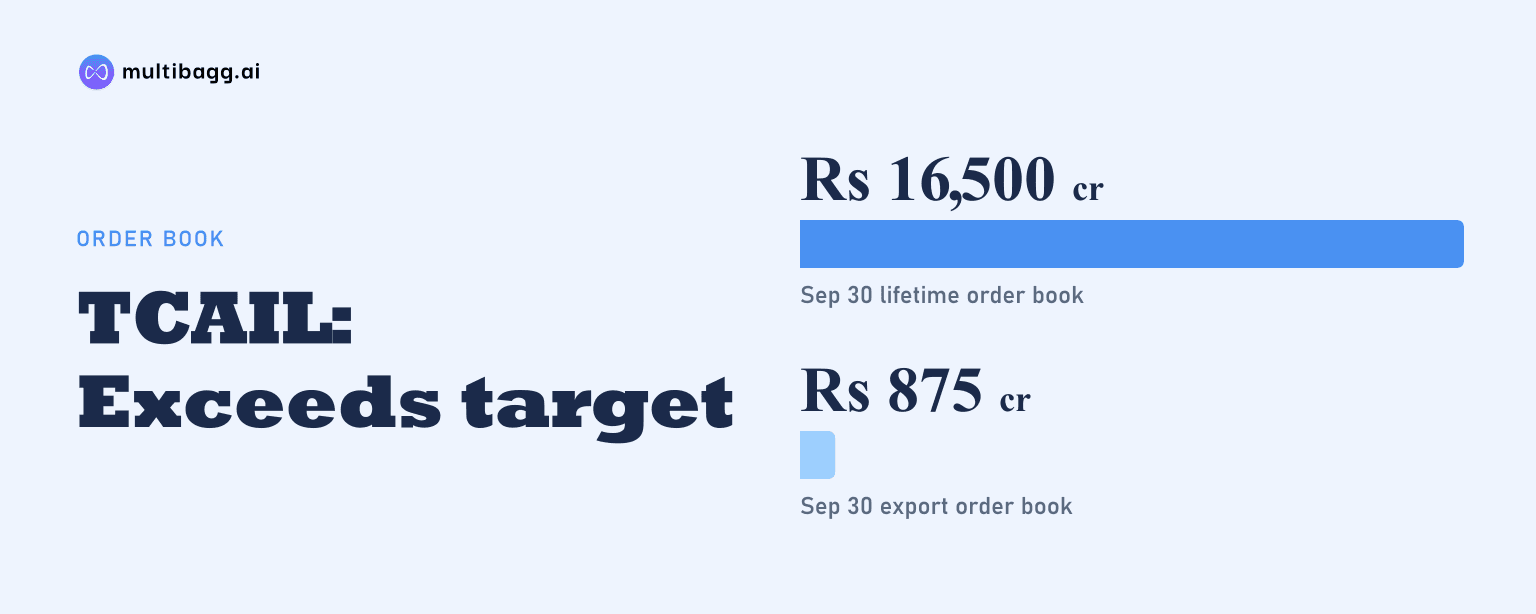
Tenneco Clean Air India Limited (TCAIL) said its Rs 16,500 crore incremental lifetime order book as of September 30, 2026 exceeded 100% of its FY30 revenue target. The order book includes Rs 875 crore of export orders and consists of original equipment manufacturer (OEM)-confirmed volume and price awards that had not entered production.
Know Tenneco Clean Air India inside out
Results, valuation, peers and who's buying, in one view.
What does TCAIL's Rs 16,500 crore order book represent?
TCAIL's Rs 16,500 crore figure is its incremental lifetime order book, covering all secured orders for which OEMs had confirmed volume and price but which were not in production on September 30, 2026. It measures future programme awards rather than revenue recorded in Q2 FY27 or H1 FY27.
The company said the order book enhances revenue visibility for approximately five to six years. Management said it supports a double-digit compound annual growth rate (CAGR) trajectory from FY25 to FY30, although the presentation does not disclose annual conversion rates, programme start dates or customer-level values.
The Rs 875 crore export order book is included within, rather than added to, the Rs 16,500 crore total. TCAIL did not provide a domestic order-book value or a split of the September 30, 2026 order book by customer, product segment or production commencement date.
How does TCAIL's order book compare with its FY30 target?
TCAIL said its Rs 16,500 crore lifetime order book covers more than 100% of its FY30 revenue target. This is a comparison between cumulative future programme awards and management's revenue target for FY30, rather than a comparison with one year's reported sales.
The presentation does not state the rupee value of the FY30 target, so the amount by which the order book exceeds it cannot be calculated. It also does not say whether the FY30 target is based on revenue from operations or value added revenue (VAR), the measure that excludes pass-through substrate costs.
For context, H1 FY27 revenue from operations was Rs 3,260 crore, up 27.2% year on year, while H1 FY27 VAR was Rs 2,904.4 crore, up 25.3%. The Rs 16,500 crore order book is larger than either six-month measure, but TCAIL expects it to convert over approximately five to six years.
Management linked its double-digit FY25-FY30 CAGR outlook to the order book, rising domestic and export penetration, technology-led wins, and investment in capacity and localisation. That outlook is forward-looking, and TCAIL's presentation identifies macroeconomic conditions, competition, regulation, customer preferences and execution as risks to actual outcomes.
Got a follow-up? Ask IRIS
Which TCAIL businesses support the order pipeline?
TCAIL said the ART business secured multiple domestic and international platform wins in H1 FY27, including content on three vehicle platforms for a leading Indo-Chinese joint venture. ART also won suspension business in the three-wheeler segment for an Indo-Korean joint venture, two next-generation models with a Japanese passenger-vehicle OEM, and three platforms with a Vietnamese OEM.
ART had a 55% share of the entire passenger-vehicle market in H1 FY27, according to the CRISIL report cited by TCAIL. The company also reported the start of production for the three-door Thar suspension programme and said it supplied India's first locally produced semi-active CVSAe product, though it did not disclose the values of those awards.
In CA and PT, TCAIL cited a commercial-vehicle exhaust hot-end programme for an Indian commercial-vehicle OEM, a cold-end assembly programme for a European OEM in compressed natural gas applications, and a spark-plug award from another European OEM. CA had a 59% share of the entire commercial-truck market in H1 FY27, based on the cited CRISIL report.
What financial performance accompanies TCAIL's order book?
TCAIL reported Q2 FY27 VAR of Rs 1,522.9 crore, up 32.2% year on year, and H1 FY27 VAR of Rs 2,904.4 crore, up 25.3%. Revenue from operations rose 34.2% to Rs 1,720 crore in Q2 FY27 and 27.2% to Rs 3,260 crore in H1 FY27, which management attributed to higher volumes and new programme launches.
Earnings before interest, tax, depreciation and amortisation (EBITDA) reached Rs 261.6 crore in Q2 FY27 and Rs 508.5 crore in H1 FY27, rising 20.7% and 14.1% year on year, respectively. EBITDA margin was 17.2% in Q2 and 17.5% in H1, down 165 basis points and 172 basis points year on year.
Profit after tax was Rs 173.4 crore in Q2 FY27, up 15.0%, and Rs 338.6 crore in H1 FY27, up 6.2%. TCAIL said Q2 FY26 and H1 FY26 included one-time post-tax interest income of Rs 6.7 crore and Rs 25.4 crore from an entity sale; excluding those amounts, it put Q2 and H1 FY27 profit growth at approximately 20.4% and 15.4%.
What should TCAIL's order-book conversion depend on?
TCAIL said it is investing in capacity expansion, localisation and innovation, including a new West India Clean Air manufacturing facility with an investment of Rs 45 crore. The presentation does not provide the facility's capacity, commissioning date, customer allocation or the portion of the Rs 16,500 crore order book it is expected to serve.
Delivery of the September 30, 2026 order book depends on OEM-confirmed programmes moving into production and generating volumes over the stated five-to-six-year visibility period. TCAIL reported free-cash-flow-to-EBITDA conversion of 50% in Q2 FY27 and 69% in H1 FY27, and said it remained net debt free in H1 FY27.
Conclusion
TCAIL has disclosed Rs 16,500 crore of confirmed but unproduced lifetime orders, including Rs 875 crore of exports, that management says exceed 100% of its FY30 revenue target. The pipeline accompanies H1 FY27 VAR growth of 25.3% and covers ART awards in passenger vehicles and three-wheelers alongside CA and PT wins in commercial vehicles, compressed natural gas and spark plugs.
The next disclosures to watch are conversion of the confirmed awards into production over the indicated five-to-six-year period, progress on the Rs 45 crore West India Clean Air facility, and the effect of commercial recovery and productivity measures on margins. TCAIL has not disclosed the FY30 target value, programme-level order values or an order-book conversion schedule.