










Tenneco Clean Air India approves 0.3m-unit western factory
Key highlights
- Tenneco Clean Air India approved a western India factory on November 4, 2026.
- The project will add about 0.3 million catalytic converters of annual capacity.
- Existing annualised hot-end capacity of about 2 to 2.2 million units was about 99% utilised.
- Tenneco Clean Air India expects to invest about Rs 45 crore from internal accruals over the next two to three financial years.
powered by IRIS
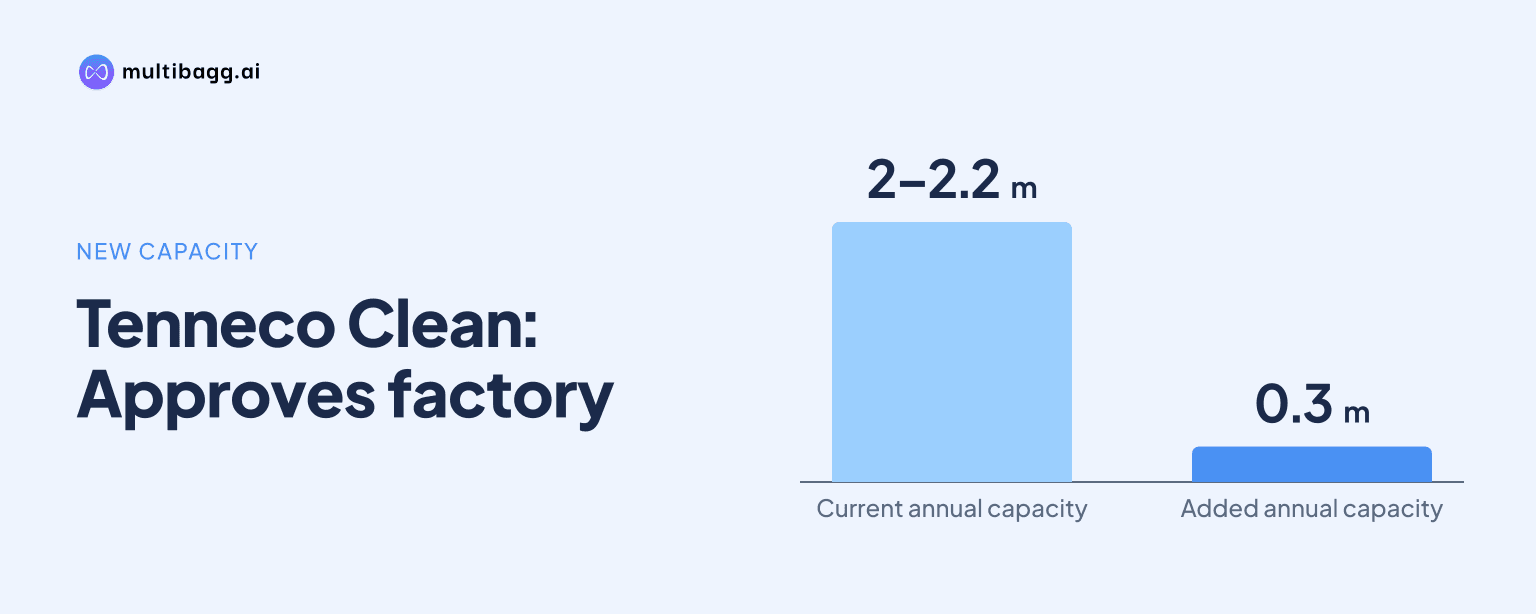
On November 4, 2026, Tenneco Clean Air India Limited approved a western India factory planned to add about 0.3 million catalytic converters annually after its existing annualised capacity of about 2 to 2.2 million units reached about 99% utilisation. Tenneco Clean Air India expects to install the capacity in phases over the next two to three financial years.
Know Tenneco Clean Air India inside out
Results, valuation, peers and who's buying, in one view.
What did Tenneco Clean Air India approve on November 4, 2026?
Tenneco Clean Air India approved a proposal to establish a new factory in western India for hot-end products, which the filing identifies as catalytic converters. The Board approved the proposal at its November 4, 2026 meeting, held from 8:00 p.m. to 9:28 p.m. Indian Standard Time.
The project covers about 0.3 million units of additional annual catalytic-converter capacity. Tenneco Clean Air India said the addition will be made in phases during the next two to three financial years, rather than providing a single commissioning date.
The filing does not name the factory's state or exact location, identify customers, or specify the capacity planned for each phase. It also does not disclose whether the new facility will make particular catalytic-converter types within the stated 0.3 million-unit capacity.
Why is Tenneco Clean Air India expanding catalytic-converter production?
Tenneco Clean Air India is expanding because its existing annualised hot-end capacity was about 99% utilised and management cited growth in demand as a rationale. The company also said the western India project is intended to improve its manufacturing footprint in that region.
The current capacity range of about 2 to 2.2 million units depends on product mix, according to the November 4 disclosure. This means annual output is not expressed as one fixed number, because different catalytic-converter products affect the rated capacity of the existing facilities.
At about 99% utilisation, the company disclosed only limited unused capacity on its annualised measure before the proposed expansion. The filing does not quantify demand growth, name vehicle manufacturers or vehicle programmes, or state whether the western India factory will supply domestic or export customers.
Got a follow-up? Ask IRIS
How large is the planned capacity addition?
Tenneco Clean Air India's proposed 0.3 million-unit addition equals about 14% to 15% of its present 2 to 2.2 million-unit annualised catalytic-converter capacity. That comparison is calculated from the disclosed capacity figures, not a percentage target provided by Tenneco Clean Air India.
Once all phases are completed, the calculated capacity range would be about 2.3 to 2.5 million units annually, compared with the current 2 to 2.2 million units. The change represents additional hot-end capacity, while the filing does not state the utilisation rate expected when each new phase begins production.
Tenneco Clean Air India reported the project in production units rather than revenue or profit terms. The November 4 announcement does not provide expected converter pricing, incremental sales, operating profit, return targets or customer orders associated with the 0.3 million-unit addition.
How will Tenneco Clean Air India fund and execute the factory?
Tenneco Clean Air India plans to fund the western India factory through internal accruals, with required investment of about Rs 45 crore. The company disclosed the outlay as about INR 450 million and did not announce debt, equity issuance or other external financing for the project.
Execution will occur in phases over the next two to three financial years. Tenneco Clean Air India did not split the about Rs 45 crore investment by year, disclose the size of the first capacity phase, or give separate construction, machinery or working-capital figures.
Internal accruals are the only financing mechanism stated in the filing. The disclosure does not state available internal cash, forecast operating cash generation, the impact on dividends or borrowings, or a date for site acquisition, regulatory approvals or production start.
Conclusion
Tenneco Clean Air India has approved a response to about 99% utilisation of its 2 to 2.2 million-unit annual catalytic-converter capacity. The proposed western India factory would add about 0.3 million units in phases, lifting calculated total capacity to about 2.3 to 2.5 million units, while using about Rs 45 crore of internal accruals.
The next disclosed point to watch is implementation over the next two to three financial years. Future announcements may clarify the factory location, phase-wise commissioning, deployment of the about Rs 45 crore budget and utilisation of the added catalytic-converter capacity.