










TCI Express Q2 FY27 EBITDA Rises 10.8% to ₹43 Crore Standalone
Key highlights
- TCI Express reported Q2 FY27 standalone EBITDA of ₹43.0 crore, up 10.8% year-on-year.
- Standalone total income increased 8.8% year-on-year to ₹339.3 crore in Q2 FY27.
- Standalone PAT rose 6.0% year-on-year to ₹26.7 crore, while EBITDA margin was 12.7%.
- TCI Express has planned FY27 capital expenditure of ₹125 crore to ₹140 crore.
powered by IRIS
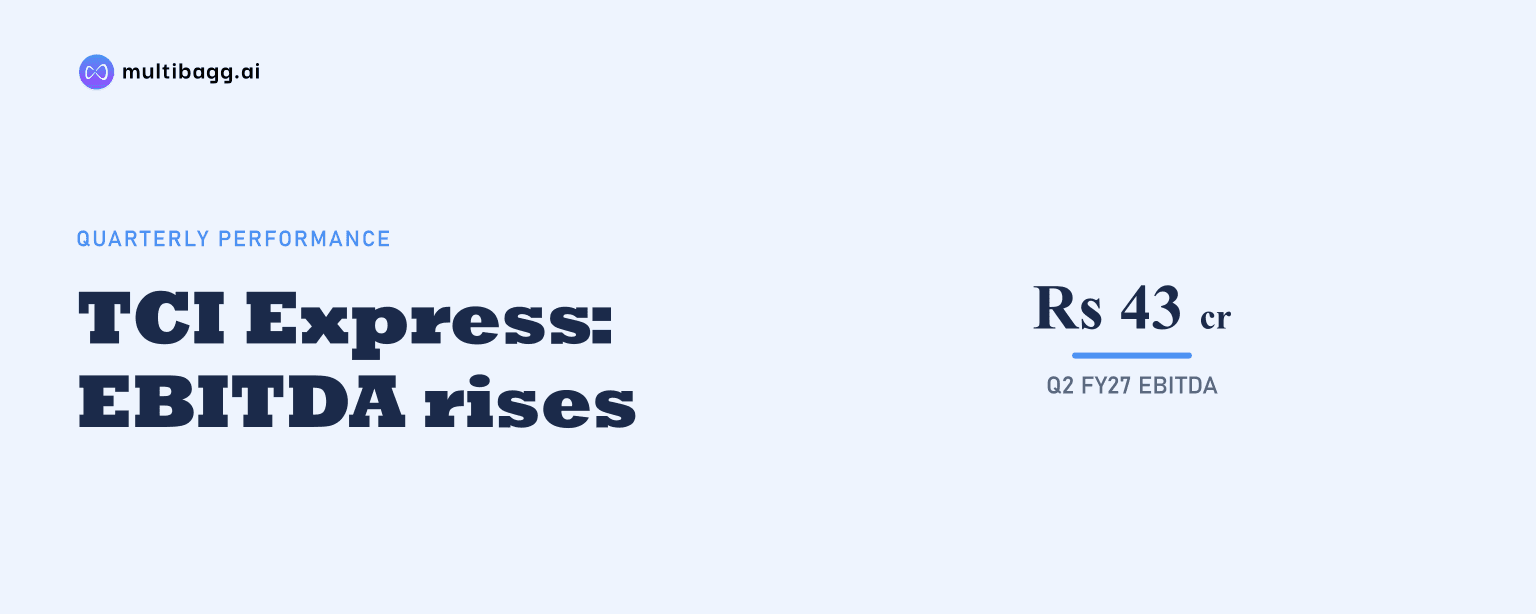
TCI Express Limited reported standalone EBITDA of ₹43.0 crore for Q2 FY27, up 10.8% year-on-year, on total income of ₹339.3 crore, which increased 8.8% from ₹312.0 crore in the corresponding quarter last year. The result is relevant because the company is pursuing growth through air, e-commerce, rail-linked multimodal services, automation and planned capital expenditure.
Know TCI Express inside out
Results, valuation, peers and who's buying, in one view.
What did TCI Express report for Q2 FY27?
TCI Express reported a 10.8% year-on-year rise in standalone EBITDA to ₹43.0 crore in the quarter ended September 30, 2026. Its EBITDA margin stood at 12.7%, while standalone profit after tax rose 6.0% year-on-year to ₹26.7 crore. Total income increased 8.8% to ₹339.3 crore from ₹312.0 crore a year earlier.
A separate results summary in the disclosed material stated that revenue from operations was ₹338 crore, up 9.6% year-on-year, and net profit was ₹23.5 crore, down 1.7% year-on-year. The supplied disclosures do not explain the difference between this net-profit figure and the standalone PAT of ₹26.7 crore cited in the investor presentation summary. Investors should therefore refer to the detailed filed financial statements for the relevant standalone and consolidated line items.
The company said that Air Express and E-commerce were the principal drivers of growth during the quarter. Surface Express continued to be the largest revenue contributor, underlining its central role in TCI Express's operating mix even as newer and faster delivery categories expand.
What drove TCI Express's quarterly performance?
TCI Express attributed the quarter's growth primarily to its Air Express and E-commerce businesses, while Surface Express retained its position as the largest source of revenue. The mix reflects the company's focus on multimodal logistics, combining road-based express freight with air, rail and e-commerce-linked services.
Earlier management commentary for FY27 had pointed to strong momentum in selected segments. E-Commerce Express was stated to have grown 63%, Air Express 30%, and International Express 25% in the Q1 FY27 discussion. These figures provide context for the company's emphasis on higher-growth service categories in its Q2 presentation.
The company has also linked its strategy to automation and capacity investment. Its disclosed FY27 capital expenditure plan is ₹125 crore to ₹140 crore. The planned spending is intended to support expansion, although the provided material does not specify project-wise allocations, commissioning dates or expected financial returns.
What is TCI Express's FY27 growth and margin guidance?
TCI Express has guided for FY27 volume growth of 11% to 12%, with price increases of around 3%, resulting in indicated overall revenue growth of 13% to 15%. Management had also reiterated a broader FY27 growth guidance of 12% to 13% in its earlier Q1 FY27 commentary.
On profitability, management has indicated an EBITDA-margin improvement of 100 to 150 basis points for FY27. The Q2 standalone EBITDA margin of 12.7% provides an early reported measure against that objective. The available material also refers to an 11.7% margin base, though it does not provide a complete reconciliation of the base period or the assumptions behind the improvement target.
The guidance depends on volumes gaining pace and margins improving, according to the presentation summary. Revenue growth could therefore be shaped by both freight volumes and the company's ability to implement price increases, while profitability will be influenced by service mix, operating efficiency and the costs associated with expansion.
Got a follow-up? Ask IRIS
What is the status of the ₹51.36 crore GST demand?
TCI Express disclosed a pending GST demand of ₹51.36 crore raised by the Additional Commissioner of Central Goods and Services Tax, Gurugram. The company has filed an appeal before the Goods and Services Tax Appellate Tribunal, or GSTAT.
The company said it does not expect an adverse financial outcome from the matter and has not made a provision in the current financial results. This is the company's stated assessment and does not represent a final resolution of the case. The eventual financial impact, if any, will depend on the appellate process and the resulting order.
For investors, the disclosure is relevant because the demand amount is material relative to quarterly profitability. TCI Express's standalone PAT for Q2 FY27 was ₹26.7 crore, while the GST demand was ₹51.36 crore. However, no provision was recorded because management does not currently anticipate an adverse outcome.
What board and investor-relations actions were announced?
TCI Express's board meeting on November 5, 2026 approved the Q2 FY27 results and proposed the appointment of Ranjana Agarwal as a Non-Executive Independent Director for a five-year term. The appointment remains subject to shareholder approval through a postal ballot.
The company had previously informed exchanges on October 30, 2026 that it would hold a virtual earnings conference call on November 5 at 5:00 PM IST. PhillipCapital (India) Private Limited organised the call to discuss unaudited standalone and consolidated results for Q2 and the first half of FY27.
Managing Director Chander Agarwal, Executive Director and Chief Financial Officer Mukti Lal, and Chief Business Officer Pabitra Mohan Panda were named as speakers. The call was intended to address the financial results, business performance and management's outlook for the period.
Conclusion
TCI Express delivered higher standalone total income and EBITDA in Q2 FY27, with Air Express and E-commerce contributing to growth while Surface Express remained its largest revenue stream. The 12.7% EBITDA margin, planned ₹125 crore to ₹140 crore capex programme and stated volume-growth guidance place execution in multimodal expansion and automation at the centre of the FY27 strategy.
The next points to watch are progress against the company's 11% to 12% volume-growth guidance, the stated 100 to 150 basis-point EBITDA-margin improvement target and developments in the ₹51.36 crore GST appeal before GSTAT. Shareholders will also consider the proposed appointment of Ranjana Agarwal through the announced postal-ballot process.