










TCI Express Q2 EBITDA margin reaches 12.7%, H1 PAT margin falls
Key highlights
- TCI Express reported Q2 FY27 EBITDA of Rs 43.0 crore and a 12.7% margin, versus 11.7% in Q1 FY27.
- TCI Express H1 FY27 PAT margin was 7.5%, below 7.7% in H1 FY26 and 8.1% in H1 FY25.
- E-Commerce Express revenue grew 51.6% year on year in Q2 FY27, the fastest growth among disclosed verticals.
- TCI Express spent Rs 80 crore on capital expenditure in H1 FY27 and reported free cash flow of Rs (52) crore.
powered by IRIS
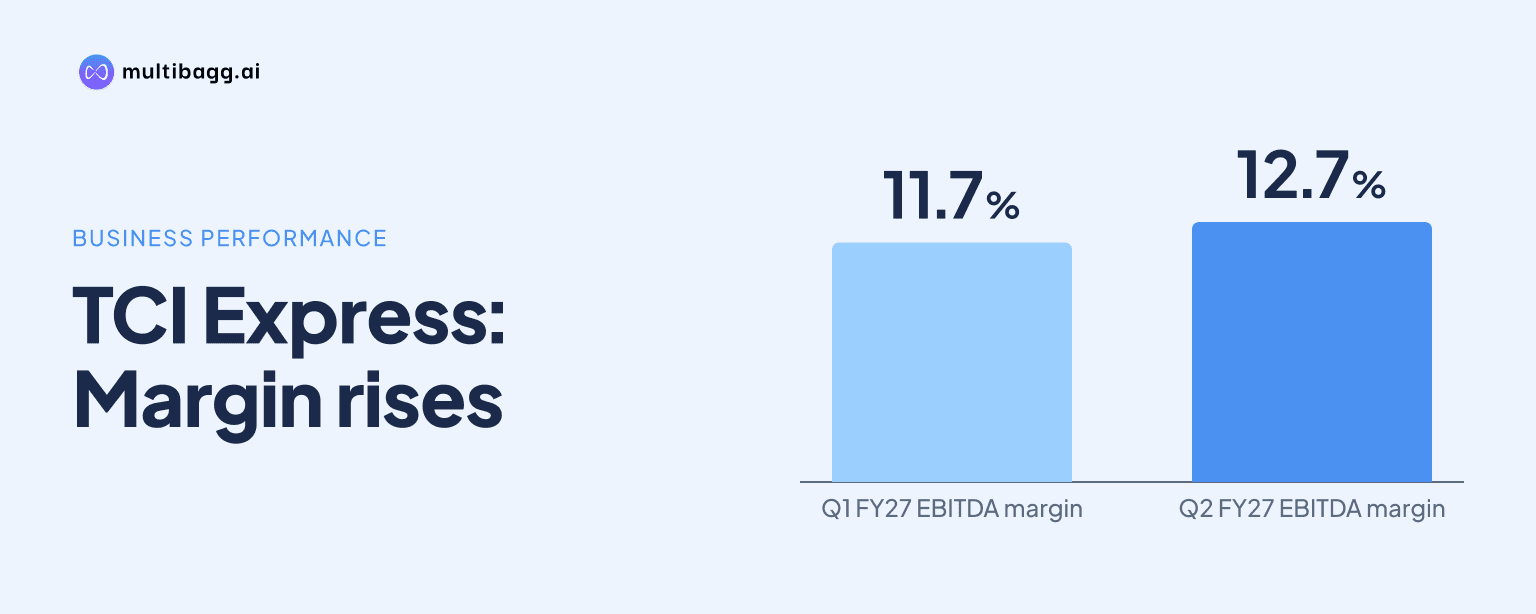
TCI Express reported a 12.7% earnings before interest, tax, depreciation and amortisation (EBITDA) margin in the second quarter (Q2) of fiscal year 2027 (FY27), up from 11.7% in Q1 FY27, while first-half (H1) profit after tax (PAT) margin was 7.5%, below 7.7% a year earlier.
Know TCI Express inside out
Results, valuation, peers and who's buying, in one view.
How did TCI Express improve profitability in Q2 FY27?
TCI Express improved Q2 FY27 EBITDA to Rs 43.0 crore, up 10.8% year on year from Rs 38.8 crore in Q2 FY26 and 16.3% sequentially from Rs 37.0 crore in Q1 FY27. The EBITDA margin rose by 0.3 percentage points from 12.4% a year earlier and by 1.0 percentage point from 11.7% in Q1 FY27, based on total income. TCI Express states that EBITDA includes other income.
Total income reached Rs 339.3 crore in Q2 FY27, increasing 8.8% from Rs 312.0 crore a year earlier and 7.6% from Rs 315.3 crore in the preceding quarter. Income from operations was Rs 335.9 crore, up 8.9% year on year, while other income was Rs 3.4 crore versus Rs 3.5 crore in Q2 FY26. EBITDA therefore rose faster than total income during the quarter.
PAT was Rs 26.7 crore in Q2 FY27, up 6.0% from Rs 25.2 crore in Q2 FY26 and 19.2% from Rs 22.4 crore in Q1 FY27. Its 7.9% margin recovered from 7.1% in Q1 FY27 but remained 0.2 percentage points below the 8.1% recorded in Q2 FY26. Profit before tax (PBT) margin followed the same pattern, reaching 10.4% from 9.4% sequentially but remaining below 10.6% a year earlier.
How did H1 FY27 margins compare with earlier periods?
TCI Express reported H1 FY27 PAT of Rs 49.0 crore, 6.1% above Rs 46.2 crore in H1 FY26, but its PAT margin declined to 7.5% from 7.7%. The margin was also below 8.1% in H1 FY25, even though PAT was close to the Rs 49.4 crore reported in that earlier half-year. The disclosed comparisons show that the first-half revenue increase did not restore the PAT margin of the preceding two H1 periods.
H1 FY27 total income rose 8.7% to Rs 654.6 crore from Rs 602.2 crore in H1 FY26, reversing the decline from Rs 609.2 crore in H1 FY25 to Rs 602.2 crore in H1 FY26. EBITDA rose 10.8% to Rs 80.0 crore from Rs 72.2 crore, and its margin improved to 12.2% from 12.0%. However, that margin remained 0.3 percentage points below the 12.5% achieved in H1 FY25.
The difference is more visible below EBITDA. H1 FY27 PBT was Rs 64.7 crore, higher than Rs 61.1 crore in H1 FY26 but below Rs 65.5 crore in H1 FY25. PBT margin fell to 9.9%, compared with 10.1% and 10.7% in the respective prior half-years. Earnings per share (EPS) were Rs 12.8 in H1 FY27, compared with Rs 12.0 in H1 FY26, a 6.2% increase.
Got a follow-up? Ask IRIS
Which TCI Express business lines supported revenue growth?
TCI Express said Surface Express, its largest contributor to revenue and profitability, grew 9.4% year on year and 7.4% quarter on quarter in Q2 FY27. H1 FY27 Surface Express revenue growth was 9.1%, supported, according to management, by pricing revisions, higher yields, enterprise-customer business and new accounts. TCI Express added 10 Surface Express branches during Q2 FY27 and reported capacity utilisation of 84%.
Air Express grew faster than the core surface segment. Domestic Air Express revenue rose 29.4% year on year and 13.8% sequentially in Q2 FY27, while H1 growth was 29.1%. International Air Express grew 26.1% year on year and 24.9% quarter on quarter, with H1 growth of 26.7%. Management attributed the expansion to new customers and higher existing-account activity, alongside overseas partners and additional routing options for International Air Express.
E-Commerce Express was the fastest-growing vertical, with Q2 revenue up 51.6% year on year and 23.8% sequentially, while H1 growth was 56.1%. TCI Express linked this increase to onboarding enterprise marketplaces, dedicated sales and operations teams, and integrations with the Open Network for Digital Commerce (ONDC) and Unicommerce. Rail Express recorded 25.9% quarter-on-quarter growth in Q2 FY27, with management citing improved shipment activity and operational execution.
What do TCI Express cash flow and balance-sheet figures show?
TCI Express reported cash flow from operations of Rs 28 crore in H1 FY27, compared with Rs 104 crore for FY26 and Rs 118 crore for FY25. Free cash flow was Rs (52) crore in H1 FY27, following Rs 24 crore in FY26, as TCI Express incurred Rs 80 crore of capital expenditure during the half-year. The spending was allocated to branch-network expansion, sorting-centre construction and information-technology infrastructure.
At September 2026, TCI Express had total debt of Rs 15.2 crore, comprising no long-term debt and Rs 15.2 crore of short-term debt. Liquid assets were Rs 92.7 crore, resulting in net cash of Rs 77.4 crore, compared with net cash of Rs 136.4 crore at March 2026. Total equity was Rs 878.5 crore at September 2026, up from Rs 828.8 crore at March 2026.
Working-capital days were unchanged sequentially in Q2 FY27: payables were 32 days and receivables were 59 days, the same as Q1 FY27. Net working-capital days remained 27, compared with 20 days in Q2 FY26. TCI Express calculates receivable days using revenue from operations inclusive of goods and services tax, and reported a H1 FY27 cash conversion ratio of 35.1%, versus 30.5% in H1 FY26.
Conclusion
TCI Express delivered a sequential Q2 FY27 recovery in operating and net margins, with EBITDA margin reaching 12.7% and PAT margin reaching 7.9%. The H1 comparison was different: EBITDA margin improved from H1 FY26, but PAT and PBT margins remained below both H1 FY26 and H1 FY25 despite total income reaching Rs 654.6 crore.
The next indicators are whether management's pricing discipline and higher Surface Express yields sustain the Q2 improvement, and whether Air Express, Rail Express and E-Commerce Express continue to grow at their disclosed rates. Management also plans network investment, dedicated Air Express teams at major gateways, C2C Express margin improvement following price revisions, and the launch of a digital wallet system that was in final preparation in Q2 FY27.