










Golkunda Mumbai plant targets 50-60% overall capacity increase
Key highlights
- Golkunda’s 5,360-sq-ft Mumbai plant is designed to add approximately 125-150 kg of annual jewellery capacity.
- The new facility is expected to increase Golkunda’s overall manufacturing capacity by 50-60%.
- Golkunda lists approximately Rs 12 crore of capital expenditure for the plant, excluding working capital.
- NIBHANA has 4 established stores and Golkunda plans 7 additional stores.
powered by IRIS
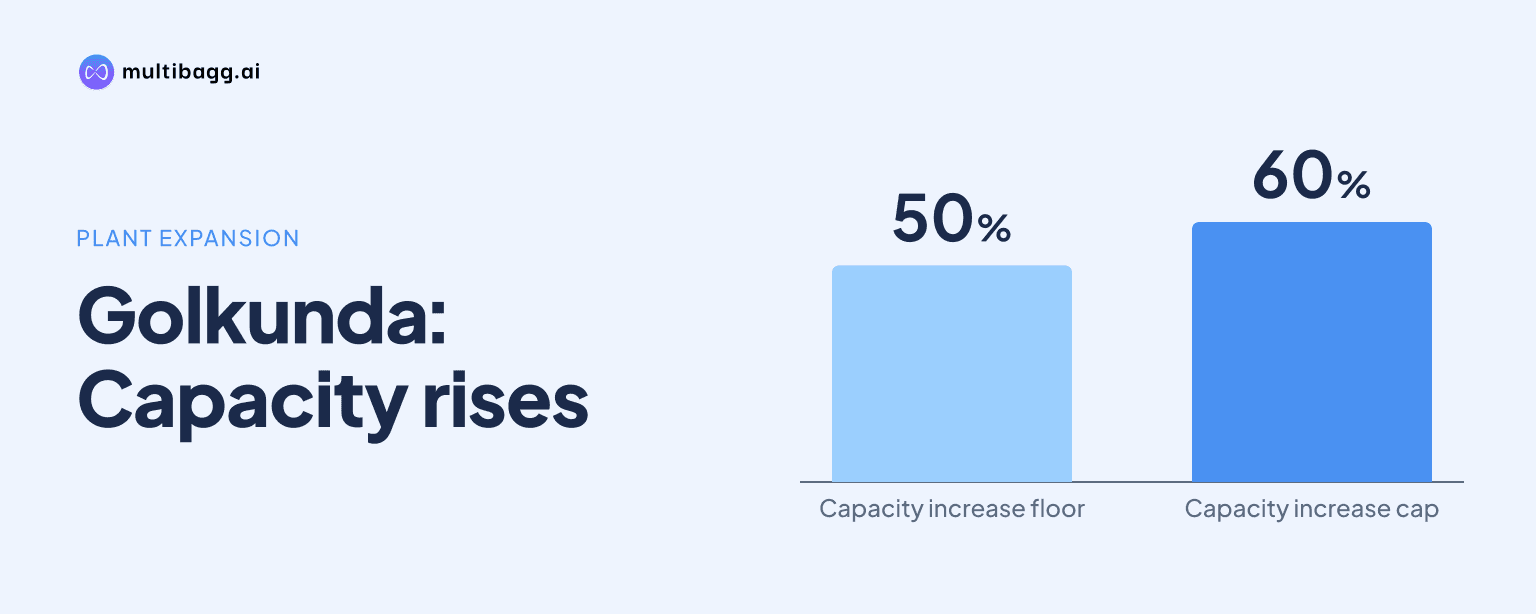
Golkunda Diamonds & Jewellery Ltd. has established a 5,360-sq-ft Mumbai plant designed to add about 125-150 kg of jewellery capacity a year and increase overall manufacturing capacity by 50-60%. Golkunda has allocated about Rs 12 crore of capital expenditure, excluding working capital, for the facility, which supports its domestic-market expansion strategy.
Know Golkunda Diamonds & Jewellery inside out
Results, valuation, peers and who's buying, in one view.
What capacity will Golkunda’s Mumbai plant add?
Golkunda’s new Mumbai plant is designed to add approximately 125-150 kg of jewellery manufacturing capacity per annum and raise the company’s overall manufacturing capacity by 50-60%. The site is at 9B, Leader House, Mahal Industrial Estate, Mahakali Caves Road, Andheri (East), Mumbai, and covers 5,360 sq. ft. The presentation describes the capacity effect as an expected impact of the new unit rather than reporting production already achieved.
The facility is intended to be a domestic manufacturing base, contrasting with Golkunda’s existing export-oriented production setup in the Special Economic Zone, or SEZ, at SEEPZ in Andheri East. The company’s stated plan is to use the added capacity to broaden its revenue base beyond exports. Its domestic strategy links manufacturing expansion with supply to retail chains and organised jewellery retailers in major Indian cities.
The capacity target is material because the presentation gives a percentage uplift as well as an annual output range. While Golkunda does not disclose its current total production capacity in kilograms, the planned 125-150 kg annual addition is expected to lift the overall manufacturing base by half to three-fifths. Golkunda has not provided a commissioning date, utilisation target or revenue contribution forecast for the new plant in the presentation.
How does Golkunda’s Mumbai footprint change its manufacturing base?
Golkunda’s Mumbai footprint combines the new 5,360-sq-ft domestic unit with a 7,145-sq-ft export-oriented manufacturing facility at G30 SEEPZ, Andheri East. It also has a 6,768-sq-ft additional SEZ unit that the presentation labels as administration-only. The change is therefore not a replacement of the SEZ base; it adds a dedicated domestic production location alongside the export-oriented facilities.
The square-footage comparison shows the new unit is smaller than both listed SEZ sites, but it is assigned a distinct commercial role. The G30 SEEPZ facility is described as export-oriented, whereas the new Andheri plant is positioned to manufacture Golkunda’s full jewellery range for the Indian market. This separation supports the stated aim of pursuing domestic customers while retaining export production infrastructure.
Golkunda cites more than 40 years of manufacturing expertise and export relationships across Europe and the Middle East as the background for the domestic move. The presentation characterises the expansion as a strategic pivot toward high-growth domestic segments, while also seeking to reduce dependence on export markets. It does not quantify the current export share of revenue or specify how the customer mix would change after the domestic unit scales up.
Got a follow-up? Ask IRIS
Which jewellery products and customers will the new plant serve?
Golkunda says the new plant can manufacture its entire product spectrum: diamond, gold, gemstone, jadau and lab-grown diamond jewellery. The stated categories include rings, earrings, pendants, necklaces, bangles and bracelets. This product scope differs from a single-category expansion because Golkunda presents the facility as one base serving multiple materials and several jewellery formats.
The target customers are leading retail chains and organised jewellery retailers across major Indian cities. Golkunda says it is entering lab-grown diamond and gold jewellery manufacturing to meet rising domestic demand from prestigious Indian retailers. The presentation does not identify retailer names, order volumes, supply contracts or city-by-city distribution, so the breadth of prospective supply is clearer than the scale of committed business.
The product programme is also connected to NIBHANA, Golkunda’s proprietary domestic retail brand dedicated exclusively to lab-grown diamond jewellery. The presentation says NIBHANA had established 4 retail stores and planned 7 additional stores. Golkunda describes the expansion as a way to increase geographical reach and customer engagement, but it does not state the timing, locations or capital requirements of the 7 planned stores.
Golkunda also identifies manufacturing technology as part of the domestic scale-up mechanism. It says upgraded processes are intended to deliver faster manufacturing, shorter production time, a broader design range, better quality, and lower rework and rejection. Customised software is intended to track every jewellery piece through manufacturing, providing traceability, inventory control and accountability across the expanded product range.
How is Golkunda funding its domestic expansion?
Golkunda states that the new facility involves approximately Rs 12 crore of capital expenditure, excluding working capital. It says capital for the expansion was raised through a preferential allotment of convertible warrants, with the objective of ensuring liquidity for timely execution. The stated uses include scaling up the new facility, strengthening working capital and removing financial constraints on strategic initiatives.
The funding mechanism matters because the presentation separates plant capital expenditure from working-capital needs. Jewellery manufacturing requires Golkunda to manage production across diamond, gold, gemstone, jadau and lab-grown diamond categories, while its domestic strategy also involves supplying organised retailers. Golkunda does not disclose the amount raised through the warrant allotment, the conversion terms, the issue date or the portion specifically allocated to the 5,360-sq-ft facility.
Beyond the plant, management says it is exploring strategic partnerships, alliances and acquisitions to accelerate entry into business-to-consumer, or B2C, retail. These are exploratory actions, not announced transactions. The presentation frames the domestic plan as having two channels: manufacturing and wholesale supply to organised retailers, plus retail growth through NIBHANA and possible external strategic routes.
Golkunda’s expected outcomes are enhanced domestic-market presence, a diversified customer base and lower dependence on exports. Those outcomes remain management expectations rather than reported results, because the presentation provides no post-expansion sales, margin or market-share figures. The measurable operating milestones currently disclosed are the 125-150 kg annual plant capacity, the targeted 50-60% overall capacity increase, 4 established NIBHANA stores and 7 additional planned stores.
Conclusion
Golkunda’s domestic expansion combines a 5,360-sq-ft Mumbai production unit, approximately Rs 12 crore of plant capital expenditure and an expected 125-150 kg of annual jewellery capacity. The planned 50-60% increase in overall manufacturing capacity is intended to support a wider domestic product offering while preserving the company’s separate 7,145-sq-ft export-oriented SEZ manufacturing facility.
The next items to watch are execution of the new facility, progress toward the 7 planned NIBHANA stores and any disclosed partnerships, alliances or acquisitions for B2C entry. Golkunda has also identified working capital as a use of the preferential-warrant funding, making the funding of facility scale-up and domestic operations a stated part of the expansion plan.