










Protean eGov Technologies Limited PAN issuance grew 9% CAGR
Key highlights
- Protean issued 4.7 crore PAN cards in FY26, compared with 4.4 crore in FY25.
- Online PAN applications reached 56% in FY26, up from 30% in FY22.
- Tax-services revenue reached Rs 498 crore in FY26, versus Rs 424 crore in FY25.
- Protean reports a 64% cumulative PAN issuance share and more than 59.6 crore cards issued to date.
powered by IRIS
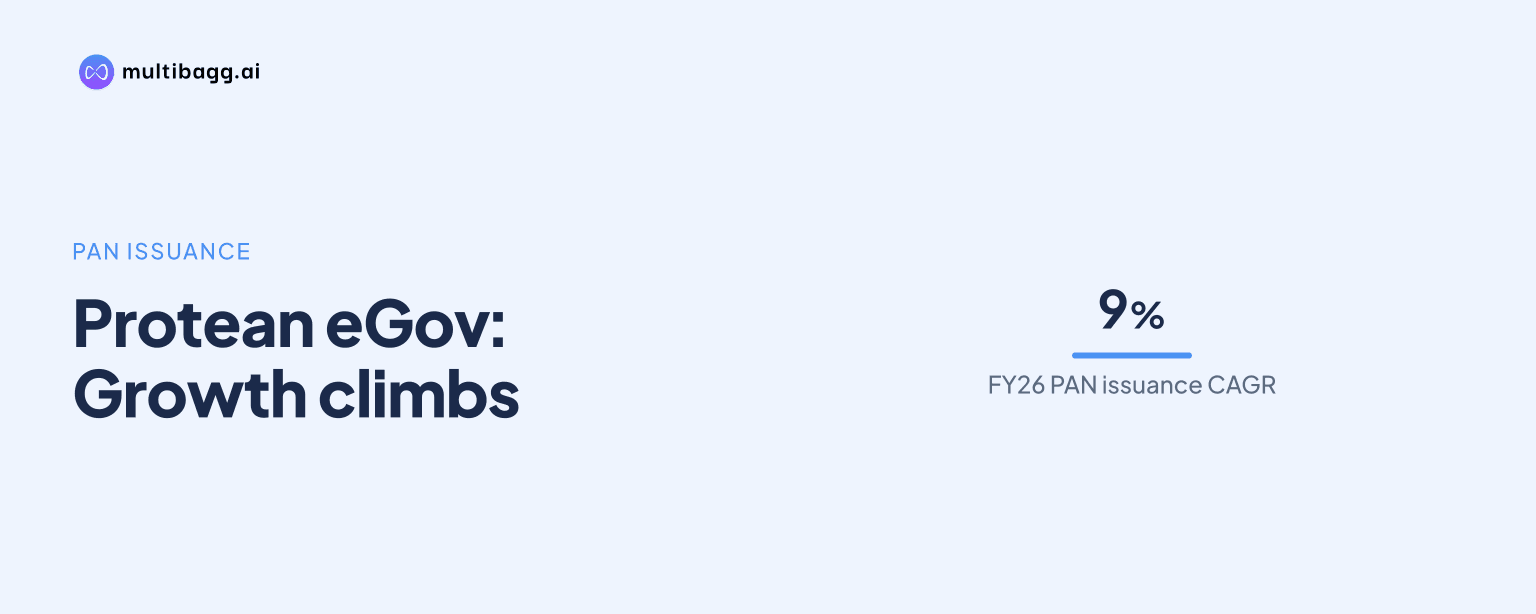
Protean eGov Technologies Limited reported 4.7 crore annual Permanent Account Number (PAN) issuances in FY26, with online applications accounting for 56% of the total versus 30% in FY22; the presentation labels the FY22-to-FY26 issuance trend as a 9% compound annual growth rate (CAGR).
Know Protean eGov Technologies inside out
Results, valuation, peers and who's buying, in one view.
How fast did Protean’s annual PAN issuance grow?
Protean issued 4.7 crore PAN cards in FY26, compared with 3.7 crore in FY22, and the company identifies a 9% CAGR across the displayed five-year period. The annual series did not increase every year: issuance rose to 4.1 crore in FY23 and 5.0 crore in FY24, before declining to 4.4 crore in FY25 and recovering in FY26.
FY26 issuance was 0.3 crore higher than FY25 but remained 0.3 crore below the FY24 peak. Protean describes PAN card issuance as a core digital public infrastructure activity, while its tax-services business includes prepaid business-to-consumer and transactional operations.
Why did online PAN applications become the majority?
Online PAN applications became the majority of Protean’s annual issuance in FY25, when their share reached 53%, and rose further to 56% in FY26. That was a 26-percentage-point increase from FY22’s 30%, while the offline share declined by the same amount, from 70% to 44%.
The change was progressive through the reported years, with online share moving from 39% in FY23 to 48% in FY24 before crossing 50% in FY25. The channel shift continued even as total issuance fell from 5.0 crore in FY24 to 4.4 crore in FY25, and FY26’s 56% online share applied to a larger total of 4.7 crore issuances.
Protean places the shift alongside India’s reported 107 crore internet users and 72% internet penetration in FY26. Its presentation also cites more than 5 crore new bank accounts opened annually and around 1.2 crore people entering the workforce each year as market indicators relevant to formalisation, rather than as forecasts of Protean’s PAN volume.
Did Protean’s tax-services revenue follow PAN issuance?
Protean’s tax-services revenue reached Rs 498 crore in FY26, the highest figure in the five-year series and Rs 132 crore above FY22’s Rs 366 crore. The presentation identifies a 9% CAGR for tax-services revenue, and FY26 exceeded the previous high of Rs 487 crore in FY24 by Rs 11 crore.
Revenue and issuance moved together in FY24 and FY25 but at different absolute rates. PAN issuance increased from 4.1 crore in FY23 to 5.0 crore in FY24 as revenue rose from Rs 434 crore to Rs 487 crore; both then declined in FY25, to 4.4 crore issuances and Rs 424 crore revenue, before recovering in FY26.
Protean characterises tax services as having stable recurring-revenue potential supported by government mandates and rising compliance needs. The presentation does not disclose revenue per PAN issuance, pricing, margins or a tax-services revenue target.
Got a follow-up? Ask IRIS
What is Protean’s position in cumulative PAN issuance?
Protean reports a 64% share of cumulative PAN issuance and says more than 59.6 crore PAN cards have been issued cumulatively to date. The company calls itself the largest issuer of India’s digital tax identity and says it set up the Tax Information Network in 2004.
The presentation estimates that about 59% of India’s population does not have a PAN card and cites an industry-wide rate of about 7 crore to 8 crore PAN cards issued annually. Protean’s reported FY26 annual issuance of 4.7 crore should be distinguished from its 64% cumulative issuance share, which is measured over the full history of PAN issuance rather than a single year.
Protean also reports more than 83 lakh PAN verifications daily and lists online PAN validation within its enterprise digital-identity offerings. Separately, it cites more than 22 crore demat account holders as an indicator of financialisation and compliance-related activity.
What could support future PAN application volumes?
Protean cites the estimated 59% of the population without PAN cards, more than 5 crore new bank accounts opened annually and about 1.2 crore workforce entrants each year as factors relevant to PAN demand. These figures describe the market conditions presented by the company and are not management guidance for future issuances.
Digital access provides a further mechanism evident in the reported mix: India had 107 crore internet users in FY26, while Protean’s online PAN share reached 56% from 30% in FY22. The presentation does not say whether online and offline PAN applications differ in fee levels, processing costs, approval rates or profitability.
Protean’s wider platform includes PAN issuance, the Tax Information Network and online PAN validation. Although the company says it has enabled more than 21 nationally critical e-governance stacks over more than three decades, the tax-services page does not provide segment profitability or a future issuance plan.
Conclusion
The reported figures show both expansion and a channel migration in Protean’s tax-services operations. Annual PAN issuance rose from 3.7 crore in FY22 to 4.7 crore in FY26 despite a decline after the FY24 high, while online applications became the majority and tax-services revenue reached Rs 498 crore in FY26.
The next disclosures will show whether annual issuance exceeds FY24’s 5.0 crore peak, whether online share extends beyond 56%, and whether revenue rises from Rs 498 crore. Protean discloses a 64% cumulative issuance share and an estimated 59% of the population without PAN cards, but it provides no future PAN issuance or tax-services revenue target.