










Protean CRA subscribers reach 9.4 crore, 92% annuity-led
Key highlights
- Protean's CRA subscriber base increased to 9.4 crore in FY26 from 8.2 crore in FY25.
- Protean reported Rs 304 crore of CRA revenue in FY26, up from Rs 283 crore in FY25.
- Annuity revenue accounted for 92% of Protean's CRA revenue, while transactional revenue accounted for 8%.
- Protean reports more than 97% market share in NPS, APY and UPS.
powered by IRIS
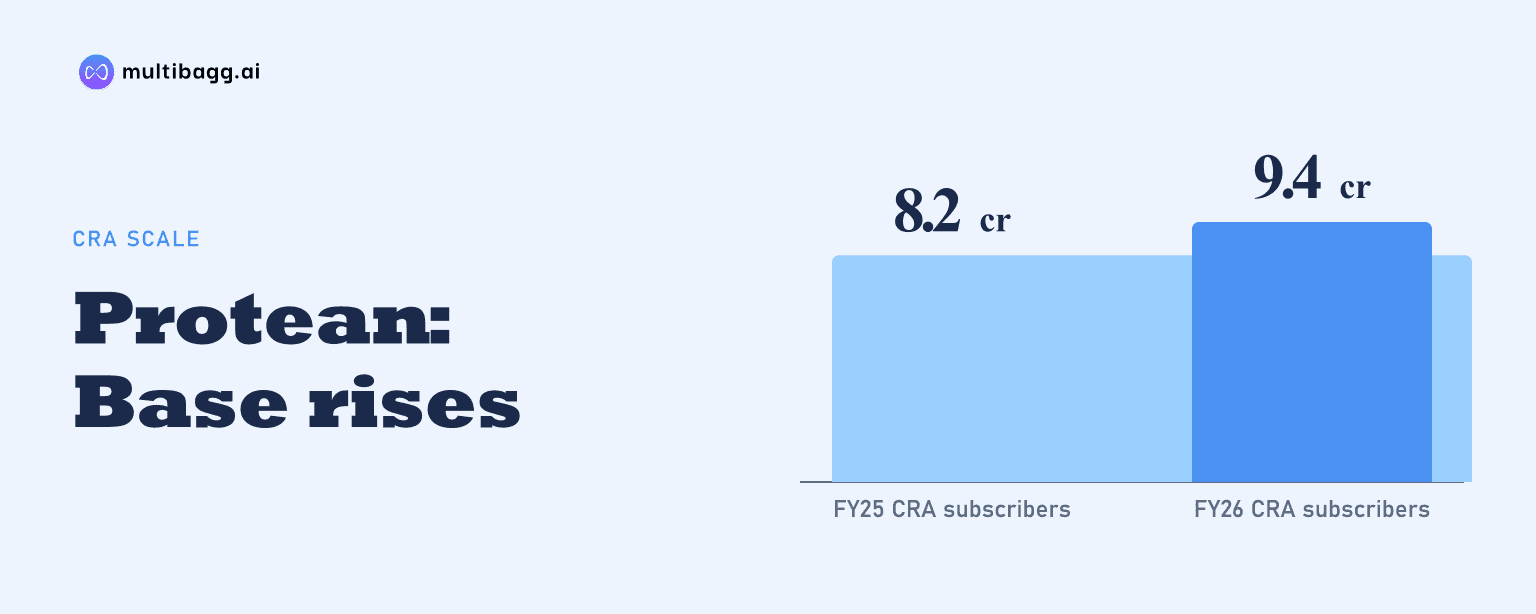
Protean eGov Technologies Limited, referred to as Protean, reported 9.4 crore Central Recordkeeping Agency (CRA) subscribers in FY26, up from 8.2 crore in FY25, while annuity income accounted for 92% of the segment's Rs 304 crore revenue. The presentation states that CRA subscribers grew at a 17% compound annual growth rate (CAGR) between FY22 and FY26.
Know Protean eGov Technologies inside out
Results, valuation, peers and who's buying, in one view.
How did Protean's CRA subscriber base grow?
Protean's CRA subscriber base rose from 5.1 crore in FY22 to 9.4 crore in FY26, adding 4.3 crore subscribers over four financial years. CRA services cover the recordkeeping function for the National Pension System (NPS), Atal Pension Yojana (APY) and Unified Pension Scheme (UPS) cited in the presentation.
The annual increase was 1.2 crore subscribers in FY26, compared with additions of 1.0 crore in FY25, 1.0 crore in FY24 and 1.1 crore in FY23. The FY26 base was therefore 14.6% above FY25's 8.2 crore, while the presentation gives the longer FY22-to-FY26 subscriber trajectory a 17% CAGR.
CRA revenue increased alongside the subscriber base, rising from Rs 204 crore in FY22 to Rs 304 crore in FY26. Revenue moved from Rs 221 crore in FY23 to Rs 253 crore in FY24 and Rs 283 crore in FY25, before increasing by Rs 21 crore in FY26; Protean reports a 9% CAGR for CRA revenue over FY22 to FY26.
The two reported growth rates differed: subscribers recorded a 17% CAGR, while CRA revenue recorded a 9% CAGR. The presentation provides the subscriber and revenue totals but does not disclose pricing per subscriber, retention rates, contract duration or the reason for the differing growth rates.
What portion of Protean's CRA revenue is annuity-based?
Protean states that annuity revenue accounts for 92% of CRA services revenue and transactional revenue accounts for 8%. This disclosed mix applies to the CRA segment, which generated Rs 304 crore in FY26, rather than to all of Protean's operations.
The Rs 304 crore CRA figure was lower than Protean's Rs 498 crore tax-services revenue in FY26 but higher than its Rs 92 crore identity-services revenue. These are separately reported business lines, so the 92% annuity share does not establish an annuity-revenue mix for tax services or identity services.
Protean describes its wider operating model as combining annuity and transactional revenue, while the CRA segment gives the specific 92%-to-8% split. The source does not quantify how much of the FY26 Rs 498 crore tax-services revenue or Rs 92 crore identity-services revenue was recurring.
The revenue composition is reported alongside a subscriber base of 9.4 crore in FY26. Protean does not provide a split of the 9.4 crore subscribers by NPS, APY or UPS, nor does it provide segment-level revenue by any of those three pension schemes.
What is Protean's position in pension recordkeeping?
Protean says it is India's largest CRA, with more than 97% market share in NPS, APY and UPS. It also says it built India's first digital pension infrastructure, enabling pension onboarding and servicing.
The company cites more than 1.7 lakh service providers supporting onboarding across government, corporate and retail channels. That distribution network is presented alongside the 9.4 crore FY26 CRA subscriber base and the company's stated market-share position in the three named pension schemes.
Protean compares about 54 crore Jan Dhan accounts with about 9.4 crore NPS and APY accounts. The comparison shows that the NPS and APY account base cited by the company is smaller than the Jan Dhan account base, although the presentation does not state that the two account populations are directly comparable or mutually exclusive.
The presentation also says NPS employer contribution increased from 10% to 14% under the new tax regime. Protean presents this change as one of several pension-related features, but does not quantify its effect on FY26 subscriber additions or Rs 304 crore of CRA revenue.
Got a follow-up? Ask IRIS
Why does Protean cite pension adoption as an opportunity?
Protean cites pension penetration of 12% of India's workforce, compared with 56% in the United States. It also puts pension assets under management (AUM) in India at about 14% of gross domestic product, versus more than 90% in Organisation for Economic Co-operation and Development nations.
The source separately compares NPS AUM of Rs 16 lakh crore with mutual-fund AUM of Rs 73.7 lakh crore. These figures describe the relative scale of the two markets cited in the presentation and do not represent a forecast for Protean's subscriber growth or CRA revenue.
Protean's stated FY26 subscriber count of 9.4 crore followed a 5.1 crore count in FY22, while the presentation identifies 12% workforce pension penetration in India. The company links its focus on accelerating pension adoption to the reported 17% subscriber CAGR, rather than giving a specific future subscriber target.
The presentation also cites 58 crore Jan Dhan accounts against 7.9 crore APY holders in FY26 in a separate market-opportunity slide. That comparison differs from the page 8 reference to about 9.4 crore NPS and APY accounts, because the source uses different pension-account measures in the two disclosures.
Which pension policy developments does Protean identify?
Protean identifies eased investment and withdrawal norms by the Pension Fund Regulatory and Development Authority (PFRDA) as relevant developments in the pension ecosystem. The presentation says the permitted exit age has been raised to 85 years.
The company does not estimate the effect of the PFRDA changes on its 9.4 crore FY26 CRA subscriber base, 92% annuity mix or Rs 304 crore CRA revenue. The policy references therefore provide context for the pension market but not quantified guidance from Protean.
For operating comparisons, the FY26 data establish two reported measures: 1.2 crore net subscriber additions from FY25 and a Rs 21 crore increase in CRA revenue. Future disclosures can show whether additions remain near the FY26 level and whether segment revenue changes in line with the expanding subscriber base.
Protean reported its 17% CAGR for subscribers over FY22 to FY26 and its 9% CAGR for CRA revenue over the same period. The presentation does not disclose a planned number of new CRA subscribers, a future CRA revenue target or a timetable for monetising the policy changes.
Conclusion
Protean's FY26 pension-recordkeeping disclosure combines a 9.4 crore CRA subscriber base with a CRA revenue mix that is 92% annuity-based. From FY22 to FY26, subscribers increased by 4.3 crore and CRA revenue rose by Rs 100 crore to Rs 304 crore, while Protean reported more than 97% market share in NPS, APY and UPS.
What to watch next is whether the PFRDA's eased investment and withdrawal norms, including the exit-age increase to 85 years, coincide with further pension adoption. Protean has identified the gap between 12% pension penetration in India's workforce and 56% in the United States, but has not disclosed a future CRA subscriber or revenue target.