










Golkunda: LGD volumes exceed natural diamonds in April
Key highlights
- India’s LGD exports reached 1.4 million carats in April 2026, compared with 1.3 million carats for natural diamonds.
- Polished LGD export value fell 10% year on year during April 2025–January 2026 despite higher export volumes.
- Organised jewellery market share is estimated at 45% in FY30E, up from 40% in FY24.
- Golkunda cites a rough-LGD import cost of US$15 per carat in 2026.
powered by IRIS
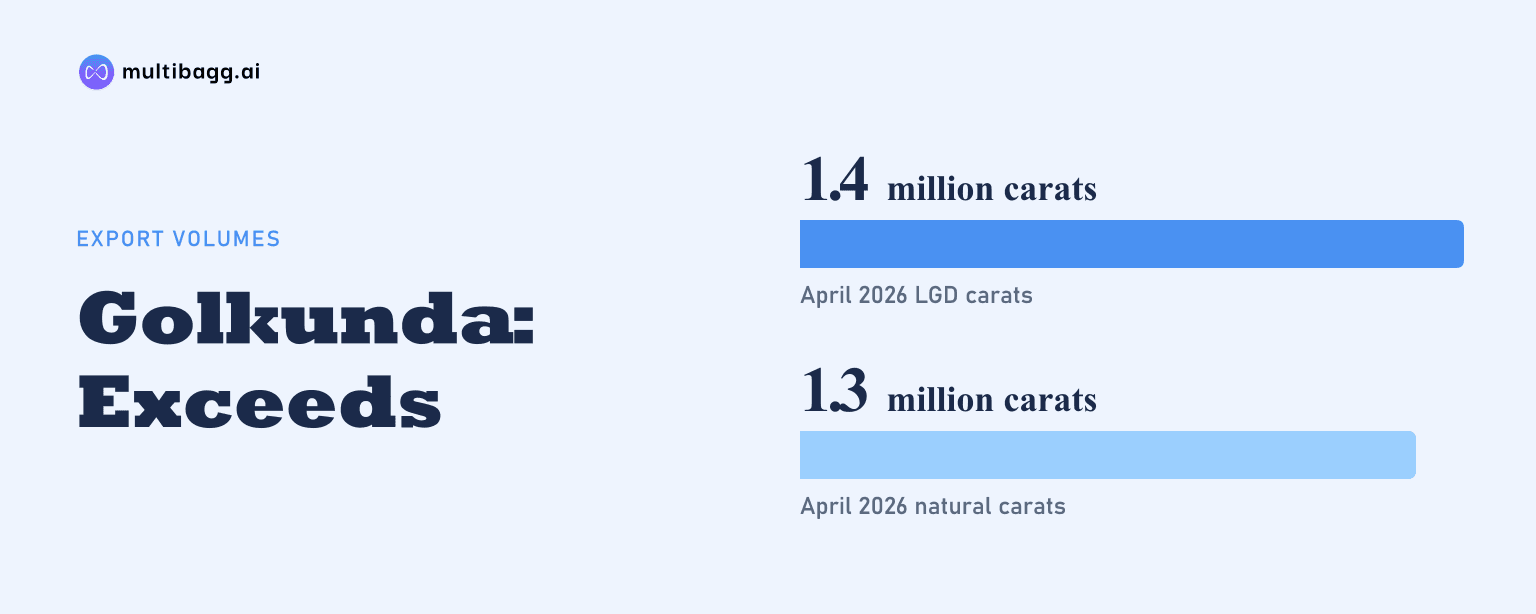
Golkunda Diamonds & Jewellery Ltd. reports that India’s laboratory-grown diamond (LGD) exports reached 1.4 million carats in April 2026, exceeding natural-diamond exports of 1.3 million carats, after the same crossover in March; however, polished LGD export value fell 10% year on year in April 2025–January 2026.
Know Golkunda Diamonds & Jewellery inside out
Results, valuation, peers and who's buying, in one view.
Did LGD exports exceed natural diamonds by volume?
Yes. Golkunda says India’s LGD exports exceeded natural-diamond exports by volume in both March 2026 and April 2026, with LGDs holding a 0.1 million-carat lead in each month.
LGD export volume increased by 0.1 million carats between March and April 2026, while natural-diamond exports rose by the same amount. The relative gap therefore did not widen, but LGDs retained the lead as both categories moved higher.
Golkunda presents the crossover as a physical-volume milestone, not as evidence that LGD exports had become larger than natural diamonds by value. That distinction matters because its cited value trend for polished LGDs covers April 2025–January 2026, rather than the two monthly export-volume readings in 2026.
Why did polished LGD export value decline despite higher volume?
Golkunda says polished LGD export value fell 10% year on year during April 2025–January 2026 because price deflation outpaced volume gains. The presentation explicitly identifies this divergence as an item to watch while reporting higher carat volumes in March and April 2026.
The source does not disclose the absolute value of polished LGD exports, an average realised price per carat, or a split between product mix and pricing effects. As a result, the reported 10% decline establishes the direction of export value but does not quantify the individual drivers behind it.
Golkunda cites a rough-LGD import cost of US$15 per carat in 2026, with supplies mainly associated with China using high-pressure high-temperature, or HPHT, production and Dubai using chemical vapour deposition, or CVD. The company describes this as a cost advantage, while separately stating that lower polished-diamond prices were moving faster than export-volume growth.
India is largely self-sufficient in LGD cutting and polishing, according to the presentation, while Gujarat and Maharashtra account for about 17% of LGD production. This places the export-volume development alongside domestic processing capability, but Golkunda does not provide a company-specific LGD production, sales or margin figure.
What regulatory and customs changes apply to LGDs?
Golkunda says Bureau of Indian Standards, or BIS, standard IS 19469:2025 mandates use of the label “laboratory-grown” for LGDs. The presentation characterises the requirement as regulatory clarity intended to build trust in the category through clear product identification.
The company also says that the 5% customs duty on diamond seeds was scrapped and that dedicated LGD import codes were created. It does not state implementation dates for those measures or quantify their effect on rough-LGD costs, imports, export realisations or domestic manufacturing.
The three changes operate through different mechanisms. The “laboratory-grown” requirement concerns product labelling, dedicated import codes concern customs classification, and the removed 5% duty concerns a production input. Golkunda does not project whether these measures will change the 10% decline in polished-LGD export value reported for April 2025–January 2026.
Golkunda places the policy changes within industry trends that include LGD growth, sustainability and traceability, product customisation and branded-jewellery adoption. These are sector observations rather than company targets, and the presentation does not disclose a target for Golkunda’s LGD revenue or export volumes.
Got a follow-up? Ask IRIS
How does organised jewellery retail shape the LGD backdrop?
Golkunda cites Nomura data showing India’s organised jewellery market share rose to 40% in FY24 from 30% in FY18, with an estimate of 45% for FY30E. FY30E denotes the estimate for financial year 2030, implying a further 5-percentage-point increase from FY24.
The presentation divides jewellery demand by value into wedding jewellery at 60%, daily wear at 30% and fashion jewellery at 10%. It identifies lightweight and everyday jewellery, product customisation and branded retail as industry trends, but does not state what proportion of any occasion segment is served by LGD jewellery.
For the 2025 wedding season, Golkunda cites an estimate of about 46 lakh weddings scheduled between 1 November and 14 December 2025, generating about Rs 6.5 lakh crore of business across venues, catering, fashion and décor. It also says Diwali-week sales typically contribute 15% to 20% of India’s annual jewellery business, establishing the festive and wedding-demand setting for organised retail expansion.
What does the export crossover mean for India’s jewellery industry?
The March and April 2026 data show that LGDs moved ahead of natural diamonds in reported export carats, with both categories increasing by 0.1 million carats over the month. Yet the 10% year-on-year decline in polished-LGD export value during April 2025–January 2026 shows that higher physical shipments did not resolve the presentation’s identified price-deflation issue.
The policy framework provides clearer labelling and changes to customs treatment, while the retail backdrop includes a projected rise in organised jewellery market share to 45% in FY30E from 40% in FY24. Neither development is accompanied by a disclosed Golkunda target for LGD export value, selling prices, sales mix or profitability.
Conclusion
Golkunda’s industry presentation points to a shift in India’s diamond trade measured in carats: LGDs led natural diamonds in two consecutive reported months. The accompanying fall in polished-LGD export value means the trade data should be read as a volume crossover alongside pricing pressure, rather than as a like-for-like improvement in export proceeds.
The next disclosed marker is the estimated increase in organised jewellery market share to 45% in FY30E. Readers can also watch whether the IS 19469:2025 labelling rule, dedicated LGD import codes and removal of the 5% diamond-seed duty coincide with changes in polished-LGD prices or export value, outcomes that Golkunda has not quantified.