










Aadhar Housing Finance Ltd has 478 emerging branches, 5% checks
Key highlights
- AHFL reported 632 branches at September 30, 2026, or 644 including offices.
- AHFL classified 478 branches as emerging and 154 as urban at September 2026.
- AHFL reported Rs 32,600 crore of AUM at September 2026, with no state above 15%.
- AHFL revalues about 5% of mortgaged properties in each quarter after disbursal.
powered by IRIS
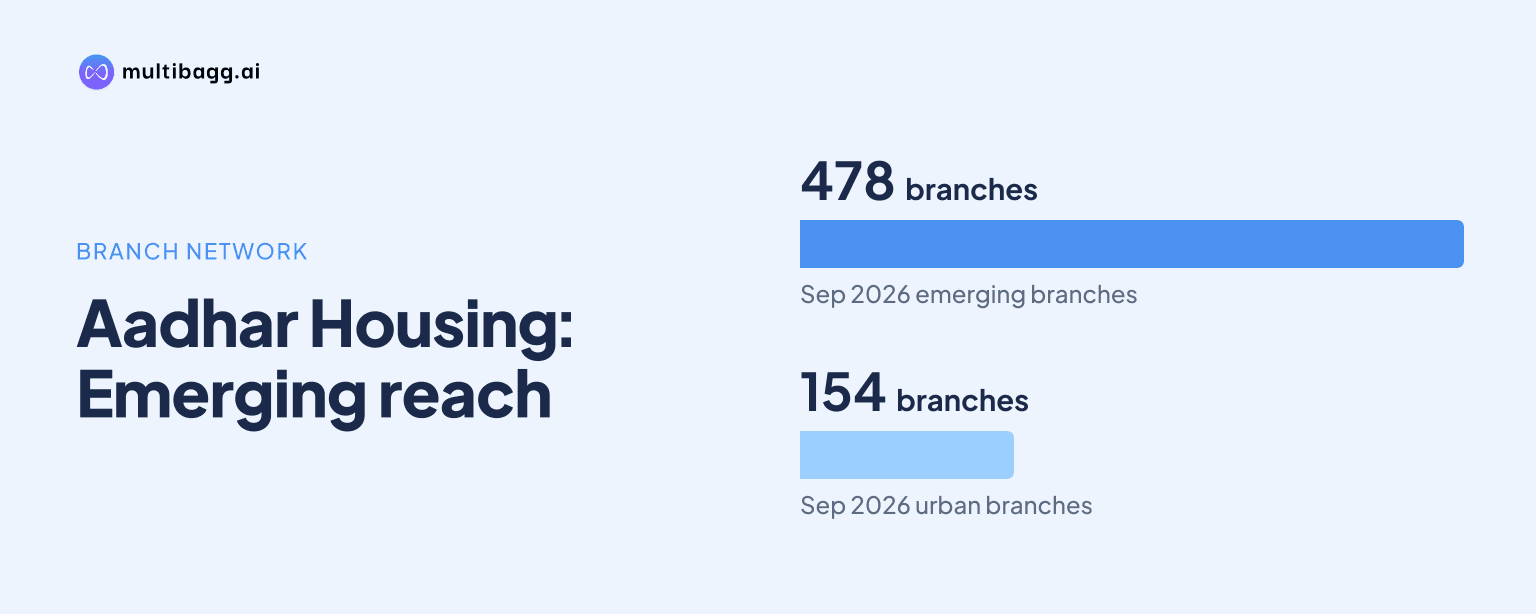
At September 30, 2026, Aadhar Housing Finance Ltd had 478 emerging branches within a 632-branch network and said it revalues about 5% of mortgaged properties each quarter. AHFL combined this predominantly emerging-market footprint with centralised and branch-led underwriting, while reporting Rs 32,600 crore of assets under management, with no state exceeding 15%.
Know Aadhar Housing Finance inside out
Results, valuation, peers and who's buying, in one view.
How broad is AHFL’s branch network?
AHFL reported 632 branches at September 30, 2026, or 644 branches including offices. Maharashtra had the largest disclosed count at 74 branches, followed by Gujarat with 73 and Uttar Pradesh with 72. Tamil Nadu had 63 branches, Madhya Pradesh 57 and Rajasthan 56, while the Other States grouping accounted for 112 branches.
The network covered 10 reported state groupings, and AHFL entered Jammu & Kashmir in the second quarter of financial year 2027, or Q2 FY27. The presentation does not provide a pre-entry branch count for Jammu & Kashmir or a branch-expansion target following the entry. It instead presents the September 2026 distribution as a pan-India presence across the disclosed markets.
Assets under management, or AUM, were distributed differently from the branch footprint. Maharashtra accounted for 12% of branches but 15% of AUM, while Rajasthan represented 9% of branches and 13% of AUM. AHFL reported total AUM of Rs 32,600 crore at September 2026 and said no individual state accounted for more than 15% of that total.
How does AHFL adapt its branch format to each location?
AHFL uses five disclosed formats: main branches, small branches, micro branches, ultra-micro branches and Deep Impact branches. Management said each location is served by an appropriate branch size to help control operating expenses. The presentation does not disclose the number of outlets, staffing levels or disbursals for any of the five formats.
Deep Impact branches are being opened in remote locations to address housing needs in tier 4 and tier 5 towns. This is the only format for which AHFL specifies a location objective. The source does not provide a numerical rollout plan, a count of existing Deep Impact outlets, or a separate AUM figure for remote-location lending.
AHFL also uses Aadhar Mitras in non-allied businesses, citing vegetable vendors, cement dealers and salons as examples. This representative model sits alongside the 632 branches reported at September 2026. The presentation does not state how many Aadhar Mitras operate, what volume they source or how their activity is measured against branch-originated business.
What share of AHFL’s branches are in emerging markets?
AHFL classified 478 of its 632 branches as emerging and 154 as urban at September 2026. Emerging branches therefore accounted for about three quarters of the network, exceeding the urban branch count by 324 locations. The classification shows that the company’s disclosed physical distribution is weighted toward emerging markets rather than urban centres.
The presentation separately lists 100 category A, 198 category B and 180 category C branches. Those categories total 478 branches, the same number as the reported emerging-branch count, but AHFL does not explicitly define the relationship between the A, B and C categories and the emerging classification. It also does not state the criteria used to distinguish the three categories.
AHFL gave examples of category A locations including Varanasi, Kolhapur and Sawai Madhopur; category B examples included Bareilly, Amravati and Pali; and category C examples included Firozabad, Malegaon and Churu. The examples span Uttar Pradesh, Maharashtra and Rajasthan, which represented 12%, 15% and 13% of AUM respectively at September 2026. Branch-level loan balances for the named cities were not disclosed.
Got a follow-up? Ask IRIS
How does AHFL assess borrowers before disbursal?
AHFL uses centralised regional processing units for salaried-customer applications. Management said this structure is intended to standardise processing, optimise costs and improve turnaround time. Applications from other customers are processed at branch level by credit managers, with on-ground verification of business and income and analysis of expected business cash flow.
The Risk Containment Unit, or RCU, screens every loan application and supporting document, according to AHFL. Suspicious documents are sampled and verified at source. The presentation does not disclose the number of suspicious documents identified, the sampling volume, or the outcome of RCU investigations.
Legal due diligence includes loan documentation, builder due diligence and title checks. AHFL said its in-house legal team and empanelled lawyers verify documents to ensure a property is legally enforceable, while reports prepared by empanelled lawyers are reviewed by the in-house legal team. This control applies alongside the centralised process for salaried borrowers and branch-led work for other customers.
How does AHFL review mortgage collateral after disbursal?
AHFL’s technical due diligence includes site visits, technical evaluation of properties and periodic review of construction projects. Its in-house civil-engineering team assesses property valuations. For properties above an unspecified threshold, AHFL seeks an additional valuation from independent third parties, but it does not disclose that threshold or the number of second opinions obtained.
After disbursal, AHFL revalues about 5% of mortgaged properties in each quarter to review valuation variance. Where a variance is identified, the company says the case is examined for remedial action. The quarterly exercise is a sample-based review, not a full revaluation of the mortgage portfolio.
The post-disbursal sampling follows technical, legal and RCU checks applied earlier in the loan process. AHFL reported Rs 32,600 crore of AUM at September 2026, but the presentation does not disclose the amount represented by the quarterly revaluation sample, the size or direction of any valuation differences, or the actions taken in individual cases.
Conclusion
AHFL’s disclosed model combines a 632-branch network, including 478 emerging branches, with varied outlet formats and layered loan controls. The state comparison shows that branch distribution and AUM shares differ across markets, while the reported 15% state-AUM ceiling limits geographic concentration. Its underwriting framework combines segment-specific processing, field verification, document screening, legal review and technical property assessment.
What to watch next is AHFL’s stated opening of Deep Impact branches in tier 4 and tier 5 towns, where the presentation provides no outlet target or separate lending data. The source also identifies the Q2 FY27 entry into Jammu & Kashmir, while future disclosures could clarify whether the quarterly 5% revaluation sample produces valuation variances or remedial actions.