










AHFL AI ranks collections and screens loan applications daily
Key highlights
- AHFL says collections officers receive a daily AI-ranked worklist based on estimated cure probability.
- AHFL says every incoming application is scored at login before a credit officer begins underwriting.
- AHFL reports 100% paperless onboarding and 97% NACH conversion in its digital operating model.
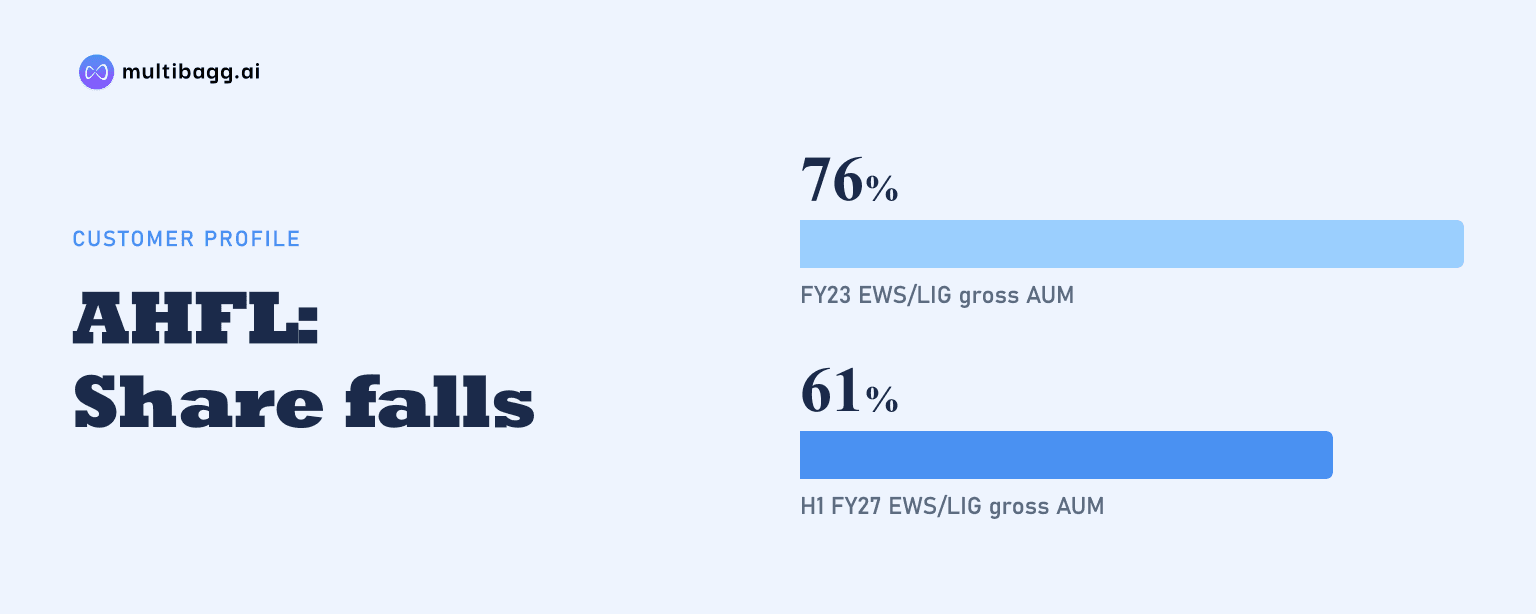
- Economically weaker section and lower-income group customers represented 61% of gross AUM in H1 FY27, down from 76% in FY23.
powered by IRIS
During its disclosed daily operations, Aadhar Housing Finance Ltd says artificial intelligence ranks delinquent accounts for collection, scores every new application before underwriting and flags behavioural stress before a missed payment; its wider digital model reports more than 108,000 customer-app logins.
Know Aadhar Housing Finance inside out
Results, valuation, peers and who's buying, in one view.
How is AHFL making AI part of lending operations?
AHFL says artificial intelligence, or AI, is an enterprise intelligence layer across origination, underwriting, surveillance, collections and retention, rather than a separate analytics project. Its six-layer architecture covers data foundation, intelligence and decisioning, surveillance and early warning, service and execution, orchestration, and governance and trust. The company links these layers to non-performing assets, or NPAs, turnaround time, cost-to-income, retention and yield.
The data layer includes customer, loan and property records, bureau data, document stores and feature stores. These inputs feed scores, predictions, risk-based pricing, fraud flags and next-best-action logic, which then appear in sales queues, credit workbenches, collections queues and retention workflows. AHFL says its orchestration layer uses application programming interfaces, workflow routing and integrations with loan origination, loan management and customer relationship management systems, with human-in-the-loop controls and override tracking.
How does AHFL use AI for collections and retention?
AHFL says collections officers receive a ranked worklist each morning, with delinquent accounts ordered by estimated cure probability. Officers contact higher-ranked accounts first, while field routes are optimised by score rather than geography alone. The stated purpose is to direct the existing collection workforce towards accounts where recovery is more likely and raise field productivity.
For retention, AHFL says it scores existing customers on delinquency behaviour when evaluating balance-transfer-out, or BT-Out, requests. Customers with elevated risk scores are excluded from retention, and their requests for top-up loans or rate-of-interest concessions are declined, according to the presentation. This differs from the collections process: collections prioritises overdue accounts for recovery, while retention selects customers the company intends to keep.
The retention process applies within a customer mix that has changed over time. Economically weaker section and lower-income group customers accounted for 76% of gross assets under management, or AUM, in FY23 and 61% in H1 FY27, a decline of 15 percentage points. AHFL does not attribute that movement to AI, but says its behavioural scoring is intended to focus retention spending and concessions on selected customers in the live portfolio.
How does AHFL screen applications and detect borrower stress?
AHFL says its Reject Scorecard scores every incoming application at the login stage before it reaches a credit officer. Applications below the relevant threshold are deprioritised or rejected before consuming underwriting or processing capacity. The company identifies lower processing costs for non-viable cases, lower front-end credit losses and greater officer capacity for other cases as the intended outcomes.
Its Early Warning Signals process uses a red-amber-green, or RAG, framework for daily surveillance of the live portfolio. Risk and branch teams receive a daily watchlist of accounts showing early behavioural deterioration, and AHFL says intervention can start before the first missed payment. The presentation identifies lower migration into NPA buckets, lower provisioning requirements and earlier recovery action as intended results, but does not quantify changes in NPAs, provisions or credit cost.
The two tools work at different points in the lending cycle. The Reject Scorecard addresses a new application before underwriting begins, while Early Warning Signals monitor existing accounts after disbursal. AHFL’s stated mechanism is therefore to filter cases at entry and identify payment-risk deterioration later in the portfolio before a delinquency is recorded.
Got a follow-up? Ask IRIS
Which AI platforms and digital systems support AHFL’s plan?
AHFL says it is building five reusable AI platforms in-house: Lekha, Dhvani, Samvit, Saarthi and Gati. Lekha provides document intelligence, including optical character recognition, extraction, classification and validation, for sourcing, underwriting, operations and collections. Dhvani provides voice intelligence, including speech-to-text, summarisation, conversational tagging and call-quality analytics, across sales, credit, operations, collections and servicing.
Samvit is AHFL’s decision-intelligence platform, using application, bureau, bank-statement and personal-discussion inputs in collections, retention and field interactions. Saarthi is a centralised generative AI and large language model platform for guided query resolution and workflow assistance. Gati provides cross-functional dashboards, funnel visibility, exception monitoring and control views across business and support functions.
AHFL separates these five reusable platforms from its six-layer architecture. The architecture describes how data, decisioning, monitoring, execution, integration and governance connect, while the platforms supply document, voice, decision, assistance and management capabilities. The company also says core credit, operations and collections workflows run on in-house applications, reducing reliance on third-party licensing and support systems.
How does AI fit AHFL’s wider digital lending model?
AHFL reports a 25-to-35-minute door-to-login time, 100% paperless onboarding and 97% National Automated Clearing House, or NACH, conversion in its digital-first operating model. It also reports more than 108,000 customer-app logins and over 40 fintech integrations. These are digital operating metrics rather than separately reported measures of AI performance.
The Tata Consultancy Services-enabled core system covers digital onboarding, loan origination, servicing, collection management, mobility, customer engagement, finance and analytics. Its collection-management function allocates accounts to agents in real time and handles agent payments and collections. AHFL’s AI tools add application scoring, behavioural surveillance and worklist prioritisation to those operational workflows.
The company’s governance layer includes model validation, bias and drift controls, audit trails, explainability, override tracking and regulatory readiness. AHFL says its initiatives are active in daily operations and are governed and tracked, but provides no model-accuracy rate, collection uplift, application rejection rate, cost saving or implementation timetable for the AI platforms being built in-house.
Conclusion
AHFL’s disclosed AI strategy applies automation across the lending cycle: applications are scored before underwriting, live accounts are monitored for early stress, delinquent borrowers are prioritised for collection and existing customers are segmented for risk-adjusted retention. The programme combines five in-house platforms with a six-layer operating architecture and sits within a digital model reporting 100% paperless onboarding and 97% NACH conversion.
The next point to watch is whether AHFL discloses outcome data for systems it says are active daily, especially NPA flows, provisioning, recovery yield, processing cost, turnaround time and retention outcomes. The presentation identifies these business measures and says the five platforms are being built for reuse and control, but leaves their quantified performance and implementation milestones unresolved.