










Aadhar Housing Finance Ltd: Fresh Borrowing Costs Fell to 7.5%
Key highlights
- AHFL's weighted average rate on fresh borrowings fell to 7.5% in Q2 FY27 from 8.0% in Q2 FY26.
- ECBs represented 7% of AHFL's borrowing mix at September 2026, while banks accounted for 53%.
- AHFL reported a total positive ALM gap of Rs 3,800 crore at September 2026.
- Care Ratings, ICRA and India Ratings each listed AHFL at AA+/Stable for long-term ratings.
powered by IRIS
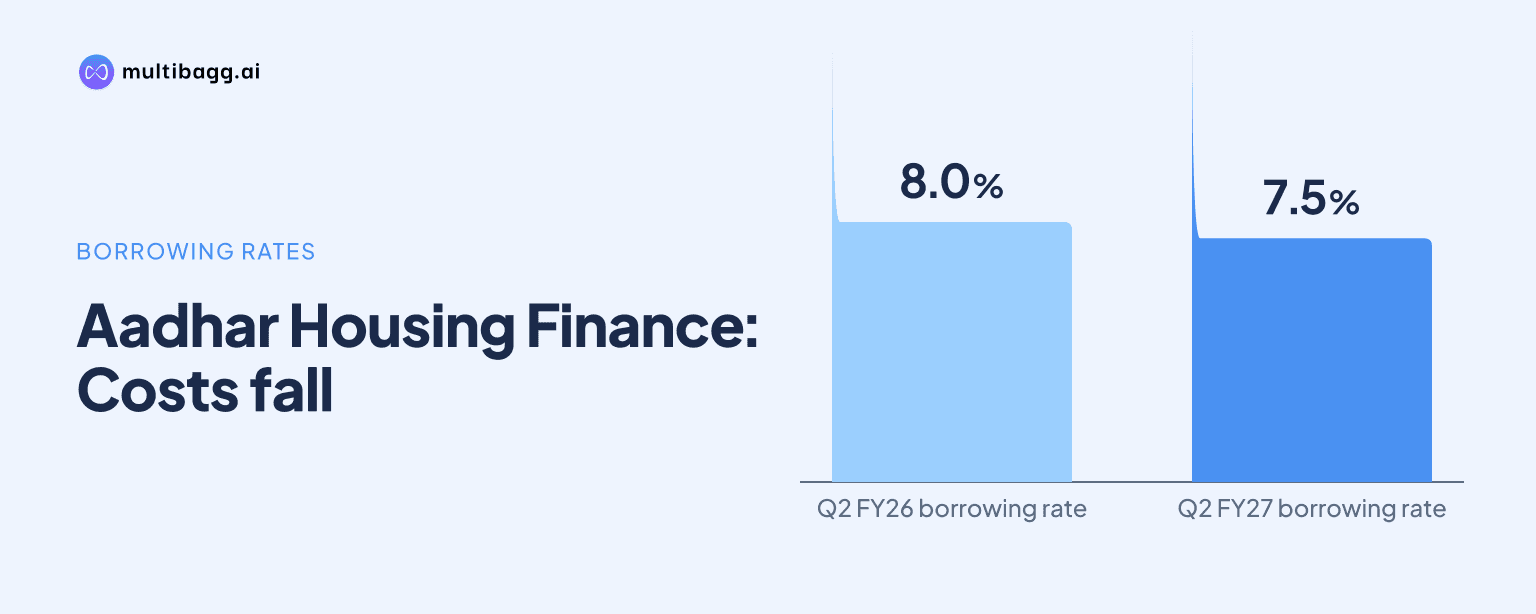
AHFL’s weighted average rate on fresh borrowings fell to 7.5% in Q2 FY27, the second quarter of FY27, from 8.0% in Q2 FY26, while external commercial borrowings represented 7% of its borrowing mix at September 2026 and banks remained its largest source at 53%.
Know Aadhar Housing Finance inside out
Results, valuation, peers and who's buying, in one view.
What changed in AHFL's borrowing mix?
AHFL added external commercial borrowings, or ECBs, as a separately disclosed 7% share of borrowings at September 2026, whereas ECBs were not shown in its March 2022 mix. Banks remained the largest source of funding, but their share declined by 7 percentage points to 53% from 60%. National Housing Bank, or NHB, funding was unchanged at 22%, while non-convertible debentures, or NCDs, declined to 15% from 17%.
The other disclosed categories also changed between the two periods. Others represented 3% of borrowings in September 2026, compared with 1% in March 2022. Banks and NHB together therefore accounted for 75% of the September 2026 mix, down from 82% in March 2022, while NCDs, ECBs and others made up 25%.
AHFL’s presentation lists relationships with banks, mutual funds, NHB and development finance institutions, including the Asian Development Bank and International Finance Corporation. The disclosed mix does not quantify individual lender exposures, but it identifies ECBs as an additional category in the September 2026 funding composition.
How did AHFL's fresh borrowing cost decline?
AHFL reported a 7.5% weighted average interest rate on fresh borrowings in Q2 FY27, 0.5 percentage points below the 8.0% reported in Q2 FY26. The company defines the measure as the weighted average rate of interest on fresh borrowings in the relevant year or period, rather than the cost of its total outstanding debt.
The Q2 FY27 rate was also lower than the 7.8% reported for FY26 and the 8.4% reported for FY25. FY25 was the highest annual rate in the five full financial years shown, following 8.0% in FY24, 7.1% in FY23 and 5.9% in FY22.
Fresh borrowing volume was Rs 1,600 crore in Q2 FY27, compared with Rs 1,800 crore in Q2 FY26. On a full-year basis, incremental borrowings increased to Rs 6,400 crore in FY26 from Rs 5,000 crore in FY25, while the reported fresh-borrowing rate declined by 0.6 percentage points over the same comparison.
Got a follow-up? Ask IRIS
What was AHFL's asset-liability management position at September 2026?
AHFL reported positive asset-liability management, or ALM, gaps in each displayed maturity bucket at September 2026, with a total positive gap of Rs 3,800 crore. On the company’s maturity-profile basis, assets were Rs 41,000 crore and liabilities were Rs 37,200 crore.
The reported gap was Rs 2,900 crore in the up-to-one-year bucket, Rs 2,600 crore in the up-to-three-year bucket and Rs 5,200 crore in the up-to-five-year bucket. The displayed total gap of Rs 3,800 crore is based on assets of Rs 41,000 crore and liabilities of Rs 37,200 crore.
AHFL also reported that 73% of gross assets under management, or AUM, and 81% of borrowings had floating interest rates at September 2026. The company defines assets for this analysis to include cash and cash equivalents, bank balances, housing and other loans, investments, receivables and other financial assets.
The liabilities definition includes trade payables, debt securities, borrowings other than debt securities, deposits, subordinated liabilities and other financial liabilities. AHFL notes that the asset maturity profile is calculated using historical customer behaviour on loan assets, meaning the disclosed asset profile is not based solely on contractual loan maturities.
Which ratings did AHFL update to AA+?
AHFL reported updated long-term ratings of AA+/Stable from Care Ratings, ICRA and India Ratings. Care Ratings previously assigned AA/Stable, while ICRA and India Ratings previously assigned AA/Positive, according to the company’s September 2026 presentation.
The disclosure concerns long-term ratings across the three named agencies. It does not present a revised short-term rating: the short-term table lists ICRA’s old rating as A+ but does not show an updated short-term assessment.
AHFL describes the revised long-term assessments as ratings across tenures from leading rating agencies. The presentation does not state a future ratings target, the basis for each rating action, or a scheduled date for another ratings review.
Conclusion
AHFL’s September 2026 disclosures show a funding mix in which banks still provided the largest 53% share, but their share had fallen from 60% in March 2022 as ECBs reached 7%. At the same time, the weighted average rate on fresh borrowings declined to 7.5% in Q2 FY27 from 8.0% a year earlier, while the company reported positive ALM gaps and AA+/Stable long-term ratings from three agencies.
The next disclosed items to watch are changes in the ECB share from 7% and the fresh-borrowing rate from 7.5% in subsequent company updates. AHFL has not disclosed an intended ECB allocation, a fresh-borrowing-cost target, or an updated ICRA short-term rating in the presented material.