










Transport Corporation of India Q2 revenue rises 14.8% to ₹1,397.9 crore
Key highlights
- TCI reported Q2 FY27 consolidated revenue of ₹1,397.9 crore, up 14.8% year on year.
- Q2 FY27 EBITDA rose 8.3% to ₹175.9 crore, while PAT increased 3% to ₹116.9 crore.
- TCI maintained FY27 guidance of 10% to 12% growth in both revenue and bottom line.
- The CONCOR joint venture grew 10.5% in Q2 FY27, according to call highlights.
powered by IRIS
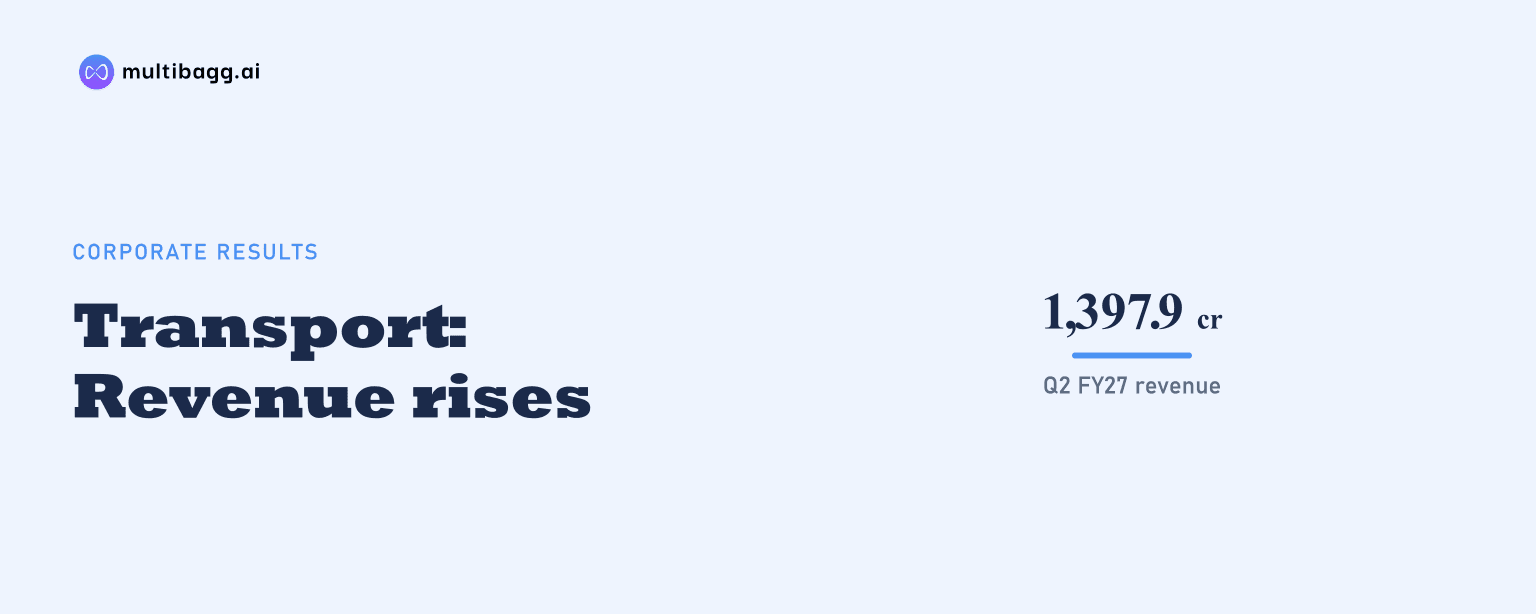
Transport Corporation of India Limited reported consolidated revenue of ₹1,397.9 crore in Q2 FY27, up 14.8% year on year, while profit after tax rose 3% to ₹116.9 crore for the quarter ended September 30, 2026. The result matters because revenue growth outpaced profit growth during the period, placing focus on margins and the company’s investment-led expansion.
Know Transport Corporation of India inside out
Results, valuation, peers and who's buying, in one view.
What did TCI report for Q2 FY27?
TCI reported consolidated revenue of ₹1,397.9 crore for Q2 FY27, compared with ₹1,217.4 crore in the corresponding quarter of the previous year. EBITDA increased 8.3% year on year to ₹175.9 crore from ₹162.4 crore. Profit after tax rose to ₹116.9 crore from ₹113.5 crore.
The company announced the unaudited quarterly and half-year results on October 27, 2026, for the quarter ended September 30, 2026. Its investor call, originally scheduled around the results period, was held on October 30. TCI subsequently made the audio recording available on its website for shareholders and investors.
The reported figures show that the company added revenue at a faster pace than EBITDA and net profit in the quarter. That distinction is relevant for investors because the quarterly performance included continued spending on strategic assets, while the company also discussed the operating contribution of its businesses and joint ventures.
What drove Transport Corporation of India’s quarterly growth?
TCI said its quarterly growth was supported by value growth and new contracts. Call highlights indicated that the overall business grew by about 15% during the quarter, broadly in line with the consolidated revenue increase reported in the company’s financial release.
The company’s multimodal logistics operations remain central to the reported performance. TCI operates across transport, supply-chain and seaways activities, and management referred to ongoing investment in strategic assets. The available material does not provide a segment-wise revenue or profit breakdown for the quarter, so the relative contribution of each operating division cannot be quantified from the disclosed information.
Management also discussed the CONCOR joint venture, which grew 10.5% according to the call highlights. This indicates continuing activity in the rail-linked logistics operation, although the source does not state the joint venture’s revenue, profit contribution or ownership economics for Q2 FY27.
For the Seaways business, Managing Director and Executive Director Vineet Agarwal said EBITDA margin was expected to settle in the 35% to 40% range, with the Q2 level broadly representative of the new normal. The statement was specific to Seaways and should not be read as the margin for TCI’s consolidated operations.
Why did profit grow slower than revenue in Q2 FY27?
TCI’s 14.8% revenue increase was higher than its 8.3% EBITDA increase and 3% PAT increase. The company disclosed the figures but did not provide a detailed reconciliation in the supplied material for the difference between revenue, operating-profit and net-profit growth rates.
The company has continued to invest in strategic assets, which is an important context for assessing reported earnings. Asset additions can affect depreciation, financing costs and the pace at which new capacity contributes to revenue. However, the information provided does not quantify these costs for the quarter, and no conclusion on their precise effect on PAT can be drawn from the disclosed summary.
The Q2 performance also reflects the importance of seasonality in TCI’s business. Management said the second half is always seasonally better. That comment provides context for the company maintaining its FY27 guidance despite the difference between top-line and bottom-line growth in the September quarter.
Got a follow-up? Ask IRIS
What guidance has TCI provided for FY27 and FY28?
TCI maintained guidance for 10% to 12% growth in both top line and bottom line for FY27. Management cited a seasonally stronger second half while reiterating this outlook during the October 30 investor call.
For FY28, call highlights referred to an outlook of 12% to 15% growth. The stated outlook is management guidance rather than a reported result, and it depends on operating conditions and execution over the remaining periods.
The company also discussed ships of about 7,500 tonnes each in its Seaways operation. Management said their contribution would be for only part of FY27, guiding Seaways revenue growth at 15% to 20% and bottom-line growth at 10% to 15% for the year. It said a fuller impact was expected in FY28.
How do the results matter for investors and logistics operations?
For investors, the principal Q2 FY27 signal is that TCI delivered double-digit revenue growth while net profit growth remained comparatively modest. The company’s reported figures therefore put attention on operating leverage, the timing of returns from strategic assets and progress during the seasonally stronger second half.
For customers and industry participants, the results point to continuing demand for integrated logistics services and new contract additions. The reported 10.5% growth at the CONCOR joint venture and management’s comments on Seaways capacity indicate activity across rail-linked and coastal logistics channels, though the supplied disclosures do not state changes in freight pricing, volumes or customer contracts.
TCI has also followed its results announcement with an investor call recording and prior conference-call transcripts filed with the exchanges. These disclosures give shareholders access to management’s stated guidance and operating commentary, while the quarterly financial release remains the primary source for reported financial performance.
Conclusion
TCI’s Q2 FY27 results showed consolidated revenue rising 14.8% to ₹1,397.9 crore, EBITDA increasing 8.3% to ₹175.9 crore and PAT advancing 3% to ₹116.9 crore. Revenue growth was supported by value growth and new contracts, while the gap between revenue and profit growth remains a central point for assessing the quarter.
The next factors to watch are execution in the seasonally stronger second half, progress toward management’s 10% to 12% FY27 growth guidance, and the partial-year contribution of the Seaways ships. Management has indicated that the fuller impact of those assets is expected in FY28.