








TCI adds 17-18% Seaways capacity, extends ships to FY30

Find your next multibaggerBe a Pro Investor
Research stocks and track your picks on the go. Download the app.
Key highlights
- TCI is adding two 7,500-tonne, 500-TEU Seaways vessels, increasing capacity by roughly 17-18% from 78,000 tonnes.
- The new vessels add 15,000 tonnes of capacity and should have their fuller operating effect in FY28.
- TCI extended through FY30 the operating lives of ships that were due to expire in FY28.
- TCI aims to exit FY30 with 1 lakh tonnes of net Seaways capacity.
powered by IRIS
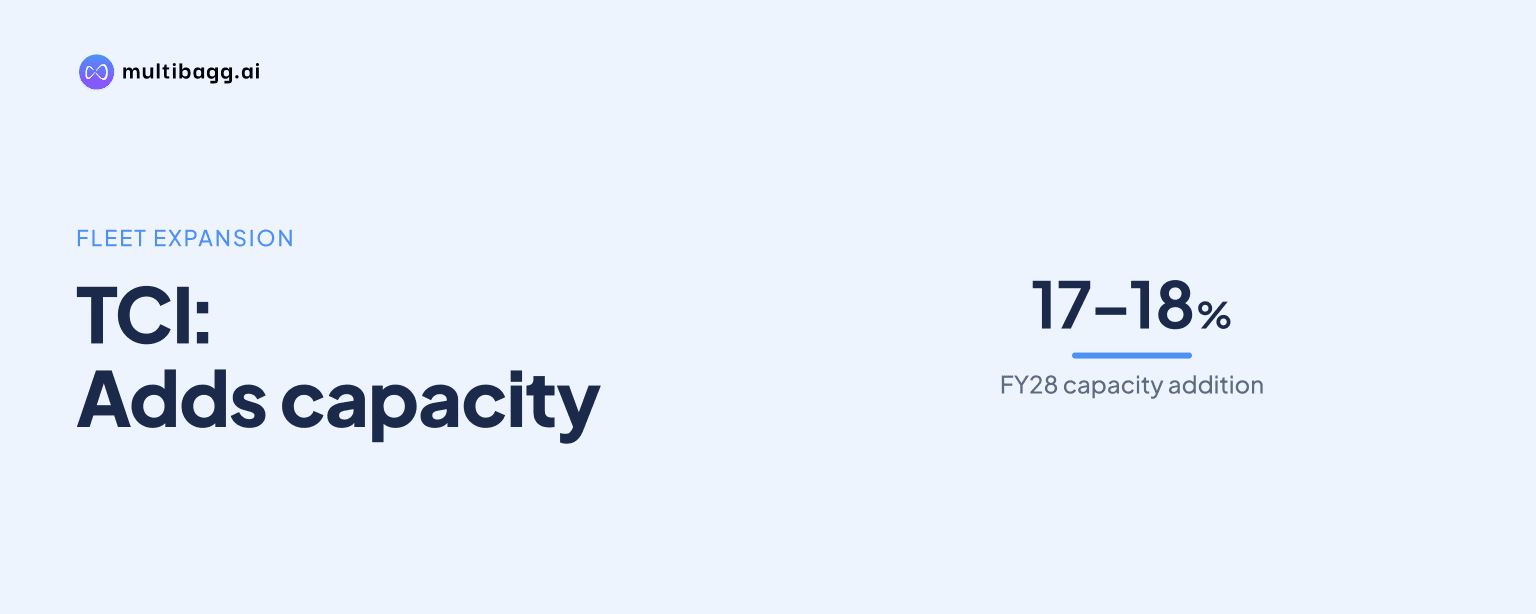
TCI is adding two 500-twenty-foot equivalent unit (TEU) ships that will increase Seaways capacity by about 17-18% from 78,000 deadweight tonnes, while ships whose operating days were due to expire in FY28 have been extended through FY30. Management expects the vessels’ full business effect in FY28 after commissioning and utilisation ramp-up.
Know Transport Corporation of India inside out
Results, valuation, peers and who's buying, in one view.
How much Seaways capacity is TCI adding?
TCI is adding two vessels of about 7,500 tonnes each, for combined capacity of 15,000 tonnes. Management said the additions equal roughly 17-18% of the existing 78,000 deadweight-tonne fleet and described each as a 500-TEU ship. Deadweight tonnes measure the weight a vessel can safely carry, while TEU is a standard container-capacity measure.
The additions would take the fleet to about 93,000 deadweight tonnes before any future vessel retirements. Management said the higher capacity should support a 15-20% increase in volumes once the ships are operating in the network, but distinguished this from revenue growth because freight rates can change independently of cargo volumes.
TCI said it would not initially load a new 500-TEU ship with 500 containers. Calibration and continuous testing mean utilisation will build over several months, so the stated capacity addition does not translate into immediate peak cargo volumes. This commissioning process is the reason management expects a fuller contribution in FY28 rather than FY27.
When will TCI’s new ships affect Seaways results?
TCI expects the more meaningful impact from both ships in FY28, because their FY27 operating periods will be short and utilisation will take time to stabilise. Management said the first vessel would start real operations by the end of November, while the second was initially discussed as a fourth-quarter arrival and later referred to as arriving in January.
Management said the first vessel would contribute for roughly four months in FY27 and the second for roughly two months. It therefore said the ships would not add substantially to FY27 revenue, despite the 15,000-tonne addition. For FY28, management said business growth could be in excess of 20% when both vessels are available for the full year.
The company’s basic expectation is for volumes to increase 15-20% in line with added capacity, but management did not give a fixed revenue forecast. It said a decline in bunker fuel prices could reduce freight rates and therefore realised pricing, even if Seaways carries more containers. Conversely, higher fuel costs may support freight-rate increases only to the extent customers accept them.
Where will TCI deploy the additional Seaways vessels?
TCI plans to deploy the two ships mainly in domestic shipping, while considering selective opportunities involving Colombo, Myanmar, Thailand and Indonesia. Management also mentioned possible traffic between islands, but said the key decision would be to place vessels in sectors providing the maximum output rather than commit them to a specified international route.
Domestic demand remains the central basis for deployment. Management described TCI as domestically focused and said it had sufficient demand, subject to using capacity in the right sectors. The overseas opportunities were presented as opportunistic movements rather than a change in the company’s principal domestic orientation.
Fuel prices are an important mechanism in route economics and freight pricing. Management said bunker prices had moved from about Rs 70,000-Rs 80,000 a tonne to Rs 95,000-Rs 98,000 a tonne, an increase of almost 20%, and that it had raised freight rates by about 10-15% where the market could absorb them. It also said customers may move cargo to rail or other transport modes if sea-freight rates rise too far.
Got a follow-up? Ask IRIS
How does the FY30 extension change TCI’s fleet plan?
TCI has extended through FY30 the operating lives of ships that had been due to expire in FY28. Management said those vessels remain in service and are in good condition following regular dry docking and related maintenance, while adding that it would make an appropriate decision on them when required.
The extension provides continuity while TCI pursues both replacement tonnage and net fleet expansion. Management said some tonnage would leave over the next three to four years, requiring additional vessels not only to replace departing ships but also to build capacity beyond the current 78,000 tonnes and the incoming 15,000 tonnes.
TCI’s stated objective is to have net capacity of 1 lakh tonnes when it exits FY30. That plan assumes ships will both leave and join the fleet by FY30, rather than treating the two new 7,500-tonne vessels as the final stage of expansion. The extension to FY30 means the vessels previously facing FY28 operating-life expiry are not an immediate replacement requirement.
Maintenance will continue alongside the expansion. TCI said it had already completed one dry dock in the current financial year and expected another smaller vessel to enter dry dock around mid-March next year, resulting in two dry docks during the year. Management confirmed Vijay in the discussion of the dry-docking schedule, but did not quantify its revenue or capacity impact.
What could affect TCI Seaways margins after the expansion?
TCI management indicated a Seaways margin range of roughly 30-35% to 40% and said near-term margins would largely remain in line with the second-quarter level. It also referred to a 35-40% margin structure, while stressing that fuel movements and the pace of cost pass-through can affect the outcome.
Management identified higher fuel costs, the potential for lower volumes when fuel prices decline, and higher depreciation and possible finance costs from new ships as factors that could suppress margins. The two vessels are part of a broader capital programme that also includes trucks, railway rakes and hard infrastructure, so group profitability will not reflect Seaways investment alone.
The company had overall capital-expenditure guidance of about Rs 500 crore-Rs 550 crore, including final payments for the ships. Management said approximately Rs 300 crore of capital expenditure had yet to deliver its full effect in the half year, muting return on capital employed. It also said the effective tax rate of around 9.5-10% should remain at a similar percentage because other taxable businesses are expected to generate more profit.
Conclusion
The two 7,500-tonne vessels expand TCI’s Seaways fleet by a stated 17-18%, but their near-term financial contribution will be limited by partial-year operations and gradual loading after commissioning. Extending older vessels from FY28 to FY30 keeps existing capacity available while the company builds toward a larger, replenished fleet.
The next disclosures to watch are the second vessel’s final timing and deployment, the rate at which both ships reach normal utilisation, and progress toward the 1 lakh-tonne net-capacity target at FY30 exit. Management has also flagged bunker-price changes, currently at Rs 95,000-Rs 98,000 a tonne, as a continuing variable for freight pricing and margins.

