










TeamLease GCCs Generate 70% of Specialised Staffing Revenue
Key highlights
- TeamLease reported Rs 190 crore of specialised-staffing revenue in Q2FY27, up 15% year on year.
- GCCs generated about 70% of TeamLease specialised-staffing revenue and around 67%+ of gross margin in Q2FY27.
- TeamLease had 130+ active GCC clients and added 16 GCC clients in H1FY27.
- Global revenue represented 11% of TeamLease specialised-staffing revenue in FY26, versus 0% in FY24 and FY25.
powered by IRIS
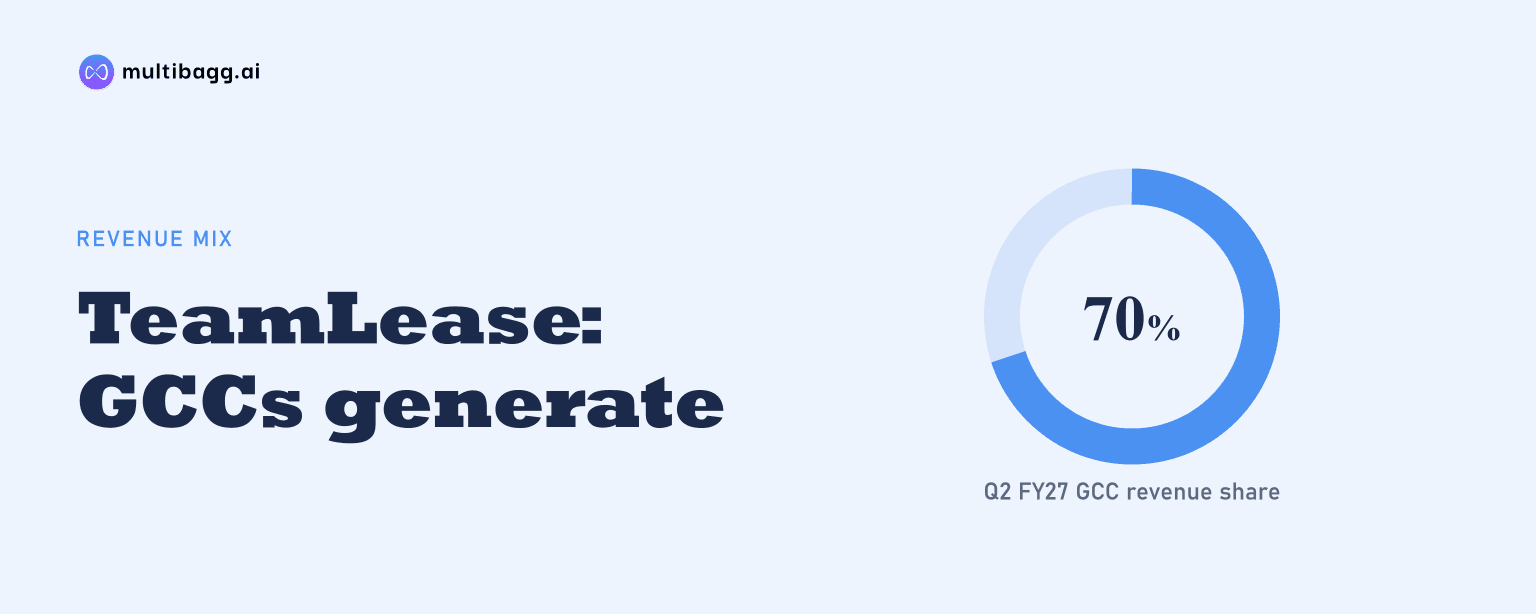
TeamLease generated about 70% of specialised-staffing revenue from Global Capability Centres (GCCs) in Q2FY27, when the segment recorded Rs 190 crore in revenue, up 15% year on year. GCCs also contributed around 67%+ of gross margin, while global revenue became 11% of the segment’s FY26 revenue mix.
Know Team Lease Services inside out
Results, valuation, peers and who's buying, in one view.
Why do GCCs matter to TeamLease specialised staffing?
GCCs matter because TeamLease attributed about 70% of Q2FY27 specialised-staffing revenue and around 67%+ of gross margin to this client category. The segment reported Rs 190 crore of revenue in Q2FY27, with a 7.1% earnings before interest, tax, depreciation and amortisation (EBITDA) margin and 15% year-on-year revenue growth.
TeamLease had more than 130 active GCC clients in Q2FY27 and added 16 GCC clients during H1FY27, the first half of FY27. More than 4,500 associates worked on GCC accounts out of more than 7,650 deployed associates in specialised staffing, linking the client concentration to a substantial part of the segment’s workforce.
The presentation does not provide revenue per associate, margin by GCC client or the countries in which individual GCC customers operate. It does, however, show that GCC accounts contributed a larger share of revenue than the disclosed proportion of associates, alongside their stated 67%+ gross-margin contribution.
How has TeamLease shifted its workforce toward GCCs?
TeamLease shifted specialised-staffing headcount toward GCC technology and specialised GCC roles in FY26, while the IT Services share declined. GCC technology rose to 33% of segment headcount in FY26 from 26% in FY25 and 24% in FY24, while GCC Specialised increased to 22% from 14% and 11%, respectively.
The two GCC categories together represented 55% of FY26 specialised-staffing headcount, compared with 35% in FY24. Over the same period, IT Services fell 17 percentage points to 43%, demonstrating that the changing mix reflected both the expansion of GCC roles and a lower IT Services share.
Total specialised-staffing headcount was 7,500 in FY26, compared with 6,620 in FY25 and 7,230 in FY24. The FY26 GCC mix therefore coincided with an 880-associate increase from FY25, although TeamLease does not specify how much came from new customers, existing-account expansion or role reclassification.
Got a follow-up? Ask IRIS
Which delivery models generate TeamLease specialised-staffing revenue?
Contract-to-Hire (C2H) remained TeamLease’s main specialised-staffing delivery model, accounting for 85.7% of FY26 revenue. Under C2H, TeamLease initially employs candidates before they transition to the client’s payroll based on performance and tenure, making it the central mechanism in the segment’s revenue mix.
C2H’s FY26 share was lower than 86.2% in FY25 and 87.2% in FY24. Transaction-Based Outsourcing (TBO), which involves building and managing teams to deliver defined processes and outcomes, increased to 7.1% in FY26 from 4.6% in FY25 and 5.2% in FY24.
Build-Operate-Transfer (BOT) declined to 5.9% of FY26 revenue from 6.5% in FY25 and 7.6% in FY24. TeamLease describes BOT as building and operating dedicated teams before transferring them to the client, while permanent hiring represented 0.4% of FY26 revenue and learning represented 1.3%.
The disclosed mix shows that C2H remained dominant even as TBO gained share in FY26. The presentation also lists Recruitment Process Outsourcing, Employer on Record, managed services with governance, learning and upskilling, regulatory compliance and payroll outsourcing as elements of TeamLease’s GCC-oriented offering stack.
Has TeamLease expanded specialised staffing beyond India?
TeamLease expanded the geographic mix of specialised staffing in FY26, when global revenue accounted for 11% of segment revenue and India accounted for 89%. India had represented 100% of specialised-staffing revenue in both FY24 and FY25, so FY26 was the first disclosed period with a global revenue share.
The 11% global share is the presentation’s direct measure of diversification, but India remained the larger market at 89% of FY26 revenue. TeamLease does not disclose the countries, clients, service lines or delivery locations that generated the global component.
TeamLease groups its specialised-staffing proposition into capability, capacity, competence and continuity. Capability includes C2H, Recruitment Process Outsourcing, BOT and Employer on Record, while capacity includes managed services with governance and TBO for defined processes and outcomes.
Competence includes ATLAS, or AI Talent, Learning, Advisory & Services, and CapQ, which TeamLease describes as end-to-end solutions for GCCs. Continuity includes learning and upskilling, regulatory compliance and payroll outsourcing, but the presentation does not quantify revenue from these offerings separately.
Conclusion
TeamLease’s specialised-staffing segment is increasingly tied to GCC demand: these customers generated about 70% of Q2FY27 revenue and around 67%+ of gross margin, while GCC technology and GCC Specialised roles reached a combined 55% of FY26 headcount. C2H still accounted for 85.7% of FY26 revenue, showing that the client-mix shift has occurred within a largely C2H-led delivery model.
The next disclosures to watch are whether TeamLease adds to the 16 GCC clients gained in H1FY27 and expands beyond the 130+ active GCC-client base reported for Q2FY27. Further detail on the countries, clients and delivery models behind FY26’s 11% global revenue share would clarify how the segment’s international mix is developing.