










Technocraft adds Bidkin extrusion and formwork capacity
Key highlights
- Technocraft’s Bidkin extrusion plant has stated capacity of 1,500 MT per month across 7-inch and 9-inch lines.
- Technocraft’s Bidkin aluminium formwork facility has stated capacity of 60,000 square metres per month.
- The extrusion facility can produce profiles up to a 300 mm C channel and includes in-house ingot manufacturing.
- The Bidkin formwork plant uses robotic panel welding, automatic lacquering and ERP-driven packaging and dispatch.
powered by IRIS
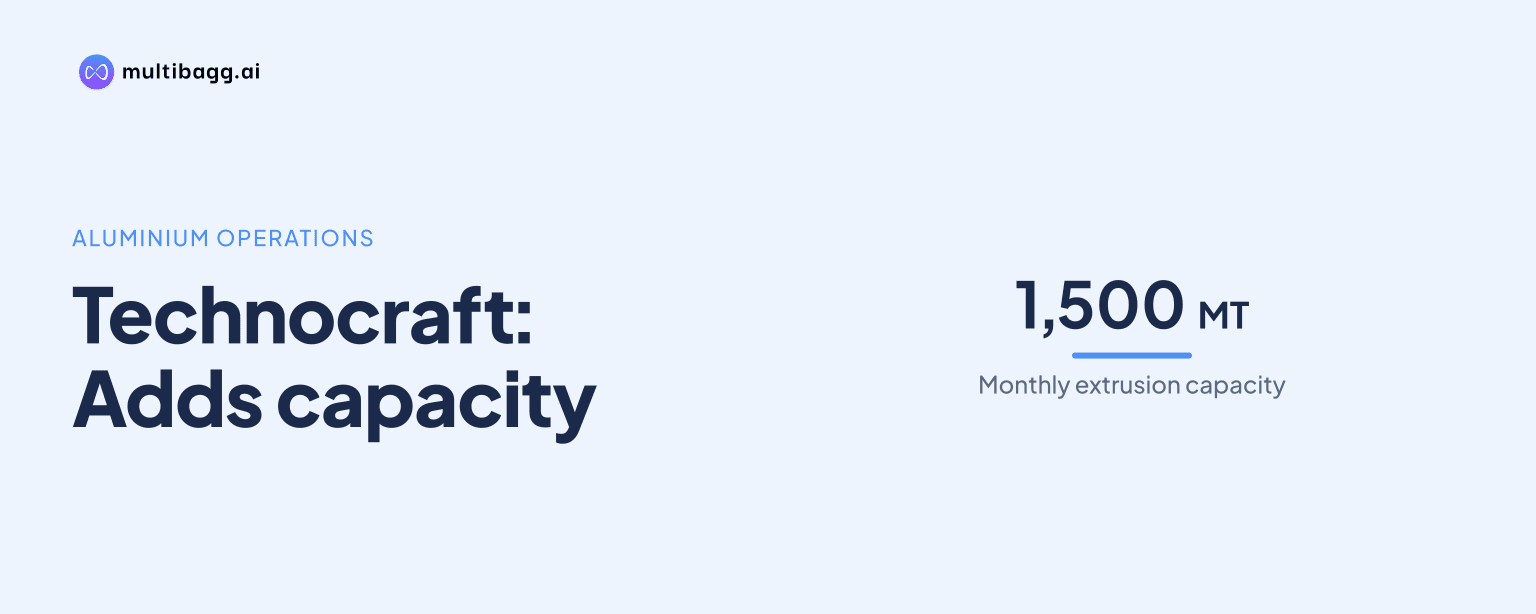
Technocraft Industries (India) Ltd. has established aluminium extrusion and formwork-fabrication facilities at Bidkin in the Aurangabad region of Maharashtra, with stated capacity of 1,500 metric tonnes (MT) a month of extrusion and 60,000 square metres a month of fabrication. The facilities add extrusion to Technocraft’s existing Maharashtra fabrication activities.
Know Technocraft Industries (India) inside out
Results, valuation, peers and who's buying, in one view.
What aluminium extrusion capacity has Technocraft added at Bidkin?
Technocraft has added 1,500 MT of monthly aluminium-extrusion capacity at Bidkin through its wholly owned subsidiary, Technocraft Extrusions Pvt. Ltd. The plant has two extrusion lines, a 7-inch line and a 9-inch line, and can produce profiles up to a 300-millimetre C channel.
The Bidkin unit also has in-house ingot manufacturing, according to the presentation. Technocraft describes extrusion as an additional activity alongside its existing aluminium fabrication at Murbad in Maharashtra, meaning the new plant adds an upstream manufacturing process to the group’s disclosed aluminium operations.
The 1,500-MT figure is a monthly capacity measure rather than reported production or sales. The presentation does not disclose when the two lines were commissioned, their utilisation level, output by profile type, or the quantity of ingots produced internally.
What formwork-fabrication capacity has Technocraft installed at Bidkin?
Technocraft has installed aluminium-fabrication capacity of 60,000 square metres per month at Bidkin through its wholly owned subsidiary, Technocraft Formworks Pvt. Ltd. The facility is described as an aluminium formwork manufacturing unit and includes automatic panel welding on robots.
The formwork plant also has a conveyor-based automatic lacquering line and enterprise resource planning, or ERP, driven packaging and dispatch. These features cover panel welding, finishing and post-production handling, while the presentation does not provide robot numbers, panel sizes, staffing or the throughput of the lacquering line.
The fabrication capacity is measured in square metres because the stated output is fabricated formwork, while extrusion capacity is measured in MT because it concerns metal profiles by weight. The 60,000-square-metre and 1,500-MT monthly figures therefore describe separate production stages and cannot be added into one capacity total.
How does the Bidkin project change Technocraft’s Maharashtra footprint?
Technocraft’s Bidkin project adds both extrusion and fabrication to a Maharashtra footprint that already included aluminium fabrication at Murbad and Shivale. Bidkin is the only location in the presentation identified with both a 1,500-MT-per-month extrusion operation and a 60,000-square-metre-per-month formwork-fabrication facility.
The roles of the two Bidkin subsidiaries are distinct. Technocraft Extrusions Pvt. Ltd. runs the two-line extrusion unit with in-house ingot manufacturing and profiles up to 300 mm C channel, while Technocraft Formworks Pvt. Ltd. operates the robotic-welding and automatic-lacquering fabrication plant.
Compared with the earlier disclosed Murbad activity, the stated change is the addition of extrusion at Bidkin and another fabrication location alongside Murbad and Shivale. The presentation gives no capacity figures for Murbad or Shivale, so it does not support a percentage comparison between the Bidkin plant and the older fabrication sites.
Got a follow-up? Ask IRIS
What automation does Technocraft disclose for its operations?
Technocraft discloses automatic panel welding on robots, a conveyor-based auto lacquering line and ERP-driven packaging and dispatch at the Bidkin formwork unit. These mechanisms are specifically attached to the 60,000-square-metre-per-month fabrication facility rather than to the 1,500-MT extrusion-capacity disclosure.
Elsewhere in its scaffolding material, Technocraft identifies robot welding in the scaffolding department, a pick-and-place robot, and a robot at Mach One for aluminium welding. The company also names Mach Deck, Mach One, Pier Head Segment and Mach AluPly in its formwork material, but gives no production allocation or capacity by product.
Technocraft’s project snapshots show its Ringlock system used for bridge repair in Washington, USA, and its Ringlock plus Machplus system used for an overhead water-tank construction project in Qatar. The presentation does not state project dates, order values, delivery volumes or a direct manufacturing link between these applications and the Bidkin facilities.
What does Technocraft’s presentation not quantify?
Technocraft does not quantify revenue, earnings before interest and tax, or EBIT for the extrusion, aluminium formwork, fabrication or scaffolding activities on the cited pages. It also does not disclose capital expenditure, quarterly capacity utilisation, sales volumes or margins for the Bidkin operations.
The presentation provides the installed-capacity measures of 1,500 MT per month for extrusion and 60,000 square metres per month for fabrication, but not output targets. It similarly discloses in-house ingot manufacturing without stating ingot capacity, external sourcing needs, or the proportion of Bidkin formwork supplied by Bidkin-made extrusions.
Conclusion
Technocraft’s Bidkin facilities extend its disclosed aluminium manufacturing arrangement beyond fabrication at Murbad and Shivale. The new site combines a 1,500-MT monthly extrusion plant, including in-house ingot manufacturing, with a 60,000-square-metre monthly formwork-fabrication unit using robotic welding, automatic lacquering and ERP-driven dispatch.
What to watch next is whether Technocraft discloses utilisation, production volumes or financial contribution from the 7-inch and 9-inch extrusion lines and the formwork plant. The presentation identifies the facilities’ capacities and manufacturing mechanisms, but does not disclose a commissioning timetable, sales target or target for internal supply from extrusion to fabrication.