










Technocraft drum-closure EBIT margin rose to 39% in Q2
Key highlights
- Technocraft reported drum-closure volume of 226 lakh sets in Q2.
- Technocraft’s drum-closure EBIT margin rose to 39% in Q2, with EBIT increasing 53%.
- Technocraft states that its steel drum-closure worldwide market share is approximately 36%.
- Technocraft’s drum-closure marketing and distribution network reaches more than 80 countries.
powered by IRIS
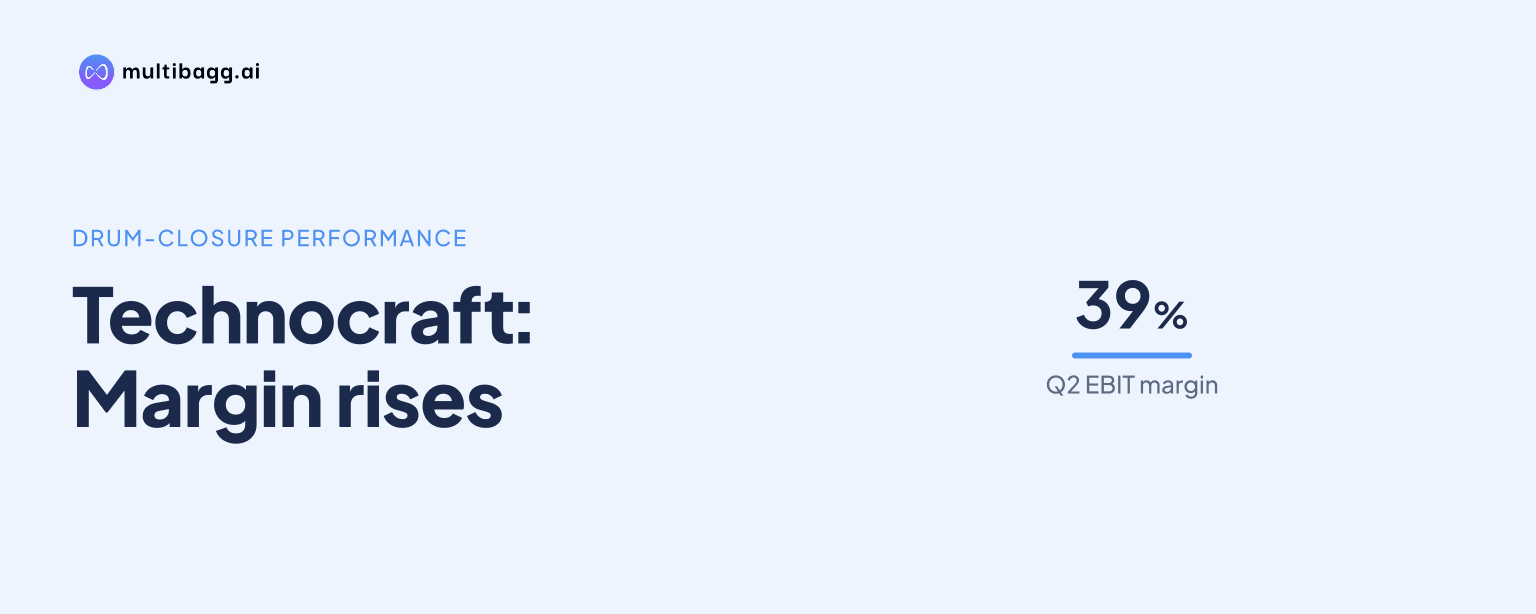
Technocraft Industries (India) Ltd. reported drum-closure volume of 226 lakh sets in Q2, while the segment’s earnings before interest and tax, or EBIT, margin rose to 39% and EBIT increased 53%. Technocraft’s presentation identifies a globally distributed steel-drum-closure operation, with manufacturing in India and China and an approximately 36% worldwide market share.
Know Technocraft Industries (India) inside out
Results, valuation, peers and who's buying, in one view.
How did Technocraft’s drum-closure segment perform in Q2?
Technocraft’s drum-closure segment reached 226 lakh sets in Q2, and its EBIT margin rose to 39% as EBIT increased 53%. The disclosed result combines a volume measure, expressed in sets, with a profitability measure, making it the presentation’s clearest indication of Q2 operating performance for drum closures.
The stated 53% EBIT increase shows that segment profit grew faster than the disclosed Q2 volume figure alone can explain, although the supplied material does not give revenue, prior-period EBIT, or a prior-period volume base. The supplied topic links the business to higher volumes, favourable product mix and process improvements, while also noting geopolitical uncertainty in the segment’s operating environment.
What does Technocraft manufacture in drum closures?
Technocraft manufactures and supplies steel drum closures, alongside nylon and plastic plugs, capseal closures, canseal closures, insertion dies and clamps. This range means the 226 lakh sets reported in Q2 comes from a business covering closure components and related tooling rather than a single steel-closure product alone.
Technocraft’s product portfolio includes flanges, gaskets, epoxy-lacquered and phenolic-lacquered closures, stainless-steel closures, and lever latches for fibre and metal drum locking rings. The presentation also lists fully automatic flange insertion systems and cap-sealing tools, indicating that its drum-closure offer extends beyond the individual closing component to production and application equipment.
The mix of metal, plastic and specialised closure products matters because the supplied topic attributes the Q2 margin outcome partly to favourable product mix. The presentation does not quantify sales or margins for stainless-steel closures, plastic plugs, capseal products or tooling separately, so it does not establish which product category made the largest contribution to the 39% EBIT margin.
How broad is Technocraft’s drum-closure market reach?
Technocraft says its marketing and distribution network reaches more than 80 countries, while its drum-closure manufacturing facilities are located in India and China. That geographic structure places the Q2 volume of 226 lakh sets within an operation that combines two manufacturing bases with sales and distribution across a wider international network.
Technocraft describes itself as the largest manufacturer of steel drum closures and gives its worldwide market share as approximately 36%. It separately says it has the largest market share globally excluding China, a distinction that matters because China is also one of its manufacturing locations and the presentation does not provide a separate Chinese sales or market-share figure.
The drum-closure segment differs from Technocraft’s scaffolding systems business in its disclosed international market position. Drum closures are presented with an approximately 36% worldwide share and distribution in more than 80 countries, whereas the scaffolding material focuses on modular panel shoring, formwork applications and product-development initiatives rather than a comparable worldwide share statistic.
Got a follow-up? Ask IRIS
What operating mechanisms support Technocraft’s margin?
Technocraft attributes the Q2 improvement to higher volumes, favourable product mix and process improvements, resulting in a 39% EBIT margin and 53% EBIT growth. The presentation’s description of the business provides several operational mechanisms that can support those factors, including research and development, quality control, testing and packaging facilities.
Technocraft also says it has in-house tool-and-die manufacturing and design facilities. In a product range that includes insertion dies, GRT flanges, octagonal closures, clinched closures and drum-top products, internal tooling capability is a disclosed part of its manufacturing setup rather than an externally sourced service described in the presentation.
Technocraft says it has designed and developed patented technology for drum-closure manufacturing and lists three global patent products for manufacturing GRT flanges, octagonal clinched closures and drum-top products. The presentation does not assign revenue, volume or EBIT to these patented products, so their direct contribution to the 53% EBIT increase cannot be calculated from the disclosed information.
What limits the available Q2 comparison?
Technocraft discloses the Q2 result as 226 lakh sets, a 39% EBIT margin and 53% EBIT growth, but it does not provide the matching earlier-period volume, revenue, EBIT amount or EBIT margin in the supplied pages. The change that can be stated plainly is that EBIT rose 53% and margin rose to 39%; the scale of the margin increase in percentage points is not disclosed.
The supplied presentation also does not split the 226 lakh sets between steel closures, nylon and plastic plugs, capseal closures, canseal closures or other products. Nor does it divide segment activity between the India and China plants, despite identifying both as manufacturing locations, leaving the country-level source of Q2 growth unresolved.
Geopolitical uncertainty is identified alongside the explanation of higher volumes, mix and process improvements, but no specific event, geography, cost item or customer effect is quantified. As a result, the supplied information supports the reported 53% EBIT growth but does not allow a numerical assessment of how uncertainty affected sales, input costs, logistics or distribution across more than 80 countries.
Conclusion
Technocraft’s Q2 drum-closure result combines 226 lakh sets of volume with a 39% EBIT margin and 53% EBIT growth. The supplied information supports an explanation centred on volume, product mix and process improvement, within a steel-drum-closure business that has manufacturing in India and China, distribution in more than 80 countries, and an approximately 36% worldwide market share.
The next point to watch is whether Technocraft provides comparable prior-period volume, revenue and segment EBIT figures, which would show how much of the 39% margin came from mix, efficiency or scale. Readers can also watch for any quantified update on geopolitical uncertainty, product-category mix, or the contribution from its three patented drum-closure product lines.