








Tera Soft current liabilities rise Rs 47.28 crore in H1FY27
MAX Plan at ₹4,999/yr

Find your next multibaggerBe a Pro Investor
Research stocks and track your picks on the go. Download the app.
Key highlights
- Tera Soft’s current liabilities increased by Rs 47.28 crore to Rs 216.45 crore in H1FY27.
- Tera Soft’s other financial liabilities rose by Rs 31.14 crore to Rs 45.55 crore in H1FY27.
- Tera Soft’s current assets increased by Rs 67.93 crore to Rs 354.07 crore, including Rs 15.60 crore of cash.
- Tera Soft reported a Rs 3,001.30 crore closing order book as of 30 September 2026.
powered by IRIS
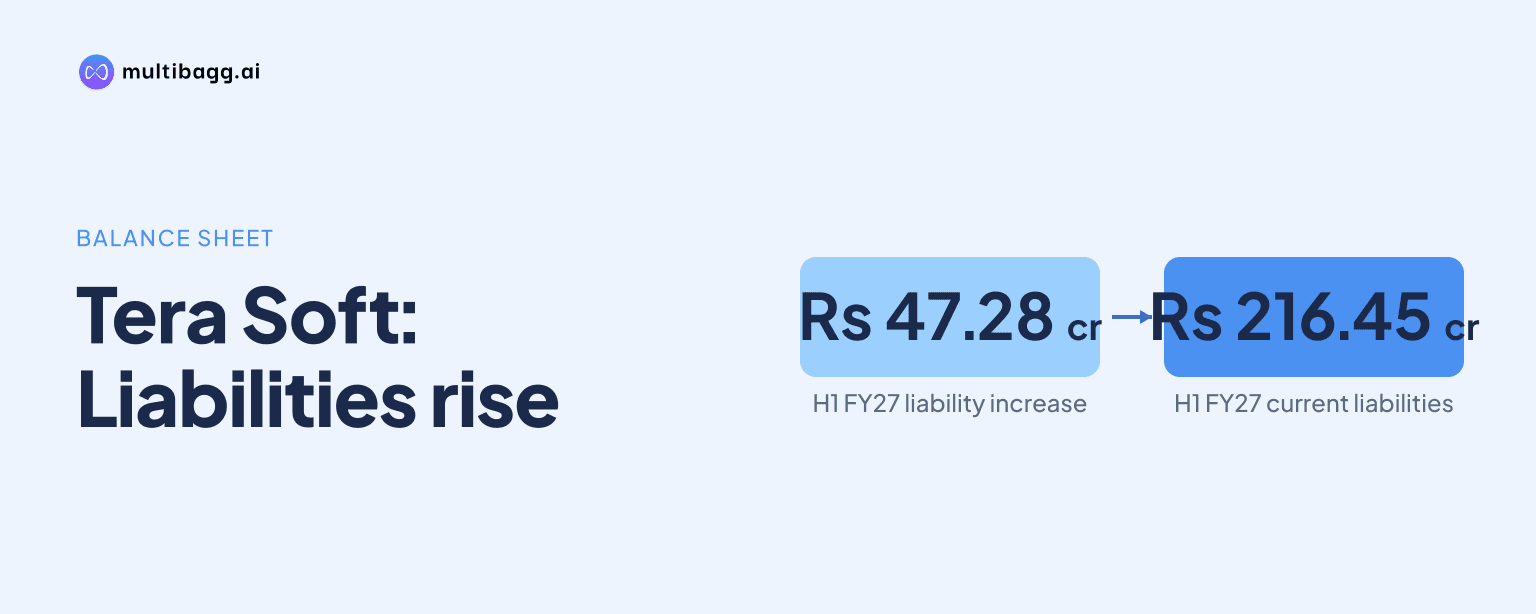
Tera Software Limited reported current liabilities of Rs 216.45 crore in H1FY27, up Rs 47.28 crore from Rs 169.17 crore in FY26, chiefly because other financial liabilities rose Rs 31.14 crore to Rs 45.55 crore. Tera Soft’s short-term borrowings were broadly stable at Rs 31.00 crore, while current assets increased by Rs 67.93 crore.
Know Tera Software inside out
Results, valuation, peers and who's buying, in one view.
Why did Tera Soft’s current liabilities increase in H1FY27?
Tera Soft’s current liabilities increased because other financial liabilities more than tripled to Rs 45.55 crore in H1FY27 from Rs 14.41 crore in FY26. The Rs 31.14 crore rise in that line accounted for about two-thirds of the Rs 47.28 crore increase in total current liabilities. Trade payables, other current liabilities and provisions also increased during the six-month period.
Trade payables rose by Rs 5.57 crore to Rs 112.66 crore, other current liabilities increased by Rs 6.77 crore to Rs 15.06 crore, and provisions grew by Rs 3.89 crore to Rs 12.19 crore. Short-term borrowings edged down by Rs 0.09 crore to Rs 31.00 crore from Rs 31.09 crore, meaning borrowings due within a year did not cause the overall increase.
The presentation does not provide a composition, maturity profile or counterparty detail for the Rs 45.55 crore of other financial liabilities. It also does not explain the underlying transactions behind the movements in other current liabilities and provisions. The disclosed balance sheet therefore identifies where the Rs 47.28 crore increase occurred, but not the due dates or commercial reasons for every liability category.
How did Tera Soft’s current assets change alongside liabilities?
Tera Soft’s current assets increased by Rs 67.93 crore to Rs 354.07 crore in H1FY27 from Rs 286.14 crore in FY26, exceeding the Rs 47.28 crore increase in current liabilities. Other financial assets were the largest contributor, rising by Rs 56.57 crore to Rs 156.47 crore from Rs 99.90 crore.
Cash and cash equivalents increased by Rs 10.29 crore to Rs 15.60 crore, compared with Rs 5.30 crore at FY26. Other current assets added Rs 4.15 crore to reach Rs 26.76 crore. These increases were partly offset by a Rs 3.09 crore decline in trade receivables, which stood at Rs 155.23 crore in H1FY27.
The decline in receivables contrasts with the rise in other financial assets, although the presentation does not specify the instruments or balances within the latter category. Trade receivables of Rs 155.23 crore and other financial assets of Rs 156.47 crore together totalled Rs 311.70 crore at H1FY27, against total current liabilities of Rs 216.45 crore. No ageing schedule for receivables or trade payables is disclosed.
What changed in Tera Soft’s equity and long-term liabilities?
Tera Soft’s total equity increased by Rs 13.25 crore to Rs 159.23 crore in H1FY27 from Rs 145.98 crore in FY26. Share capital remained unchanged at Rs 12.51 crore, while other equity increased by Rs 13.25 crore to Rs 146.71 crore from Rs 133.46 crore.
Tera Soft reported profit after tax of Rs 13.25 crore for H1FY27 in its consolidated profit-and-loss statement. The presentation also reports Rs 9.62 crore of profit after tax for H2FY26, though those periods are not directly comparable as they are consecutive half-years rather than the same period a year earlier.
Non-current liabilities rose by Rs 7.09 crore to Rs 17.02 crore from Rs 9.93 crore at FY26. Long-term borrowings increased by Rs 7.60 crore to Rs 15.92 crore, while long-term provisions declined by Rs 0.51 crore to Rs 1.11 crore. Total equity and liabilities consequently increased by Rs 67.62 crore to Rs 392.70 crore, matching total assets.
Got a follow-up? Ask IRIS
What operating performance accompanied Tera Soft’s balance-sheet movement?
Tera Soft reported revenue from operations of Rs 141.73 crore for H1FY27, compared with Rs 104.17 crore for H2FY26 in the presentation. Earnings before interest, tax, depreciation and amortisation, or EBITDA, were Rs 21.37 crore in H1FY27 versus Rs 19.06 crore in H2FY26, while finance costs rose to Rs 4.57 crore from Rs 3.70 crore.
The presentation does not connect the increase in finance costs with the Rs 7.60 crore rise in long-term borrowings or the stable Rs 31.00 crore short-term borrowing balance. It also does not state whether the Rs 31.14 crore increase in other financial liabilities carries financing costs, arises from operating obligations, or contains a mixture of items.
In Q2FY27, Tera Soft’s revenue from operations was Rs 91.85 crore, up 84.18% from Rs 49.87 crore in Q1FY27 and 28.59% from Rs 71.43 crore in Q2FY26. Q2FY27 EBITDA was Rs 10.40 crore, up from Rs 5.95 crore in Q1FY27 and Rs 8.84 crore in Q2FY26.
The EBITDA margin was 11.32% in Q2FY27, versus 11.94% in Q1FY27 and 12.37% in Q2FY26. The Projects Division contributed Rs 71.21 crore of Q2FY27 revenue, while the Technical Division contributed Rs 20.65 crore, together matching total quarterly revenue of Rs 91.85 crore.
Which Tera Soft balance-sheet items should be monitored next?
Tera Soft’s key balance-sheet items for subsequent disclosures include other financial liabilities of Rs 45.55 crore, trade payables of Rs 112.66 crore, other financial assets of Rs 156.47 crore and cash and cash equivalents of Rs 15.60 crore at H1FY27. The presentation supplies no maturity or ageing data that would show how quickly these balances convert into cash payments or collections.
Tera Soft reported a closing order book of Rs 3,001.30 crore as of 30 September 2026, after executing Rs 140.66 crore during H1FY27 from an opening order book of Rs 3,141.96 crore at 31 March 2026. The order-book movement gives a disclosed execution marker, but the presentation does not allocate working-capital balances or financial liabilities to particular orders.
Management also disclosed a Rs 3,502.78 crore work share in the Rs 7,005.55 crore BSNL BharatNet Phase II consortium project and described it as a multi-year execution opportunity. Separately, Tera Soft stated that BharatNet Phase III includes a three-year implementation period followed by seven years of operations and maintenance. The presentation does not state whether either project is included in the Rs 3,001.30 crore closing order book.
Conclusion
Tera Soft’s Rs 47.28 crore increase in H1FY27 current liabilities was concentrated in the Rs 31.14 crore rise in other financial liabilities, with higher trade payables, other current liabilities and provisions adding to the movement. Current assets rose by a larger Rs 67.93 crore, led by the Rs 56.57 crore increase in other financial assets and a Rs 10.29 crore increase in cash, while receivables declined by Rs 3.09 crore.
The next disclosed markers are execution against the Rs 3,001.30 crore order book at 30 September 2026 and progress on the BharatNet opportunities described by management. Future balance-sheet disclosures will be relevant for the composition and maturity of Rs 45.55 crore in other financial liabilities, as well as the relationship between that balance, Rs 112.66 crore of trade payables and the company’s project execution.

