










Texmaco Q2 revenue rose 14.6%, while PAT fell 30.1% on tax reversal
Key highlights
- Texmaco reported Q2 FY27 standalone revenue of Rs 863 crore, up 14.6% from Rs 753 crore in Q1 FY27.
- Q2 FY27 PBT increased to Rs 51.2 crore from Rs 44.1 crore in Q1 FY27.
- Q2 FY27 PAT fell to Rs 36 crore from Rs 52 crore after Q1 included a Rs 20 crore deferred-tax reversal.
- Texmaco’s consolidated order book was Rs 10,940 crore as at September 30, 2026, up 10.2% during the quarter.
powered by IRIS
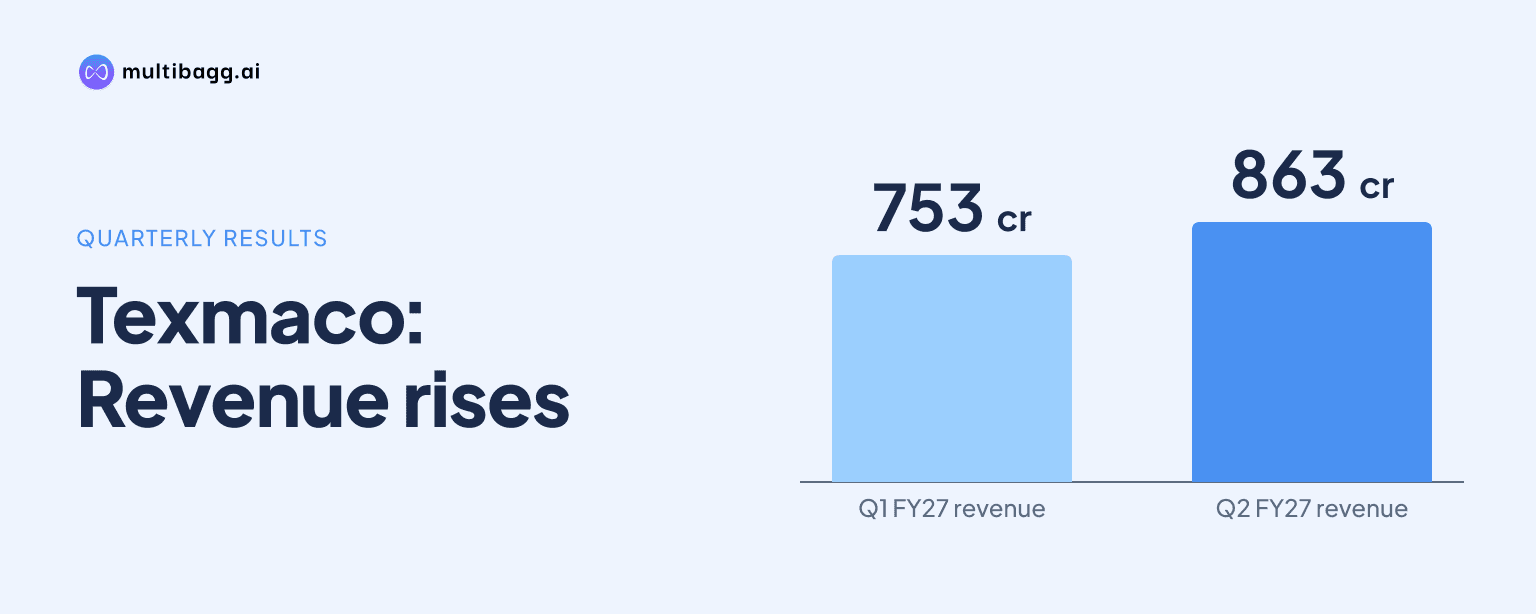
Texmaco Rail & Engineering Ltd. reported standalone revenue from operations of Rs 863 crore in Q2 FY27, up 14.6% from Q1 FY27, while profit after tax fell 30.1% to Rs 36 crore because the preceding quarter included a Rs 20 crore deferred-tax liability reversal. Profit before tax nevertheless increased to Rs 51.2 crore from Rs 44.1 crore.
Know Texmaco Rail & Engineering inside out
Results, valuation, peers and who's buying, in one view.
What changed in Texmaco’s Q2 FY27 financial results?
Texmaco’s reported Q2 FY27 operating revenue increased by Rs 110 crore from Rs 753 crore in Q1 FY27 to Rs 863 crore, although it remained below Rs 1,257 crore in Q2 FY26. The sequential increase was accompanied by an increase in earnings before interest, tax, depreciation and amortisation, or EBITDA, from Rs 81 crore to Rs 88 crore. The presentation defines EBITDA as including other income and excluding exceptional expenses.
The reported EBITDA margin fell to 10.2% in Q2 FY27 from 10.8% in Q1 FY27 and 10.9% in Q2 FY26, with all margins calculated on revenue from operations. Profit before tax, or PBT, rose from Rs 44 crore in Q1 FY27 to Rs 51 crore in Q2 FY27, while its margin held at 5.9%. Management’s commentary gives the more precise sequential PBT figures as Rs 44.1 crore and Rs 51.2 crore.
Why did Texmaco’s profit after tax decline despite higher revenue?
Texmaco’s profit after tax, or PAT, declined to Rs 36 crore in Q2 FY27 from Rs 52 crore in Q1 FY27, a reported 30.1% sequential fall, despite the Rs 7 crore increase in reported PBT shown in the quarterly financial table. The company specifically notes that Q1 FY27 PAT included a Rs 20 crore reversal of deferred-tax liability, making the headline PAT comparison different from the movement in pre-tax earnings.
No adjusted PAT figure excluding the Rs 20 crore item was provided in the presentation. The available reported figures show Q2 FY27 PAT margin at 4.2%, compared with 6.9% in Q1 FY27 and 4.9% in Q2 FY26. Management said that, after adjusting for non-recurring items in Q1 FY27, Q2 recorded a 0.70 basis-point improvement in EBITDA from core operating activities; a basis point is one-hundredth of a percentage point.
Which Texmaco businesses drove the sequential revenue increase?
Texmaco said all three reported operating areas expanded revenue sequentially in Q2 FY27: Freight Car rose 3.8%, Railway Infrastructure rose 41.7%, and Infrastructure Electrical rose 38%. The largest business remained Freight Car, representing 62.3% of the Rs 863 crore standalone revenue total, while Infra-Electrical accounted for 27.9% and Infra-Rail & Green Energy for 9.8%.
Management attributed the Freight Car improvement to cost rationalisation and a better product mix, reporting 3.75% sequential revenue growth and 60 basis points of EBITDA-margin growth for that business. It also said Infra-Electrical revenue rose 37.6% sequentially and that Infra-Rail & Green Energy improved revenue and profitability through project execution. Wagon sales in Q2 FY27 were 1,106 units.
Got a follow-up? Ask IRIS
How has Texmaco’s order book changed as Indian Railways demand declined?
Texmaco reported a consolidated order book of Rs 10,940 crore as at September 30, 2026, up 10.2% during the quarter. Its division mix was 67.9% Freight Car, 14.9% Infra-Electrical, 8.4% Infra-Rail & Green Energy, and 8.8% other subsidiaries and joint ventures. The company separately reported an order book of Rs 9,983 crore excluding subsidiary and joint-venture orders.
Within that excluding-subsidiaries-and-joint-ventures measure, non-Indian Railways orders were Rs 9,874 crore at September 2026, or 99% of the Rs 9,983 crore total, versus Rs 3,002 crore in FY23. Indian Railways represented Rs 109 crore, or 1%, compared with Rs 5,618 crore, or 65%, in FY23. The presentation said export wagons contributed Rs 5,883 crore, private wagons Rs 1,207 crore and rail infrastructure and electrification Rs 2,589 crore to three identified growth engines.
What is Texmaco planning after the Q2 FY27 performance?
Texmaco said it is expanding its leasing activity after Trinity Rail became a joint-venture partner in Touax Texmaco Railcar Leasing. Management also said it was exploring collaborations with global partners on digitalisation, advanced train-control systems and Kavach solutions for India. These initiatives were described as plans and exploration, rather than as reported Q2 revenue or profit contributors.
The company also disclosed that Vagus Def Tech & Aerospace Fund acquired a 30% equity stake in Texmaco Defence Technologies Ltd. Management said the stake would help that unit develop capabilities for defence projects. After September 30, 2026, Texmaco announced a Rs 412 crore Indian Railways order for 1,020 BOXNS wagons in October 2026 and a Rs 330 crore November 2026 order from Jujhar Logistics & Travels for 15 rakes with 15 BVCM wagons.
Conclusion
Texmaco’s Q2 FY27 results show a sequential operating recovery: revenue increased 14.6%, EBITDA increased from Rs 81 crore to Rs 88 crore, and PBT increased from Rs 44.1 crore to Rs 51.2 crore. Reported PAT moved in the opposite direction because Q1 FY27 contained a disclosed Rs 20 crore deferred-tax reversal. Segment growth was led by the two infrastructure businesses, while Freight Car remained 62.3% of revenue.
The next items to watch are execution against the Rs 10,940 crore consolidated order book at September 30, 2026, the recently announced Rs 412 crore Indian Railways wagon order, and management’s stated leasing, digital rail and defence plans. The presentation also identifies expansion in private and export freight-car markets, including Africa and high-value US rail components, as part of its diversification effort.