










Thomas Cook (India) Limited Q2 PBT holds at Rs 84.8 crore
Key highlights
- TCIL reported Q2 FY27 PBT excluding exceptional items of Rs 84.8 crore, versus Rs 84.5 crore in Q2 FY26.
- TCIL’s Q2 FY27 total income was Rs 2,003 crore, down 5% year-on-year.
- TCIL Financial Services revenue from operations grew 21% year-on-year in Q2 FY27.
- TCIL held Rs 2,843 crore of cash and short-term investments at 30 September 2026.
powered by IRIS
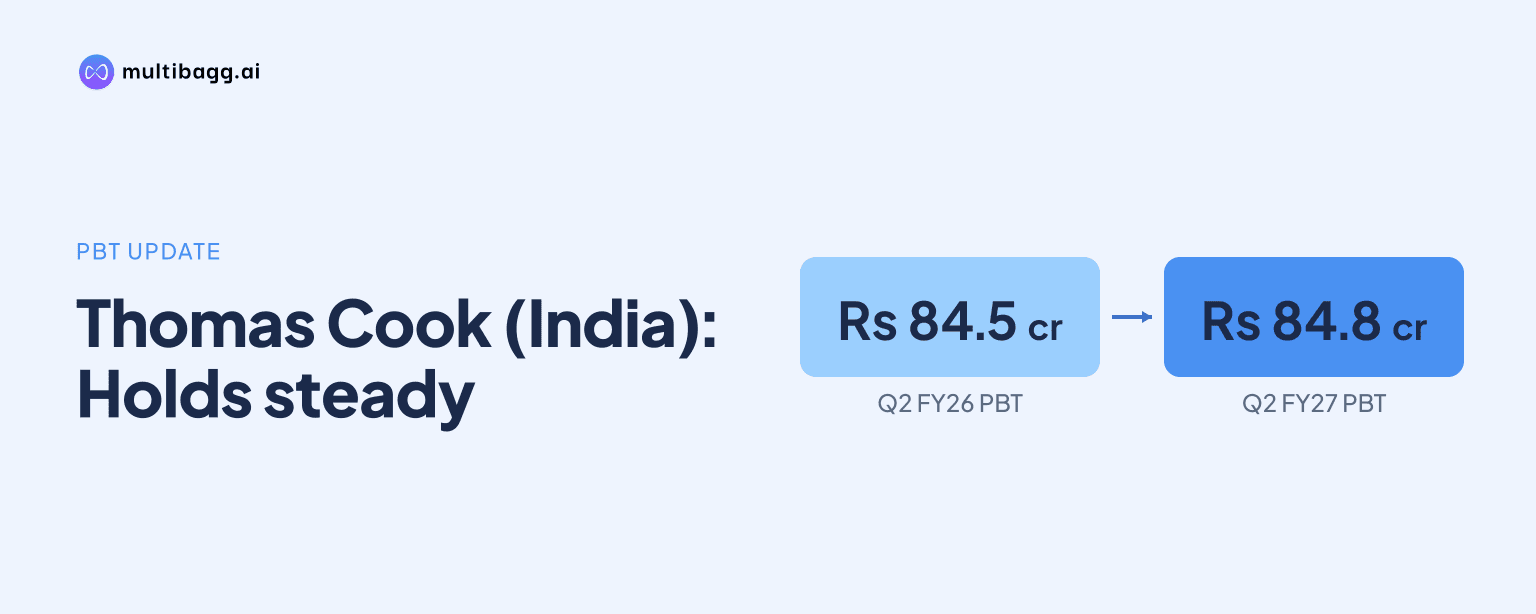
Thomas Cook (India) Limited held profit before tax, excluding exceptional items, at Rs 84.8 crore in Q2 FY27, versus Rs 84.5 crore in Q2 FY26, despite a 5% year-on-year fall in total income to Rs 2,003 crore, with management citing margin-focused execution amid geopolitical disruption.
Know Thomas Cook (India) inside out
Results, valuation, peers and who's buying, in one view.
How did TCIL maintain Q2 FY27 profit despite lower income?
TCIL reported profit before tax, or PBT, excluding exceptional items of Rs 84.8 crore for Q2 FY27, compared with Rs 84.5 crore a year earlier. The Rs 0.3 crore increase came as total income fell 5% year-on-year, according to the company’s 2 November 2026 announcement.
Total income was Rs 2,003 crore in Q2 FY27 and Rs 4,156 crore in H1 FY27, the first half of financial year 2027. H1 FY27 total income was 9% below the prior-year period, compared with the 5% decline in Q2 FY27, indicating that the quarterly contraction was narrower than the first-half decline.
Mahesh Iyer, Managing Director and Chief Executive Officer, said disciplined execution and a focus on margins offset some of the travel-business shortfall in Q2 FY27. That is management’s explanation for the Rs 84.8 crore PBT result, as the announcement does not provide a consolidated cost or segment-profit reconciliation.
Which TCIL businesses offset the travel shortfall?
TCIL’s Financial Services segment increased revenue from operations by 21% year-on-year in Q2 FY27 and by 14% in H1 FY27. Segment earnings before interest and tax, or EBIT, grew 10% in Q2 FY27 and 9% in H1 FY27, with Education and Corporate segments identified as contributors.
Financial Services retail sales rose 12% in Q2 FY27 and Education sales increased 33%, while overall sales grew 7%. Holiday sales declined 6% and card loads fell 3%, showing that the segment’s reported revenue and EBIT growth occurred alongside weaker activity in some travel-linked categories.
India destination management services, or India DMS, grew revenue from operations by 16% in a seasonally softer Q2 FY27. TCIL attributed the result to steady inflows from the United Kingdom, Germany, France, Portugal and Japan, while Domestic and Short-Haul segments led the recovery in India Travel Businesses.
TCIL’s Leisure Hospitality network reached 83 resorts as of September 2026, up 20% year-on-year, after seven resorts opened in Q2 FY27. The new locations were Jagdalpur, Sattal, Agra, Varanasi, Corbett, Tadoba and Jawai; occupancy at owned and leased resorts was 52%, up 400 basis points year-on-year, while average room rate rose 9%.
Got a follow-up? Ask IRIS
Where did TCIL face the biggest operating pressure?
TCIL’s India Travel Businesses ended Q2 FY27 with revenue 6% below the previous year after a slow July, although EBIT margin was 3.8%. Leisure Travel revenue from operations across Thomas Cook and SOTC fell 17% year-on-year, contrasting with 11% growth in Corporate Travel and 1% growth in Meetings-Incentives-Conferences-Exhibitions, or MICE, sales.
Overseas DMS turnover declined 7% year-on-year in Q2 FY27 as geopolitical disruption affected specific markets. Allied T Pro in the United States recorded sales 22% lower amid softer inbound tourism, while Desert Adventures in the Gulf Cooperation Council region reported a 67% sales decline as Middle East uncertainty weighed on travel demand.
Some overseas businesses partly offset those declines in Q2 FY27. Asian Trails revenue increased 9% year-on-year, while Private Safaris grew revenue by 31% in Southern Africa and 10% in East Africa; TCIL cited resilient inbound demand, strategic upselling and supplier negotiations in Southern Africa.
Digital Imaging Solutions, or DEI, remained affected by geopolitical headwinds, but cost-containment measures initiated in Q1 FY27 narrowed its Q2 loss to Rs 7.6 crore from Rs 20.8 crore. The disclosed Rs 13.2 crore reduction in losses shows the effect of those measures within a business that continued to face external disruption.
What do TCIL’s cash balance and bookings show?
TCIL had cash and short-term investments of Rs 2,843 crore as of 30 September 2026, compared with Rs 2,648.8 crore as of 30 June 2026. The Rs 194.2 crore increase accompanied CRISIL’s reaffirmation of its AA/Stable rating on long-term bank facilities and A1+ rating on short-term bank facilities and short-term debt.
For Q3 FY27, India leisure travel forward bookings were 30% higher than the prior year. Management said the bookings signalled positive future demand despite elevated airfares and other input costs, but the announcement did not give a Q3 FY27 revenue, profit or margin forecast.
Nature Trails increased its resort count from three to six, doubled year-on-year, and reported 10% revenue growth, 79% growth in room inventory and a 19% increase in guest ratio. Agreements for three more resorts had been signed for opening in the current quarter, providing a disclosed expansion item after the seven Q2 FY27 resort openings.
Conclusion
TCIL’s Q2 FY27 result combined a Rs 84.8 crore PBT outcome with a 5% decline in total income, reflecting uneven performance across its businesses. Financial Services revenue rose 21%, India DMS grew 16% and DEI losses narrowed, while India Travel Businesses remained 6% below the previous year and Overseas DMS turnover fell 7%.
The next period will show whether the 30% increase in India leisure travel forward bookings converts into revenue while elevated airfares and input costs remain in place. TCIL has also signed agreements for three Nature Trails resorts to open in the current quarter, while Desert Adventures’ early booking improvement remains subject to continuing regional uncertainty.