










Thomas Cook (India) Limited reports 18% volume growth in Q2
Key highlights
- TCIL reported 18.15% year-on-year growth in total corporate travel volumes in Q2 FY27.
- TCIL's hotel volumes increased 81.83% year on year and hotel transactions rose 36.5% in Q2 FY27.
- TCIL's domestic and international air volumes rose 22.7% and 15.26%, respectively, in Q2 FY27.
- TCIL secured new corporate travel accounts across four sectors in Q2 FY27.
powered by IRIS
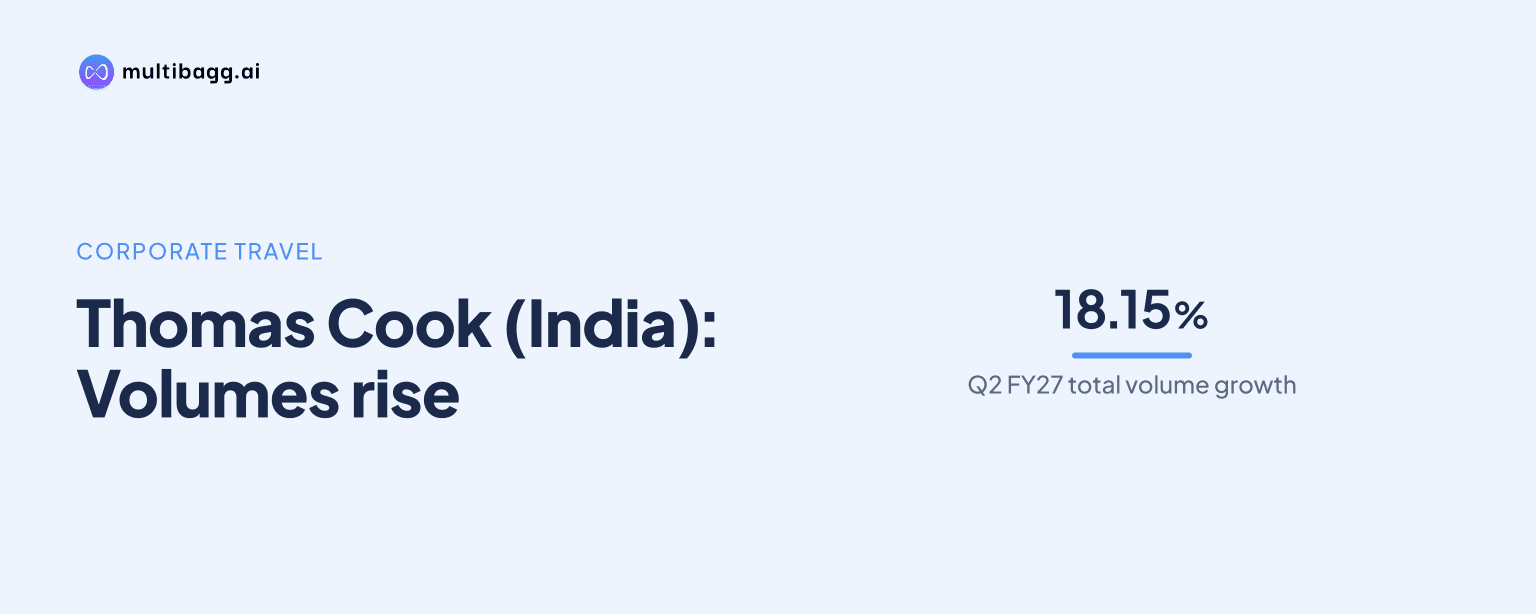
Thomas Cook (India) Limited reported 18.15% year-on-year growth in total corporate air and non-air travel volumes in Q2 FY27, led by an 81.83% increase in hotel volumes. TCIL also recorded 22.7% growth in domestic air volumes and 15.26% growth in international air volumes during the quarter.
Know Thomas Cook (India) inside out
Results, valuation, peers and who's buying, in one view.
Why did TCIL's corporate travel volumes rise in Q2 FY27?
TCIL's total corporate air and non-air travel volumes rose 18.15% year on year in Q2 FY27, supported by growth across domestic air, international air, hotels and other non-air services. The company secured new corporate travel accounts in pharmaceuticals and healthcare, auto components, financial technology and digital payments, and information technology during the quarter.
Corporate travel revenue from operations increased 11% year on year in Q2 FY27, below the 18.15% volume increase. The announcement does not disclose pricing, yield or service-mix data that would explain the difference, but it confirms that volume growth extended beyond airline ticketing.
How much did TCIL's domestic and international air travel grow?
TCIL's air volumes increased 18.2% year on year in Q2 FY27, with domestic air volumes up 22.7% and international air volumes up 15.26%. Domestic air was the faster-growing category, exceeding international air growth by 7.44 percentage points.
The company attributed domestic air growth to continued demand for business travel within India, while international air growth reflected demand for cross-border corporate travel. TCIL did not disclose ticket numbers, route data or the respective shares of domestic and international bookings in total air volumes.
Corporate air growth came as other TCIL travel operations reported mixed results. India destination management services revenue rose 16% year on year in Q2 FY27, while overseas destination management turnover fell 7% because of Middle East geopolitical disruption and softer US inbound tourism.
Why did TCIL's hotel volumes increase 81.83%?
TCIL's hotel volumes rose 81.83% year on year in Q2 FY27, making accommodation the fastest-growing corporate travel measure disclosed by the company. Hotel transactions increased 36.5%, which TCIL linked to increasing corporate-client adoption of managed accommodation programmes.
Hotel volume growth was substantially above the 18.15% increase in total corporate travel volumes and the 18.2% rise in air volumes. TCIL did not define its hotel-volume unit, disclose room-night totals or report hotel revenue separately, so the announcement does not identify whether longer stays, larger bookings or another factor accounted for the difference from transaction growth.
Management also cited elevated airfares and other input costs in its Q2 FY27 commentary on India leisure travel. The hotel transaction increase identifies managed accommodation programmes as a disclosed mechanism behind growing corporate hotel activity, rather than establishing a group-wide pricing trend.
Got a follow-up? Ask IRIS
What do TCIL's non-air and MICE results show?
TCIL's non-air volumes increased 19.2% quarter on quarter and non-air transactions grew 19.9% in Q2 FY27, showing expansion beyond air travel. The release does not separate hotels from other non-air categories in these quarter-on-quarter measures.
TCIL managed more than 176 meetings, incentives, conferences and exhibitions, or MICE, groups in Q2 FY27, with groups ranging from 50 to 7,000 delegates. Destinations included Switzerland, Italy, Japan, Thailand, South Africa and Singapore, as well as Indian locations including Goa, Jaipur, Kochi, Delhi and Dehradun.
SOTC, a TCIL brand, managed a 7,000-delegate Bangkok MICE movement for an Indian pharmaceutical company during the quarter. MICE sales, however, grew 1% year on year, below the 11% increase in corporate travel revenue and the 18.15% increase in total corporate travel volumes.
How did corporate travel compare with TCIL's wider Q2 FY27 results?
TCIL reported profit before tax, excluding exceptional items, of Rs 84.8 crore in Q2 FY27, compared with Rs 84.5 crore in Q2 FY26. Total income was Rs 2,003 crore, down 5% year on year, showing that corporate travel volume growth occurred within a group reporting lower consolidated income.
Travel Services results varied by business line in Q2 FY27. Leisure travel revenue across Thomas Cook and SOTC declined 17% year on year, India destination management services revenue rose 16%, corporate travel revenue rose 11%, MICE sales increased 1%, and overseas destination management turnover declined 7%.
TCIL said its India travel businesses ended Q2 FY27 6% below the prior year after a slow July, with earnings before interest and tax margin of 3.8%. Cash and short-term investments stood at Rs 2,843 crore on September 30, 2026, compared with Rs 2,648.8 crore on June 30, 2026.
Conclusion
TCIL's Q2 FY27 corporate travel data show growth across air, accommodation and non-air services. Total corporate volumes increased 18.15%, while hotel volumes rose 81.83%, domestic air volumes increased 22.7% and international air volumes grew 15.26%; corporate travel revenue rose 11% against mixed outcomes elsewhere in Travel Services.
The next disclosed demand indicator is Q3 FY27 forward bookings for India leisure travel, which management said were 30% above the prior year despite elevated airfares and other input costs. For corporate travel, the next results will show whether the Q2 FY27 account wins in healthcare, auto components, financial technology, digital payments and information technology support continued air, hotel and non-air growth.