










Thomas Cook India overseas DMS revenue falls 7% in Q2 FY27
Key highlights
- Thomas Cook India’s overseas DMS revenue declined 7% year-on-year in Q2 FY27.
- Desert Adventures’ Middle East sales fell 67% year-on-year in Q2 FY27.
- Allied T Pro’s US sales declined 22%, while Private Safaris Southern Africa revenue rose 31%.
- Thomas Cook India reported 30% year-on-year growth in India leisure forward bookings for Q3 FY27.
powered by IRIS
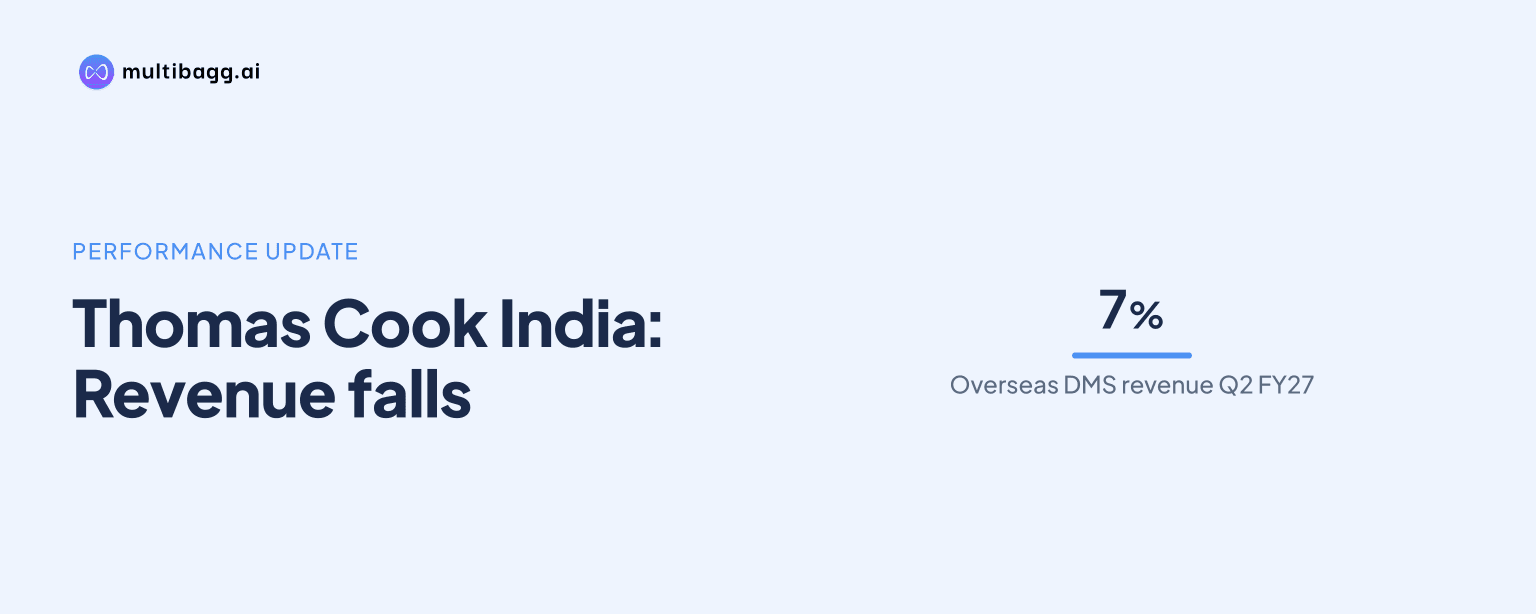
Thomas Cook (India) Limited reported a 7% year-on-year decline in overseas destination management services revenue in Q2 FY27, led by a 67% fall in Middle East sales at Desert Adventures and a 22% decline at US business Allied T Pro. Growth in Asia and African safari operations partly offset those declines.
Know Thomas Cook (India) inside out
Results, valuation, peers and who's buying, in one view.
Why did Thomas Cook India’s overseas DMS revenue decline in Q2 FY27?
Thomas Cook India’s overseas DMS revenue declined 7% year-on-year in Q2 FY27 because geopolitical disruption in the Middle East reduced travel demand, while softer international visitor arrivals affected US inbound tourism. The company identified Desert Adventures in the Gulf Cooperation Council, or GCC, region and Allied T Pro in the US as the principal areas of pressure.
Desert Adventures recorded a 67% year-on-year reduction in sales during Q2 FY27, the steepest reported movement among the overseas DMS businesses. Thomas Cook India said geopolitical uncertainty in the Middle East continued to weigh on traveller confidence in a seasonally weaker quarter. September brought early signs of improvement from key source markets, but the company said regional uncertainty still affected demand.
The US business, Allied T Pro, reported sales 22% lower year-on-year in Q2 FY27. Thomas Cook India attributed this to softer international visitor arrivals and geopolitical uncertainty, although it said the extent of the decline moderated from the preceding quarter. The filing did not disclose the prior-quarter percentage decline or the absolute revenue of either Allied T Pro or Desert Adventures.
Which overseas DMS regions grew despite the decline?
Thomas Cook India’s Asia Pacific and African safari operations grew in Q2 FY27, partly counterbalancing the sales declines in the Middle East and US. Asian Trails increased revenue 9% year-on-year, while Private Safaris’ Southern Africa and East Africa businesses increased revenue 31% and 10%, respectively.
Asian Trails’ 9% revenue rise was supported by performances in China, Singapore and Thailand. However, Thomas Cook India said softer inflows from selected source markets constrained the growth rate amid geopolitical uncertainty. That outcome contrasted with the 22% sales decline at Allied T Pro, showing that the effect on cross-border travel varied by destination and source market.
Private Safaris’ Southern Africa business delivered the fastest expansion among the overseas units, with revenue up 31% year-on-year. Thomas Cook India said resilient inbound demand, strategic upselling and stronger supplier negotiations drove the result, even as airfares remained elevated and airline capacity constrained. East Africa increased revenue 10%, supported by demand from the US, Europe and India despite uncertainty affecting traveller confidence.
How did overseas DMS compare with Thomas Cook India’s other travel businesses?
Thomas Cook India’s overseas DMS decline contrasted with growth in India DMS and corporate travel in Q2 FY27. India DMS revenue from operations increased 16% year-on-year, corporate travel revenue from operations grew 11%, and meetings, incentives, conferences and exhibitions, or MICE, sales increased 1%; leisure travel revenue from operations declined 17%.
Corporate travel volumes expanded faster than reported segment revenue. Total air and non-air volumes rose 18.15% year-on-year in Q2 FY27, including 22.7% growth in domestic air volumes and 15.26% growth in international air volumes. Hotel volumes rose 81.83%, while hotel transactions increased 36.5%, reflecting greater use of managed accommodation programmes by corporate clients.
MICE managed more than 176 groups during Q2 FY27, with group sizes ranging from 50 to 7,000 delegates. SOTC managed a Bangkok movement of 7,000 delegates for an Indian pharmaceutical company. Those operating metrics accompanied the 1% increase in MICE sales, a much slower rate than the 16% reported revenue growth in India DMS.
Got a follow-up? Ask IRIS
What actions and demand signals did Thomas Cook India report?
Thomas Cook India said Desert Adventures maintained cost optimisation and operational readiness during Q2 FY27, while forward booking trends gave the business cautious optimism for the coming quarter. The company did not quantify Desert Adventures’ bookings or provide a revenue forecast, so the disclosed demand signal does not establish the scale of a recovery.
At group level, Managing Director and Chief Executive Officer Mahesh Iyer said profit before tax, or PBT, held at Rs 84.8 crore despite the effect of the West Asia conflict. He attributed the result partly to disciplined execution and margin focus that offset some travel-business shortfall. This management statement relates to the TCIL Group’s result rather than solely to overseas DMS.
Thomas Cook India also reported 30% year-on-year growth in forward bookings for its India leisure travel business for Q3 FY27. Management said the bookings indicated positive demand despite elevated airfares and other input costs. That measure concerns India leisure travel, not Allied T Pro, Desert Adventures, Asian Trails or Private Safaris, and should therefore be read separately from the overseas DMS performance.
How did other Thomas Cook India operations perform in Q2 FY27?
Thomas Cook India’s leisure hospitality unit reported revenue from operations of Rs 125.9 crore in Q2 FY27, up 21% year-on-year in what the company described as the seasonally weakest quarter. The business reported earnings before interest, tax, depreciation and amortisation, or EBITDA, of Rs 29.8 crore, up 4%, and earnings before interest and tax, or EBIT, of Rs 18.4 crore, up 1%.
The hospitality network reached 83 resorts after seven openings in Q2 FY27, and crossed 4,000 keys. Room nights sold increased 23%, average room rate, or ARR, rose 9% to Rs 6,484, and total revenue per available room, or RevPAR, increased 12%. Cash reserves reached Rs 380.8 crore, up 12% quarter-on-quarter, while the company said Sterling remained debt-free and net cash-positive.
Digital Imaging Solutions remained affected by geopolitical headwinds, but Thomas Cook India said cost-containment measures narrowed losses from Rs 20.8 crore to Rs 7.6 crore in Q2 FY27. Its Middle East operations, representing about 50% of the portfolio, had almost all attractions restarted and functioning at roughly 40% to 50% levels. The business said its focus was the outlook for international visitors through Q4.
Conclusion
Thomas Cook India’s 7% overseas DMS revenue decline in Q2 FY27 reflected sharply different regional outcomes. The 67% sales fall at Desert Adventures and 22% fall at Allied T Pro outweighed growth of 9% at Asian Trails and 31% and 10% at Private Safaris’ Southern and East African businesses. Elsewhere, India DMS, corporate travel and hospitality provided reported growth while leisure travel revenue declined 17%.
The next point to watch is whether Desert Adventures’ early September improvement and encouraging forward bookings develop into measurable sales recovery in the coming quarter. Thomas Cook India also plans three additional Nature Trails resorts to go on stream in the current quarter, while its India leisure business has reported Q3 FY27 forward bookings up 30% year-on-year despite elevated airfares and input costs.