










TI Clean Mobility reports 25% share in three EV segments
Key highlights
- TICMPL reported about 25% market share in electric trucks, small commercial vehicles and tractors.
- TICMPL's electric-truck volume reached 311 in Q2 from 86 in the preceding quarter.
- TICMPL said passenger electric three-wheelers remained at low single-digit market share.
- TICMPL had more than 1,000 small commercial vehicles and more than 300 electric tractors on the road.
powered by IRIS
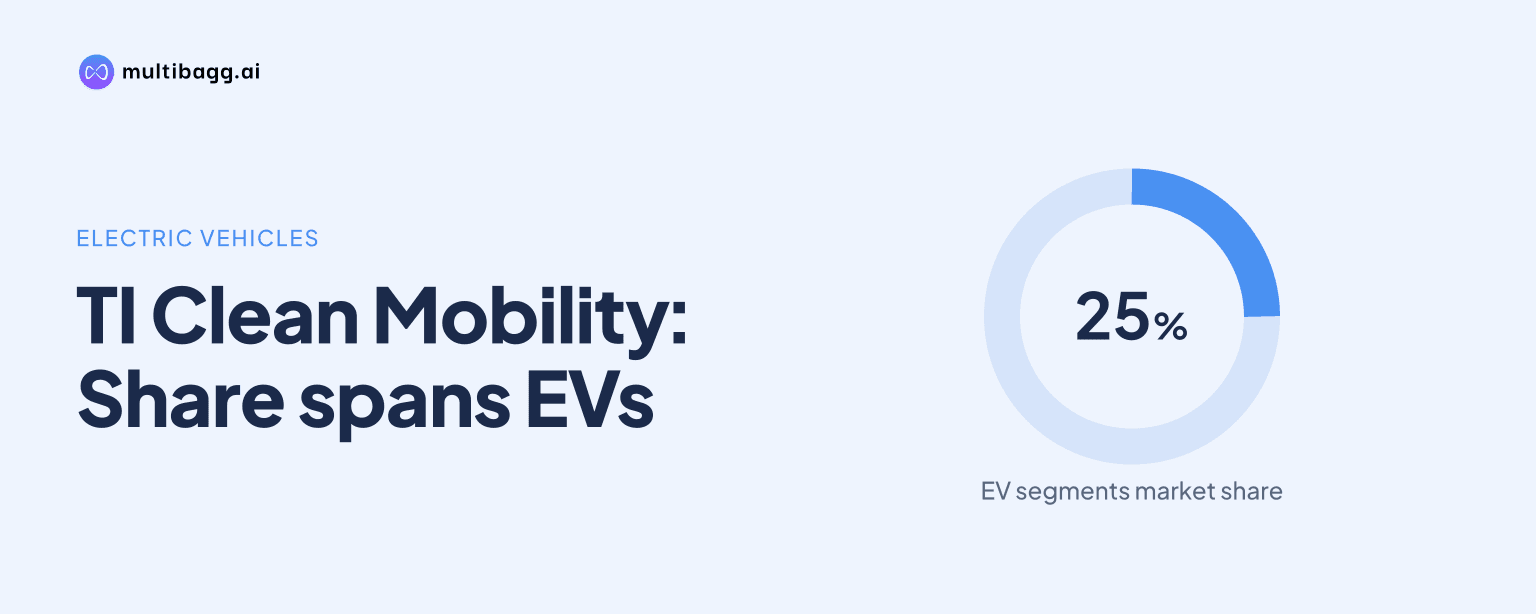
TI Clean Mobility (TICMPL) said on November 6, 2026 that it held about 25% market share in electric trucks, small commercial vehicles and tractors, while electric-truck volume reached 311 in Q2 from 86 in the preceding quarter. Management said the passenger electric three-wheeler business remained at low single-digit market share.
Know Tube Investments of India inside out
Results, valuation, peers and who's buying, in one view.
What market share does TICMPL have in electric vehicles?
TICMPL said it had about 25% market share in electric trucks and small commercial vehicles, while its electric-tractor share was also about 25% of VAHAN registrations in H1. In trucks, management gave a more specific figure of 26% in a market with about 11 to 12 competitors. It said TICMPL was either a close number one or a market leader in two of its four electric-vehicle businesses, without identifying those businesses.
The position differs in electric three-wheelers, where TICMPL said passenger models held low single-digit market share and required improvement. Its cargo three-wheeler, sold as Super Auto, was also in low single digits, although management said volumes were gaining traction toward about 200 units a month. The four businesses are trucks, three-wheelers, small commercial vehicles and tractors.
How did TICMPL's Q2 electric-vehicle volumes change?
TICMPL's Q2 volume increased in all four electric-vehicle categories from the preceding quarter, with trucks recording the largest percentage rise. Truck volume reached 311 vehicles from 86, while three-wheeler volume reached 2,242 from 1,924.
Truck deliveries increased by 225 vehicles, while three-wheelers added 318 vehicles, the largest absolute increase. Small commercial vehicles rose by 136 units and tractors by 28 units. Management said the truck increase came from multiple deals rather than one large order, and said its objective was for each business to post a better quarter than the previous one.
TICMPL also cited an installed base of more than 1,000 small commercial vehicles and more than 300 electric tractors as an operating advantage. Management said electric commercial-vehicle deployment depends on charging infrastructure and project management, and that upfront product-deployment cost can be two-and-a-half times that of an internal-combustion-engine deployment.
Why does TICMPL see scope to build its position?
TICMPL management said its simultaneous entry into all four segments created five to six years of learning, supplier engagement and dealer-network development. It said the business focuses only on electric vehicles, rather than combining electric and internal-combustion-engine products. Management also cited government incentives and subsidies intended to promote indigenous design and product development.
Management linked this strategy to faster electrification in several categories. It said electric three-wheeler penetration was above 50% in Q2, while H1 industry volume for big trucks was almost 170% of the previous full financial year's industry volume. H1 industry volume for small commercial vehicles was about equal to the previous full financial year's volume, whereas tractor electrification was expected to develop over a longer period.
TICMPL is also broadening truck applications beyond cement, which management said represented about 60% of its cumulative trucks on the road. The remaining 40% was used outside cement in steel, mining, chemicals, sugar, retail and tyre movement. It had placed 80 to 90 vehicles in metals and steel movement and entered mining during Q2.
Got a follow-up? Ask IRIS
What is affecting TICMPL's break-even plan?
TICMPL said competition intensity is increasing and that it aims to attain market leadership or a top-three position in each of its four businesses. Management said it was not satisfied with any of the four Q2 volume figures despite the sequential increases. It identified scale, bill-of-materials cost reduction, after-sales support, new end uses and products suited to market requirements as common priorities.
Q2 profitability was affected by higher cell prices, an adverse rupee exchange rate and commodity-cost increases, according to management. These factors increased bill-of-materials costs across all four businesses. TICMPL said it was assessing deal-by-deal improvements in realisation, possible price increases, cost-reduction measures and a limited number of longer-term supplier arrangements.
For electric trucks, TICMPL said it was developing a higher-battery-capacity version of its existing product to address long-haul applications, but did not disclose a launch date. Management reaffirmed guidance for the truck business to reach break-even in Q4. It also said its 2030 consolidated revenue target remained in place and would require contributions from all businesses, including long-haul trucking.
Where is TICMPL expanding charging and product access?
TICMPL has tied up with Exponent, a fast-charging provider, for electric three-wheelers, but said the rollout depends on its partner's presence in each city. Management said Bengaluru would be the first launch city, followed by Delhi National Capital Region and Ahmedabad. It said fast charging is most relevant where drivers cannot install a three-wheeler charger at home.
The company said it would test the offering and build volumes in the first three cities before expanding further. Management identified Delhi, Bengaluru and potentially Bombay as places where home-charger installation could be difficult. The city-led approach means the charging rollout is selective rather than nationwide at this stage.
For trucks, TICMPL said higher battery capacity is the industry direction needed to unlock long-haul electric operations. The business has previously focused on fixed-loop routes and cement applications, while the 80 to 90 vehicles placed in metals and steel demonstrate the move into additional uses. Management said profitable use cases that can also provide scale remain a key objective.
Conclusion
TICMPL's disclosed market-share positions show that trucks, small commercial vehicles and tractors are its better-established electric-vehicle segments, each at about 25% share, while both passenger and cargo three-wheelers remain in low single digits. Sequential Q2 volume growth across all four categories, led by trucks rising from 86 to 311 vehicles, indicates broader activity but does not resolve the gap in three-wheelers.
The next points to watch are management's Q4 truck-business break-even guidance, the planned charging launches in Bengaluru, Delhi National Capital Region and Ahmedabad, and the timing of the higher-battery-capacity truck. TICMPL has not provided a launch date for that truck, while its 2030 consolidated revenue target depends on contributions from all four businesses and longer-haul applications.