










Tube Investments Alone Funds TICMPL’s Latest Rs 250 Crore
Key highlights
- Tube Investments alone invested Rs 250 crore in TICMPL through CCPS.
- External investors made no further TICMPL investment after their earlier Rs 2,250 crore infusion.
- TICMPL truck volume rose to 311 vehicles in Q2 from 86 in the preceding quarter.
- Tube Investments said trucks and small commercial vehicles each had about 25% market share.
powered by IRIS
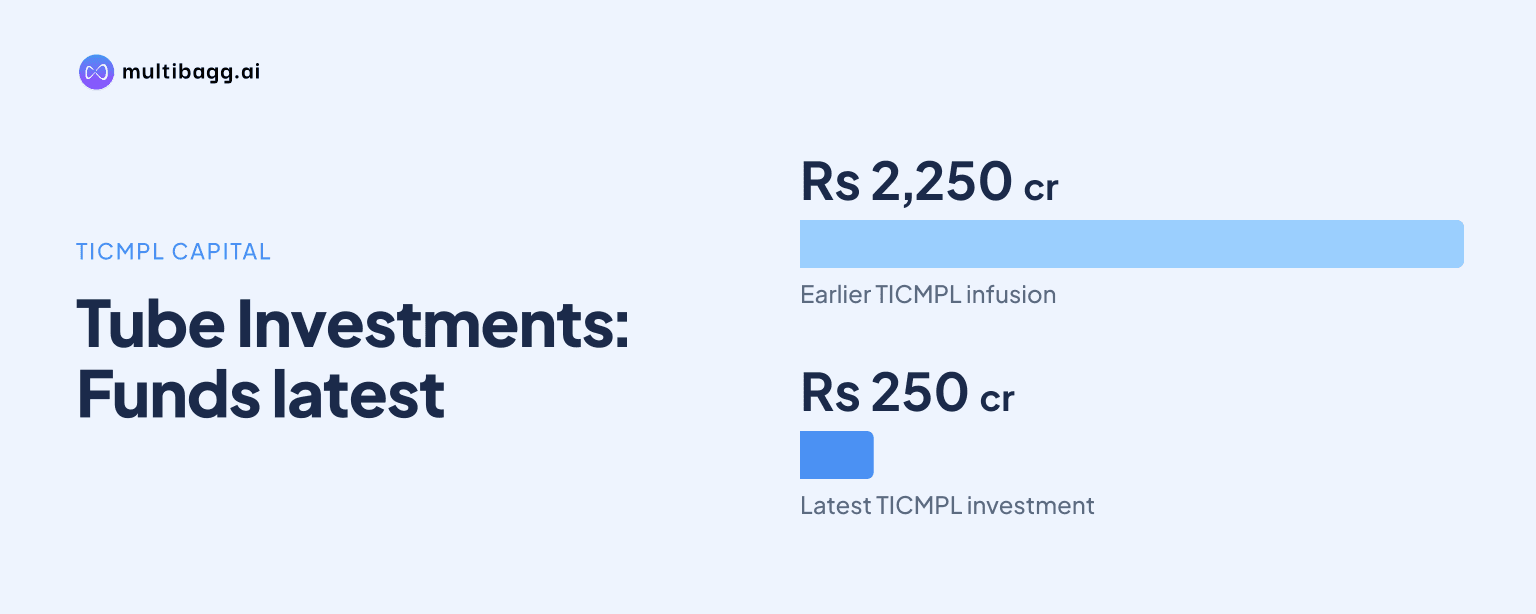
Tube Investments of India Limited said on November 6, 2026, that it alone invested Rs 250 crore in TICMPL through compulsorily convertible preference shares (CCPS), while external investors made no further investment after their earlier Rs 2,250 crore infusion. The statement identifies Tube Investments as the sole source of the latest disclosed capital for the electric-vehicle business.
Know Tube Investments of India inside out
Results, valuation, peers and who's buying, in one view.
Why did Tube Investments alone fund TICMPL’s latest Rs 250 crore?
Tube Investments alone funded TICMPL’s latest Rs 250 crore infusion, management said in response to a question on whether external investors had contributed in proportion to their holdings. Mukesh Ahuja said the entire Rs 250 crore CCPS investment came from Tube Investments. A.N. Meyyappan subsequently said that only Tube Investments had invested after the external investors’ Rs 2,250 crore investment.
The November 6 call did not specify when the external investors made their Rs 2,250 crore infusion, name the investors, or explain how TICMPL would deploy the Rs 250 crore. It did set out the sequence of funding: external investors had invested Rs 2,250 crore in TICMPL, made no subsequent investment, and Tube Investments supplied the later Rs 250 crore capital injection.
What does the funding disclosure say about TICMPL ownership?
The disclosure does not establish TICMPL’s final ownership split because management said each investor’s stake depends on the valuation at the time of exit. Meyyappan said changes to the CCPS terms were mainly clarificatory, with no change in the accounting treatment considered in March and no change in the return investors are expected to receive.
Tube Investments therefore disclosed the provider of the Rs 250 crore incremental capital, but not revised ownership percentages or a final conversion outcome. When an analyst asked whether investor stakes were frozen, Meyyappan said they were not, and linked the eventual split to TICMPL’s valuation at exit. The transcript did not provide an exit date, valuation target or post-conversion ownership estimate.
How did TICMPL’s electric-vehicle volumes perform in Q2?
TICMPL’s four electric-vehicle lines all reported higher Q2 volumes than in the preceding quarter, led by trucks, which rose to 311 vehicles from 86. Three-wheelers remained the largest-volume category at 2,242 units, compared with 1,924 in the last quarter, while small commercial vehicles and electric tractors also increased.
The largest absolute increase was in trucks, where Q2 volume rose by 225 vehicles from the preceding quarter. Jalaj Gupta said the 311 truck units resulted from multiple deals rather than one large order. He added that Tube Investments’ objective was for each business to deliver a better quarter than the previous one, but did not give a numerical volume forecast.
Management described different market positions across the four businesses. Tube Investments said trucks and small commercial vehicles each had about 25% market share, while electric tractors had about 25% of vehicle-registration market share in the first half. In three-wheelers, passenger market share was in the low single digits, while cargo share was also in the low single digits but gaining traction, with cargo volume reaching about 200 units a month.
Got a follow-up? Ask IRIS
What plans could require further TICMPL investment?
Tube Investments said TICMPL plans to build scale across its four electric-vehicle businesses through volume growth, bill-of-material cost reduction, after-sales support, new end uses and products designed for market needs. Management retained a target for TICMPL’s consolidated businesses to reach USD 1 billion in revenue by 2030, with all businesses expected to contribute rather than only medium- and heavy-commercial vehicles.
The truck business is broadening its applications beyond cement routes. Management said it had seeded 80 to 90 vehicles for metals and steel movement, while mining was another area entered during Q2. About 60% of trucks on the road were linked to cement, leaving 40% in other applications including steel, mining, chemicals, sugar, retail and tyre movement.
Tube Investments is also developing a higher-battery-capacity truck based on its existing products because management said higher battery capacity could unlock long-haul electric trucking. Gupta gave no development timeline. In three-wheelers, TICMPL has partnered with Exponent for fast charging and plans to scale first in Bengaluru, followed by Delhi National Capital Region and Ahmedabad, before expanding to other locations.
What is affecting TICMPL profitability and breakeven?
Higher cell prices, an adverse rupee exchange rate and increased commodity costs raised bill-of-material costs across TICMPL’s four businesses in Q2, management said. Gupta cited complete dependence on cell supply as a factor in the cell-cost pressure. He said the company was weighing deal-by-deal realisation improvements, possible price increases and intensified cost-reduction efforts.
Tube Investments also cited longer-term supplier arrangements as a possible mitigation measure, although management said such contracts were few in number. On breakeven, Tube Investments said it had guided for the heavy commercial vehicle business to reach breakeven in Q4. Management did not provide a consolidated TICMPL profitability target, breakeven dates for the other three vehicle lines, or an allocation of the Rs 250 crore infusion among them.
Conclusion
The November 6 disclosure separates TICMPL’s historic and later funding: external investors had put Rs 2,250 crore into the business, while Tube Investments alone supplied the subsequent Rs 250 crore. Operating momentum improved in Q2 across trucks, three-wheelers, small commercial vehicles and electric tractors, although management said cell prices, currency movements and commodities increased costs.
The next developments to watch are Tube Investments’ Q4 heavy-commercial-vehicle breakeven objective, the fast-charging three-wheeler rollout in Bengaluru, Delhi National Capital Region and Ahmedabad, and progress on the higher-battery-capacity truck. TICMPL’s eventual ownership outcome also remains unresolved because management said investor stakes depend on valuation at exit.