










TI Clean Mobility targets truck EBITDA breakeven in Q4 FY27
Key highlights
- TICMPL reported Rs 476 crore of revenue in Q2 FY27, and management said H1 revenue exceeded the prior full-year revenue.
- TICMPL targets truck EBITDA breakeven in Q4 FY27 and two further vehicle businesses at EBITDA breakeven in Q4 FY28.
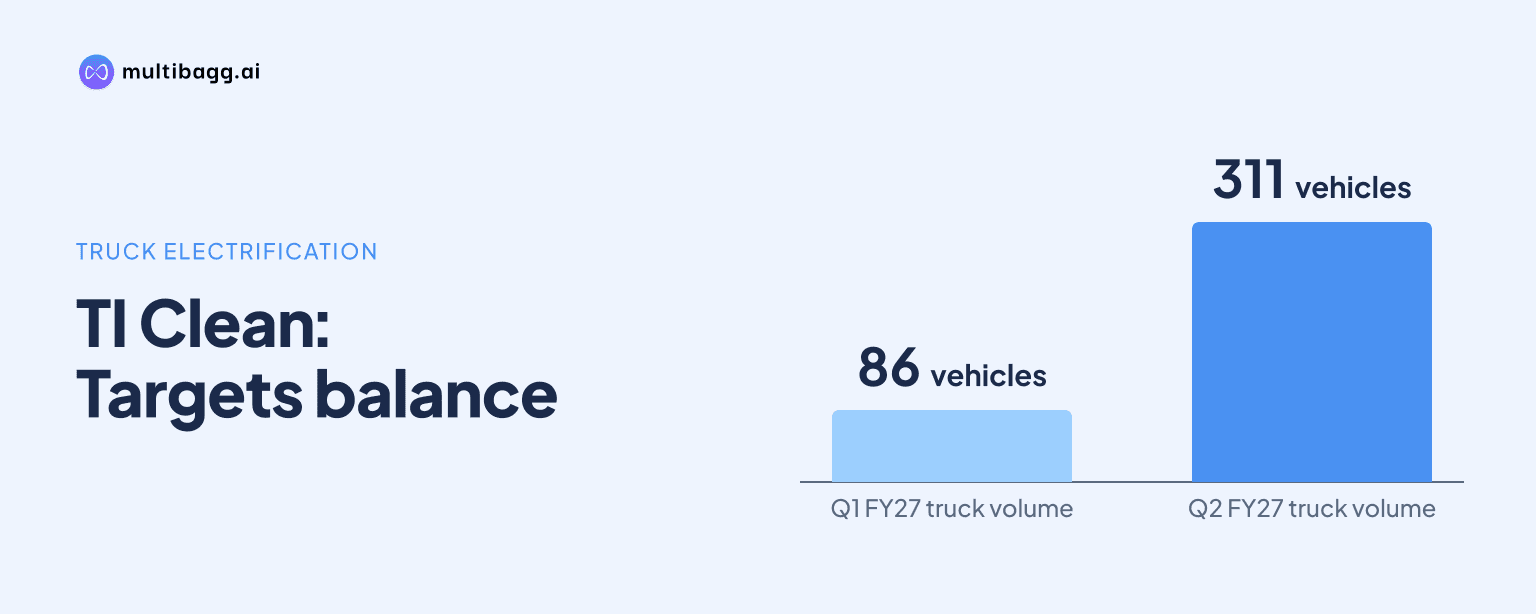
- Truck volume rose to 311 vehicles in Q2 FY27 from 86 vehicles in Q1 FY27.
- TICMPL had about Rs 350 crore of cash, which management said was sufficient for FY27.
powered by IRIS
TI Clean Mobility (TICMPL) is targeting earnings before interest, tax, depreciation and amortisation (EBITDA) breakeven in its truck business in Q4 FY27 after reporting Rs 476 crore of revenue in Q2 FY27. Management also plans for two of its other vehicle businesses to reach EBITDA breakeven in Q4 FY28, though it did not identify them.
Know Tube Investments of India inside out
Results, valuation, peers and who's buying, in one view.
What is TICMPL's EBITDA breakeven roadmap?
TICMPL's stated roadmap is truck-business EBITDA breakeven in Q4 FY27, followed by two more vehicle businesses reaching EBITDA breakeven in Q4 FY28. Management said TICMPL has four businesses, each with a separate profitability trajectory, so the company is not applying one common timetable across trucks, three-wheelers, small commercial vehicles and electric tractors.
Management said the first organisation-level objective is EBITDA breakeven, followed by profit after tax (PAT) profitability. It did not disclose individual business losses, name the two businesses targeted for Q4 FY28, or provide a date for TICMPL as a whole to report a PAT profit. The truck target is therefore the clearest disclosed near-term profitability milestone.
TICMPL reported Rs 476 crore of revenue in Q2 FY27, and management said its H1 revenue had exceeded the revenue achieved in the full preceding financial year. Management did not provide the comparable H1 or prior-year revenue figure, and it declined to give future revenue projections. Its stated operating aim is for each quarter to be better than the preceding quarter.
How did TICMPL's vehicle volumes change in Q2 FY27?
TICMPL increased volumes in all four vehicle businesses in Q2 FY27, with truck volume rising to 311 units from 86 in Q1 FY27. Three-wheelers remained the largest category by unit volume at 2,242 vehicles, compared with 1,924 in the preceding quarter, while small commercial vehicles and tractors also recorded sequential increases.
The truck business recorded the largest percentage increase, while three-wheelers added the most units in absolute terms, at 318 vehicles. Management said Q2 truck volume came from multiple deals rather than one large order. It gave no volume forecast for Q3 FY27 or Q4 FY27, beyond its stated goal of sequential improvement.
TICMPL also cited accumulated operating experience in newer categories. More than 1,000 small commercial vehicles and about 300 tractors were already on the road, according to management. It said these deployments, along with five to six years of electric-mobility experience, had developed its understanding of charging infrastructure, project management and higher deployment costs.
What needs to change for TICMPL's truck business to break even?
TICMPL said truck EBITDA breakeven depends on higher scale, lower bill-of-materials cost, better after-sales support, new end-use cases and products suited to market requirements. Management said the upfront cost of an electric commercial vehicle remains a hindrance and that electric product deployment requires about two-and-a-half times the upfront cost of an internal-combustion-engine deployment.
The truck business is broadening beyond its initial cement application. Management said cement represented about 60% of cumulative truck deployments, while 40% were in other uses, including steel, mining, chemicals, sugar, retail and tyre movement. TICMPL had placed about 80 to 90 vehicles in metals and steel applications, with mining identified as another area of activity in Q2 FY27.
Long-haul trucking remains a product-development workstream rather than a disclosed commercial launch. Management said it is developing a higher-battery-capacity truck based on its existing products because higher capacity could unlock long-haul electric trucking. It did not provide an expected launch date, planned battery specification, or projected long-haul volumes.
Got a follow-up? Ask IRIS
How do TICMPL's four electric-vehicle businesses differ?
TICMPL said its truck, three-wheeler, small commercial vehicle and tractor businesses are at different stages of maturity and require different strategies. Management described electric tractors as a particularly nascent category in India, while citing roughly 25% market share for both trucks and small commercial vehicles.
In trucks, management cited about 26% market share in a segment with 11 to 12 competitors. In tractors, it cited about 25% market share of vehicle registrations in H1 FY27 across 27-horsepower and 45-horsepower products. Management is targeting market leadership or a top-three position in all four businesses, but did not provide a deadline for that aim.
Three-wheelers have a different market position. Management said electric three-wheeler penetration had exceeded 50% in Q2 FY27, but TICMPL's passenger three-wheeler share was in the low single digits. Its cargo three-wheeler, Super Auto, was also in the low single digits, although management said its volume was approaching 200 units a month.
TICMPL is also planning a fast-charging rollout for three-wheelers through its partnership with Exponent. The initial launch is planned in Bengaluru, followed by Delhi National Capital Region and Ahmedabad. Management said the service is particularly relevant in cities where drivers cannot install home chargers, and it named Mumbai as a potential future market.
What funding position and milestones should readers watch?
TICMPL had about Rs 350 crore of cash on hand when management discussed Q2 FY27, and management said this was sufficient for the current financial year. Tube Investments of India Limited had invested about Rs 250 crore in TICMPL, while management said external investors had not invested further after their earlier Rs 2,250 crore contribution.
Management said funding needs for the following financial year would be assessed later and that it would provide an update by Q4 FY27. Tube Investments said it remained fully funded and committed to TICMPL, but did not disclose the capital required for FY28. The cash-sufficiency statement therefore applies to FY27 rather than providing a funding outlook for FY28.
The Q4 FY27 truck breakeven target depends on execution across scale, cost and customer applications, while the Q4 FY28 target depends on progress in two unnamed businesses. The higher-battery truck has no disclosed timetable, and the three-city charging plan depends partly on Exponent's presence in each market. These are operating milestones alongside the planned Q4 FY27 funding update.
Conclusion
TICMPL has set a phased profitability plan after reporting Rs 476 crore of Q2 FY27 revenue and sequential volume growth across trucks, three-wheelers, small commercial vehicles and tractors. The plan starts with truck EBITDA breakeven in Q4 FY27 and extends to two additional vehicle businesses in Q4 FY28, reflecting management's view that the four categories have different development and cost paths.
The next result to watch is whether truck scale, lower bill-of-materials costs and a larger mix of non-cement use cases support the Q4 FY27 target. Management has also said it will revisit FY28 funding needs by Q4 FY27, while the higher-battery truck development and fast-charging expansion have no detailed launch or revenue timetable.